
Trust & Transparency
How to Choose an Online Trading Course in South Africa
Francois Oosthuizen - 26 October 2026
A good online trading course in South Africa is run by a registered company with people you can name and reach, teaches a clear curriculum that puts risk management first, and shows its full price before you pay. It never promises profits, never tells you what to buy or sell, and never pushes you to deposit money with a particular platform. If a course fails any of those tests, keep looking.
That is the short answer. The rest of this guide shows how to check each point in practice, what to ask before you pay, and how to compare online and in-person options.
Why Choosing Carefully Matters
Trading courses in South Africa range from structured programmes with qualified teams to social media accounts selling "secrets". From the outside, they can look the same. A polished video and a few screenshots of winning trades cost very little to produce.
The cost of a poor choice is not only the course fee. A course that skips risk management, or that encourages you to trade before you understand what you are doing, can lead to losses far larger than anything you paid to learn. Choosing well is the first risk decision you make as a trader.
What a Good Online Trading Course Covers
Whether it is sold as a forex trading course, a trading school or an online academy, a course worth your time should cover these areas, in roughly this order:
- How markets work. What you are actually trading (currencies, indices, commodities, shares, CFDs), who the other participants are, and what moves prices.
- The language of trading. Pips, spreads, lots, leverage, margin, order types. Misunderstanding one term can cost you money on a live platform.
- Risk management. How much to risk on a single trade, how stop losses work, why leverage magnifies losses as well as gains, and how to set daily and weekly loss limits. This should come early, not as an afterthought.
- Analysis. Technical analysis (charts, trends, support and resistance) and fundamental analysis (interest rates, inflation, employment data), taught as tools for thinking, not as recipes that guarantee an outcome.
- Trading psychology. Fear of missing out, overtrading, revenge trading and the routines that help you stay consistent.
- A trading plan and a journal. How to write down your rules, test them and review your own decisions honestly.
Ask to see the full curriculum before you pay. A provider that cannot show you what each module covers is asking you to buy blind.
How to Check Who Runs the Course
Before any money changes hands, find out who is behind the course and whether you can hold them accountable.
A registered company. Ask for the company's full legal name and registration number, then check it on BizPortal (bizportal.gov.za), the government portal where the Companies and Intellectual Property Commission (CIPC) offers its company search. Register and log in, then search under BizProfile by company name or registration number. A South African company number looks like this: 2026/199265/07.
A real address and real people. The provider should list a physical address and introduce the people who teach, with names and faces. A course where you cannot find out who the educators are is a course where nobody is accountable for what you are taught.
A team you can reach. Send an email or a message with a question before you buy. How quickly and clearly they answer tells you a lot about the support you will get later.
What "accredited" really means. Most trading courses are short learning programmes, and the South African Qualifications Authority (SAQA) states that short learning programmes are not registered on the National Qualifications Framework (NQF). A course without accreditation is therefore not automatically a poor course. What matters is honesty: if a provider claims accreditation, ask which body accredited it and which registered qualification it leads to, then confirm it with that body.
The FSCA register, where it applies. In South Africa, the Financial Sector Conduct Authority (FSCA) authorises financial services providers (FSPs). The FSCA has drawn a clear line around one practice. In a press release dated 16 October 2024, the FSCA confirmed that publishing buy and sell calls for online trading falls under the FAIS Act and requires an FSP licence. In that case it fined an unlicensed provider R1 015 315.87 and debarred him for 10 years. If a course also sells trade calls, check its licence on the FSCA website or call the FSCA's toll-free number, 0800 110 443.
Warning Signs to Watch For
Walk away, or at least slow down, if you see any of these:
- Profit promises. "Make R20 000 a month", "95% win rate", "quit your job in 90 days". No educator can promise results in markets, and a legitimate one will not try.
- Selling trade calls as part of the course. A course should teach you to make your own decisions. Paid alerts telling you when to buy and sell are a separate financial service that needs a licence.
- Pressure to deposit. Being pushed to open an account with a specific platform, deposit a minimum amount or "start trading live this week" before you have finished learning.
- Lifestyle marketing. Cars, holidays and stacks of cash instead of curriculum, educators and prices.
- Urgency tricks. "Only 3 spots left" or a price that expires in 15 minutes, repeated every time you visit.
- Hidden costs. A low entry price followed by compulsory upgrades, or instalments that only add up to the true cost in the small print.
- No way to check the people. Anonymous accounts, profile pictures that look generated, or video messages that do not quite look right. In January 2025 the FSCA warned the public about schemes promoted with AI-generated videos of well-known South African business figures. Our guide to spotting deepfake trading scams shows what to look for, and why trust in online trading is low explains how to tell an honest educator from a dream-seller.
Online or In Person?
Most trading education is now online, and for good reason: markets trade on screens, you can learn at your own pace, and you can replay a lesson as often as you need. The trade-off is that online courses demand discipline. Nobody notices if you skip a module.
In-person courses give you direct contact with an educator and other learners, but they tie you to one venue and a fixed schedule. Ask what happens after the classroom days: a short burst of learning without follow-up rarely builds lasting habits.
A practical middle ground is an online course with live elements: scheduled live sessions, a community where you can ask questions, and a team that answers. When you compare courses, check how much live support is included, how often it runs and whether it is in a time zone that suits South African hours.
Comparing the Real Cost: A Worked Example
Many courses offer a monthly instalment option. Always work out the full commitment before you choose.
Imagine a course that costs R8 500 upfront or R900 a month for 12 months:
- Upfront: R8 500.
- Instalments: R900 × 12 = R10 800.
- Difference: R10 800 − R8 500 = R2 300 more on the instalment plan.
That is not necessarily a bad deal if spreading the cost suits your budget. But check whether the instalment plan is a fixed 12-month commitment or a subscription you can cancel, what happens if you stop paying, and whether anything that matters (live sessions, community access, tools) carries an extra monthly fee. If the course is priced in US dollars, remember that the rand amount you pay changes with the exchange rate.
8 Questions to Ask Before You Pay
Send these questions in writing and keep the answers:
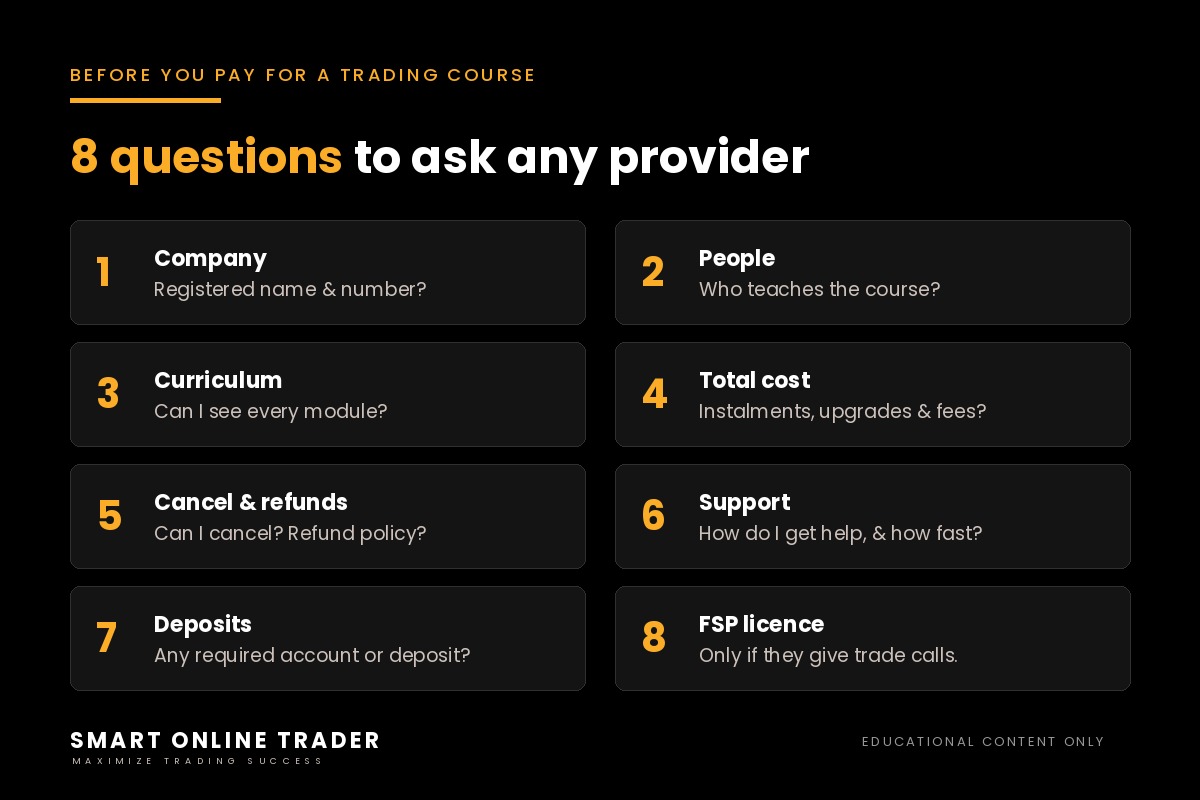
- What is the company's registered name and registration number, and where are you based?
- Who teaches the course, and where can I see their names and background?
- Can I see the full curriculum, module by module?
- What is the total cost, including any instalments, upgrades or monthly fees?
- Is the instalment plan a fixed commitment or can I cancel? What is your refund policy?
- How do I get help when I am stuck, and how quickly do you respond?
- Do you require me to open an account with a specific platform or deposit a minimum amount?
- Do you sell trade calls or tell members what to trade? If so, what is your FSP number?
A trustworthy provider will answer all eight without hesitation. If you are also choosing a platform to trade on later, our 9 quick trust checks for verifying a broker apply the same thinking to that decision.
How Smart Online Trader Approaches This
We hold ourselves to the same checklist. Smart Online Trader S.A. (Pty) Ltd is a registered South African company (2026/199265/07) based in Centurion, and you can meet the people who teach and support our members. Performance Academy brings our online trading courses together in one place: three membership programmes and two short courses, each with its curriculum shown module by module. Nebula and Trader Essentials show their prices and payment terms upfront; Premium Performance Tracker is by application, and its terms are explained before enrolment. Not sure where to start? Find My Path asks four short questions and suggests a route, with no contact details required. Smart Online Trader is not a licensed financial services provider. We teach, and we never tell members what to trade.
Whichever course you choose, choose it with your eyes open. The checks in this guide take an hour or two. Skipping them can cost far more.
Frequently asked questions
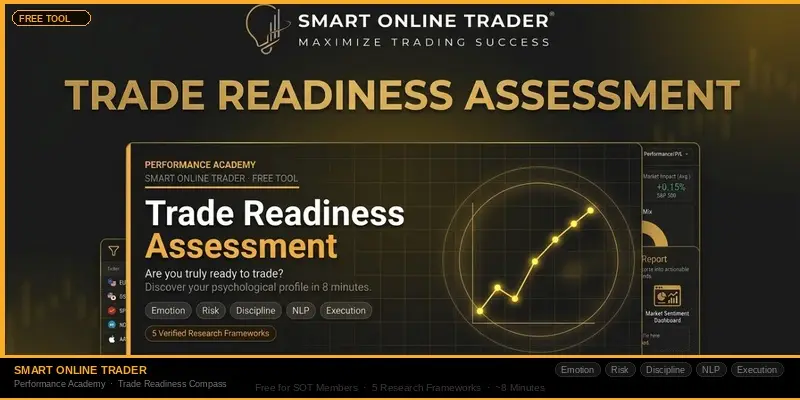
Join The Hub, free
Explore the free resources, tools and Trade Journal for yourself.
Join The Hub freeDownload the Smart Online Trader App
REAL REWARDS
The Rewards Rebate Programme
“What you invest to learn becomes what you trade with.”
Month 7
A simulated $5,000 Prop Firm Evaluation activates, included with your membership. So your training meets its first real test.
Month 13
Your membership value returns to you as credit in a Simulated Funded Account, with a 50/50 split on the profits you generate.
Simulated environment throughout. Effective 1 June 2026 and subject to the Rewards Rebate Programme terms.