
Trust & Transparency
The Trading Industry Has a Trust Issue, and We Need to Talk About It
Francois Oosthuizen - 11 October 2026
Let us begin with something the online trading industry does not like to admit out loud: trust in online trading is low, and the industry earned that. Mention that you teach people to trade, and you will meet the same wariness almost every time, the raised eyebrow, the quiet "isn''t that all a scam?" Honestly, it is a fair question. For years, too much of this profession ran on promises it could never keep. So before we talk about strategy, or tools, or anything else, we need to talk about trust: where it went, why, and how you tell a trustworthy educator from someone simply selling a dream.
Why Trust in Online Trading Is So Low
The distrust did not appear from nowhere. Instead, it was built one broken promise at a time. You have probably seen the pattern: guaranteed returns, screenshots of overnight riches, a secret strategy nobody else supposedly has, and a hard push to pay before you have had time to think it through. None of that is education. Rather, it is persuasion dressed up as opportunity. So when enough people pay for the dream and wake up to a very different reality, trust in online trading collapses for everyone, the honest operators included. The real cost is not only money. It is a person who was brave enough to try to better their situation, walking away convinced the whole profession is rigged against them.
South Africa''s response tells you how serious the problem became. The Consumer Protection Act of 2008 introduced a cooling-off period precisely because so many people were pressured into decisions they later regretted. Regulation does not arrive to punish honest businesses. It arrives because enough dishonest ones made it necessary.
Why the Dream Still Sells
It is worth asking why the empty promises keep working. The answer is uncomfortable: people reach for the dream because the need behind it is real. Someone working two jobs, watching the cost of living climb, is not foolish for wanting a way out. They are human. The dream-sellers know this, and they aim straight at that hope. That is exactly why protecting trust matters so much in this profession. The people most likely to be hurt by a false promise are usually the ones who can least afford it. So honest education is not only better business. It is simply the decent thing to do.
We Are Not Innocent
I will not pretend we were always on the right side of this. I have been in this industry since 1999, and the early years looked a lot like what I have just described. So we were part of the problem long before we chose to become part of the solution. I say that not to confess for its own sake, but because trust begins with honesty, and you cannot reasonably ask anyone to trust a business that cannot be honest about its own past. That is also why no operator claiming a spotless history should get an automatic pass. In fact, the honest ones tend to own their mistakes, not hide them.
So How Do You Tell the Difference?
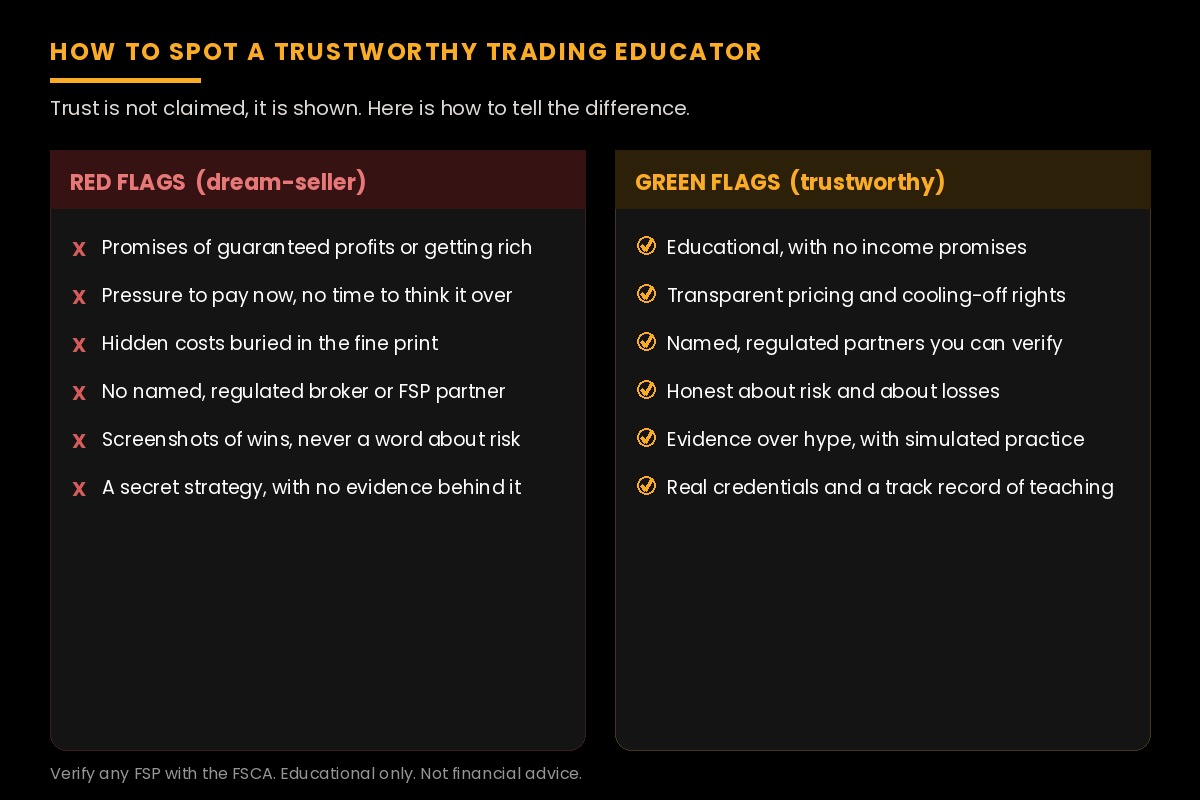
Here is the genuinely useful part, the bit you can use to protect yourself and your money. Trustworthy educators and dream-sellers behave differently, and once you know the signals, they become hard to miss. The image above lays them side by side, but a few are worth spelling out.
A trustworthy operator never guarantees a profit, because no honest person can promise what the market will do. Instead, they are transparent about price and give you room to reconsider, rather than rushing you past your own judgement. They also name their regulated partners so you can check them, and in South Africa you can verify any Financial Services Provider directly with the FSCA. Above all, they are honest about risk and about losses. A business that only ever shows you winning trades is not teaching you to trade. It is teaching you to hope, and hope is not a strategy.
So ask the questions a dream-seller does not want to hear. What does this actually cost, in full? Who regulates the broker you will use? What happens when a trade goes wrong? A trustworthy educator will welcome every one of those questions. A dream-seller will try to move you past them.
What Rebuilding Trust in Online Trading Looks Like
Rebuilding trust in online trading is not a campaign or a clever slogan. Rather, it is a thousand small, unglamorous choices, made the same way whether or not anyone is watching. It looks like saying "educational only, not financial advice" and meaning it. It looks like a simulated environment where you prove a skill before a single cent is at risk. It also looks like returning honest performance data to traders rather than hiding it, and like evidence over hype in everything we publish. It even looks like welcoming stricter regulation instead of fearing it, because higher standards protect the people we serve. If you want the fuller story of how we learned this the hard way, it is in our founder''s honest account.
We are not perfect, and we will never claim to be. However, we have decided, permanently, which side of the trust line we intend to stand on. We would rather lose a sale than lose a person''s faith, because a business built on trust outlasts one built on hype every single time.
So yes, the trading industry has a trust issue, and pretending otherwise would be its own small dishonesty. The better news is that trust, once you know what to look for, is not hard to recognise. So demand it. Ask the hard questions, verify the claims, and give your money only to the operators who earn it. The ones worth your time will welcome every question you bring, because earning your trust is the entire point.
Frequently asked questions
Join The Hub, free
Explore the free resources, tools and Trade Journal for yourself.
Join The Hub freeDownload the Smart Online Trader App
REAL REWARDS
The Rewards Rebate Programme
“What you invest to learn becomes what you trade with.”
Month 7
A simulated $5,000 Prop Firm Evaluation activates, included with your membership. So your training meets its first real test.
Month 13
Your membership value returns to you as credit in a Simulated Funded Account, with a 50/50 split on the profits you generate.
Simulated environment throughout. Effective 1 June 2026 and subject to the Rewards Rebate Programme terms.