
Markets & Mindset
Where Opportunity Really Hides When the World Feels Like It's Falling Apart
Francois Oosthuizen - 19 October 2026
Open any feed during a market shock & you will meet the same promise, worded a hundred ways. Chaos is opportunity. Volatility is where fortunes are made. The brave buy while others panic. It is seductive, & it is mostly wrong. Not because turbulent markets hold no opportunity, but because the opportunity is almost never where the headline is pointing. It does not live in the bad news. It lives in the small number of people who prepared for it, & who can stay calm long enough to understand what is actually happening while everyone else reacts.
That distinction is the whole game. This is an honest look at where opportunity genuinely hides when the world feels like it is falling apart, & why "bad" news so often conceals it in plain sight.
The sentence every trader has heard, & why it misleads
"Crisis equals opportunity" is one of the oldest lines in markets. The problem is not that it is entirely false. The problem is that it quietly collapses two very different things into one, the event & the response, & then implies the event itself hands you something. It does not. The same crash that one person later calls the opportunity of a decade wipes another person out in a single afternoon. Same event, opposite outcomes. The variable was never the news. It was the trader.
Once you see that, the whole "profit from chaos" story falls apart. Turmoil does not reward people for being present when it arrives. It simply reveals who did the work beforehand & who did not. The headline is the same for everyone. What differs is who is ready to read it.
Markets do not move on news. They move on surprise.
Here is the mechanic almost no one explains. A market price already contains the crowd's best collective guess about the future. The expected outcome is, in trading language, "priced in." So when news finally arrives, the market does not simply react to whether that news sounds good or bad. It reacts to the gap between what was expected & what actually happened.
This is why markets can behave in ways that feel upside down. A frightening economic figure that everyone already feared can see a market steady or even rise, because reality came in "less bad than feared." A perfectly decent figure that fell short of very high hopes can see a market fall. The headline is about the event. The price is about the surprise. Confuse the two & the "obvious" reaction to bad news will fool you again & again.
You can see this pattern throughout market history. A long-feared decision arrives exactly as expected & the market barely flinches, because the move had already happened quietly in the weeks of anticipation before it. The event everyone braced for turns out to be a non-event, while an offhand comment nobody prepared for is what gets things moving. The lesson keeps repeating itself: it is the surprise, not the news, that carries the move, & the trader who understands that is reading a different market to the one the headlines describe.
Learning to see that gap is a skill, & it is trainable. Our Macro Reaction Lab exists precisely for this: it lets you study how price has actually behaved around a defined set of past releases, measured against what was expected, so you understand the reaction instead of guessing the event.
Why the crowd overreacts
There is a reason the dramatic story is so dangerous. Decades of research in behavioural finance suggest that people systematically overreact to news that is sudden & emotionally charged. In their landmark study Does the Stock Market Overreact? (Journal of Finance, 1985), Werner De Bondt & Richard Thaler drew on experimental psychology showing that most people overreact to unexpected & dramatic events, & found long-horizon patterns in share returns consistent with exactly that, prices being punished too harshly on bad news & lifted too generously on good news, then drifting back as the facts reasserted themselves.
That is equity research over multi-year horizons, not a trading rule & certainly not a prediction. But the human lesson inside it is timeless & it travels: the frightening, dramatic story is the very kind most likely to provoke an outsized reaction, & an outsized reaction is a distortion. The prepared trader's edge is not cleverly predicting the distortion. It is simply not being part of it.
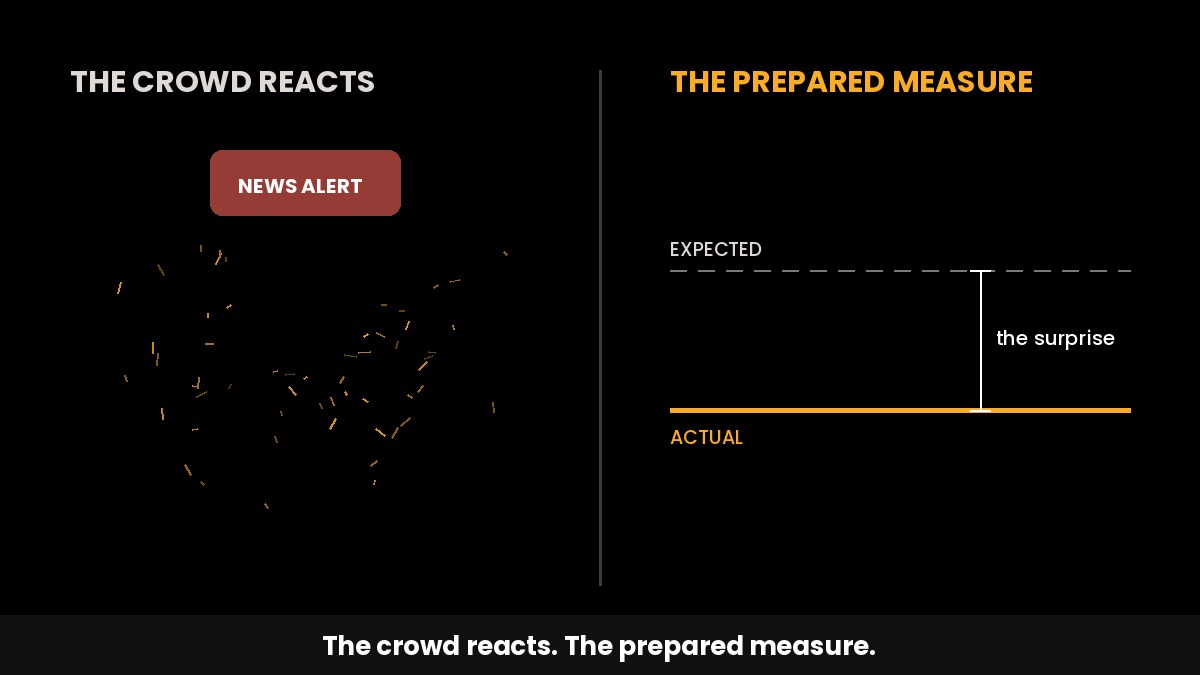
The opportunity is not the event. It is your preparation.
So let us say the honest thing plainly. Opportunity in uncertain markets does not hide in the news. It hides in preparation.
Picture two traders watching the same shock. The first has no plan, no tested process, & no real idea which releases even matter for the instruments they follow. For that person the turbulence is pure risk wearing the costume of excitement. The second has done the work. They know the calendar. They have studied how their markets have behaved around similar events. They have a written plan for how they will conduct themselves when it is loud, & they have rehearsed it somewhere mistakes cost nothing. For that trader, the same moment is legible. Not a crystal ball telling them what will happen, but a readiness for whatever does.
That readiness is the opportunity. & notice when it was built. Long before the headline. The crisis did not create it. The crisis merely revealed who already had it.
How that preparation is actually built
Readiness is not a mood you summon when the market gets scary. It is a set of specific, unglamorous habits built in advance.
It begins with separating signal from noise, knowing which news genuinely moves your markets & which headlines never mattered for your instruments at all. Most do not. It continues with studying the reaction rather than forecasting the event, because the trainable skill is reading how a market digests information against expectation, not guessing a number nobody can guess reliably. & it rests on having a pre-decided process & rehearsing it until it is almost boring. As we argue in Evidence-Based Trading, serious traders test, they do not believe. All of this is study & practice, done deliberately, in a risk-free simulated environment where the only thing a mistake costs you is a lesson.
Calm is a competitive advantage
In turbulent markets the real account-killers are rarely the events themselves. They are fear, urgency & information overload, the very things a loud news cycle manufactures on purpose. The prepared trader is not calmer because they are braver than everyone else. They are calmer because the important decisions were already made before the noise began. A pre-decided process is simply what lets you measure instead of react, & composure, like everything else here, is a skill you can build on purpose rather than a temperament you are born with.
The quieter, truer version
We could sell you the loud story. That the next crisis is your shortcut. That fortune favours the bold. We will not, because it is not true & it is not who we are.
The honest version is less thrilling & far more useful. Opportunity in uncertain markets does not belong to the bold or the lucky. It belongs to the prepared & the composed. The world will keep producing turmoil, reliably & forever. Your edge is not in predicting it. It is in being the one person in the room who did the work & can keep their head while the room loses its own. That is where opportunity really hides. It was never in the news. It was always in you.
Preparation starts with an honest look at where you actually stand today, & that is exactly what the Trade Readiness Compass is built to show you.
Frequently asked questions
Join The Hub, free
Explore the free resources, tools and Trade Journal for yourself.
Join The Hub freeDownload the Smart Online Trader App

REAL REWARDS
The Rewards Rebate Programme
“What you invest to learn becomes what you trade with.”
Month 7
A simulated $5,000 Prop Firm Evaluation activates, included with your membership. So your training meets its first real test.
Month 13
Your membership value returns to you as credit in a Simulated Funded Account, with a 50/50 split on the profits you generate.
Simulated environment throughout. Effective 1 June 2026 and subject to the Rewards Rebate Programme terms.