Advanced Trade Tech · Performance Academy · Performance Lab · Regulatory & Safety · Smart Online Trader Hub
How to Develop a Trading Plan – Build Your Stack
By Francois Oosthuizen · · Updated

How to Develop a Trading Plan That Works – Build Your Stack. If you’ve ever asked yourself how to develop a trading plan that works – one that holds up when the market moves against you, when your emotions are running high, and when real capital is on the line – you’ve been asking the right question in the wrong way. The assumption buried in that question is that trading failure is primarily a knowledge problem: that a better strategy, a better indicator, or a better entry signal is what separates struggling traders from consistently profitable ones. The data says otherwise.
Across the prop firm industry, between 75% and 90% of traders fail evaluation challenges – not because they lack technical knowledge, but because they lack the infrastructure around that knowledge. They can describe a liquidity sweep in precise detail. They can explain market structure, order flow, and smart money concepts fluently. And still, when the market opens and real capital is on the line, they collapse.
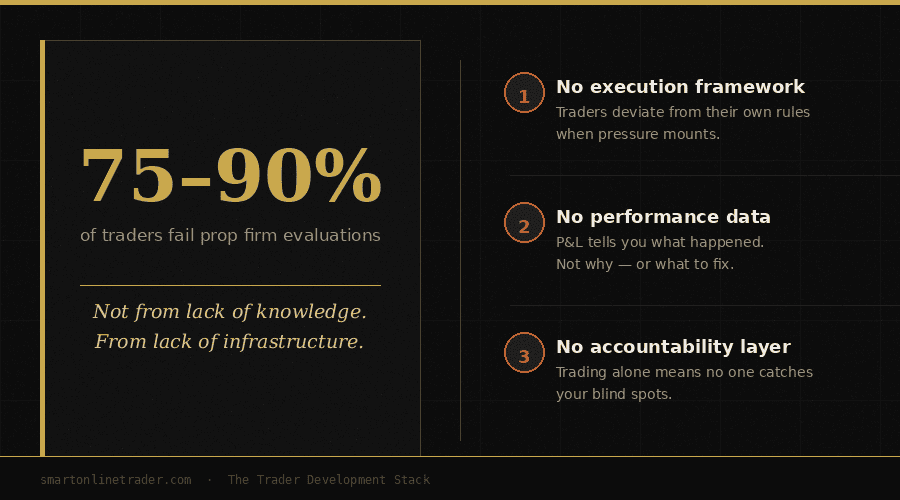
The top 5% of traders – the ones who pass funded evaluations, scale their accounts, and build genuine trading careers – are not simply smarter or more experienced. They have built something the majority has never considered: a complete, interdependent system of development infrastructure that compounds their edge across time.
We call this the Trader Development Stack.
“Strategy is the product. Infrastructure is the factory. You cannot scale a factory that doesn’t exist.” – Smart Online Trader Performance Lab
The concept is borrowed from technology. Every serious software company typically operates on a tech stack – a layered set of tools, frameworks, and systems that work together to produce reliable output. A brilliant developer writing code without a proper stack – no version control, no testing environment, no deployment pipeline – produces results that are erratic, unscalable, and fragile. The code might be excellent. The output will still fail in production.
Most traders are that developer. Brilliant in isolation. Failing in production.
Here is the complete Trader Development Stack – five layers, each one essential, and each one compounding the others.
Knowledge Infrastructure: The Difference Between Consuming and Building
Knowledge Infrastructure is not about having more information. In 2025, information has never been cheaper or more abundant. The internet is saturated with free trading education and what matters is not what you consume – it’s how the knowledge is structured and applied.
Think of it this way: a medical student and a hypochondriac can read the same textbooks. One emerges as a doctor; the other emerges with health anxiety. The difference is not the content – it’s the scaffolding around the content, structured progression, supervised application, feedback loops, and accountability to a standard.
Effective Knowledge Infrastructure has three characteristics that distinguish it from content consumption.
Sequential architecture concepts build on each other in a deliberate sequence. You cannot understand institutional order flow without first understanding market structure. You cannot manage risk without first understanding position sizing in relation to account drawdown parameters. There is an order to things, and violating that order creates knowledge gaps that manifest as real losses later.
Supervised application – knowledge that hasn’t been stress-tested in live market conditions under the guidance of someone more experienced is just theory. Expert-led mentoring isn’t a luxury add-on; it’s the mechanism that converts information into executable skill. The gap between knowing and doing in trading is wider than in almost any other discipline.
Feedback integration – the feedback loop must be short and precise. A trader who reviews their week on Friday afternoon and vaguely concludes “I need to be more patient” has no feedback system. A trader who reviews each trade within 24 hours, tags it by session, setup type, emotional state, and outcome, and tracks those variables across 200 trades – that trader has feedback infrastructure.
This is the gap that separates courses from academies. A course delivers content. A structured academy – with progressive curriculum, live mentor access, and application frameworks – delivers the first layer of a genuine development stack.
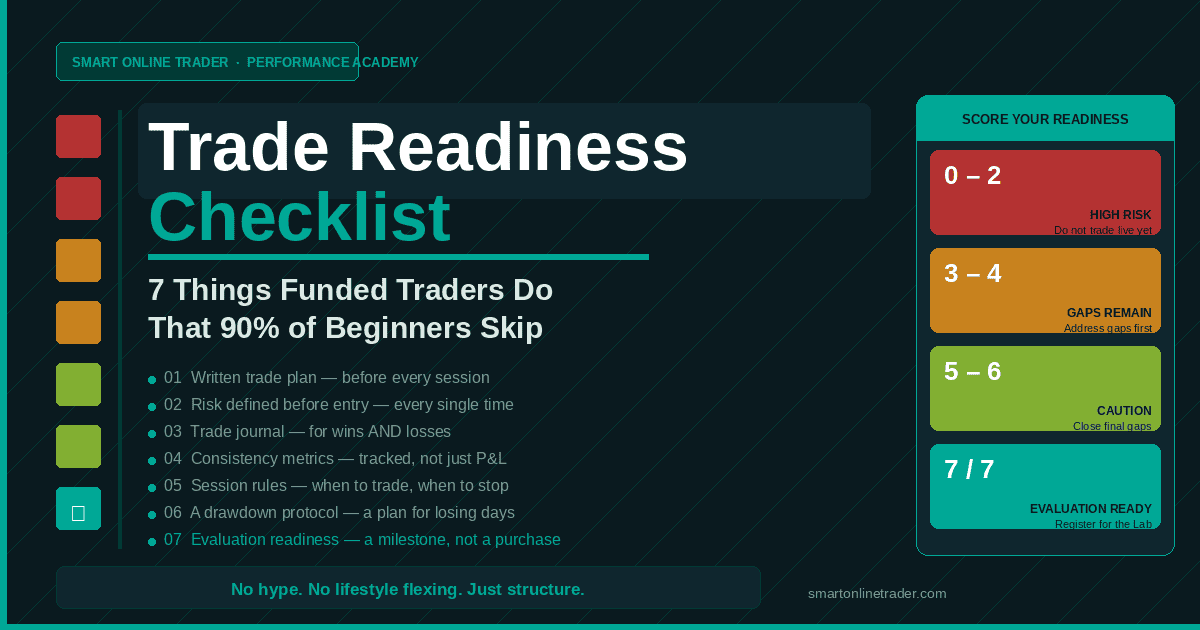
Not sure where you currently sit in your development? The Smart Online Trader Interactive Trade Readiness Guide is the right starting point. It takes you through a structured assessment of your current level and maps the most appropriate pathway for your stage – Foundation, structured mentoring, or evaluation-readiness – before you commit to anything.
The Three Membership Tiers of the Performance Academy
The Performance Academy is structured across three progressive tiers – each one designed to match a specific stage of trader development.
Nebula – Foundation, self-paced – gives you access to a 9-module, 60-lesson Foundation Learning Library covering forex, commodities and crypto, a full glossary and eBook library, Trade Tech orientation, and your first community channel access. It is the entry point for traders who are building from scratch and need to establish core habits before anything else.
Trader Essentials Trade with structure, guided by experts – adds 4 advanced modules and 35 lessons, Technical and Fundamental trading strategies, Advanced Trading Tech online workshops, access to the Trade Desk & Market Insights channel, weekly online mentoring with a mentor-reviewed weekly scorecard, and TradingView heatmaps and screeners across forex, crypto and US stocks. This is the tier where real development begins – structured, accountable, and measurable.
Premium Performance Tracker – One-on-One Expert Led Mentoring and Simulated Funding Ready – includes everything in Nebula and Trader Essentials, plus one-on-one weekly mentoring check-ins, priority seating at all live events with walkthrough pre-briefs, VIP community discussion access, and direct progression eligibility into the Performance Lab prop firm evaluation. The Premium one-time promo also includes a $2,500 prop firm evaluation – bundled at a significant discount.
Every tier includes short assessments at the end of each module. Pass them and you unlock completion badges and, where applicable, formal certificates – so your progress is measured and verifiable, not self-declared.
Execution Environment Design: The Invisible Layer Nobody Talks About
Your execution environment is everything that surrounds the moment you press buy or sell – and it has almost nothing to do with your strategy. It includes your platform, your hardware, your pre-trade checklist, your risk parameters, your decision rules, and critically, the psychological operating conditions you create for yourself before the market opens.
Elite traders treat the execution environment with the same rigour that surgeons treat the operating theatre. No surgeon begins a procedure in a disorganised room with unclear roles, uncertain equipment, and no defined protocol for complications. Yet thousands of traders open their platforms in precisely these conditions every single day – no pre-market preparation, no defined risk ceiling, no decision framework for when a trade goes against them.
A well-designed execution environment includes four components.
First, a pre-session protocol which is a fixed sequence of actions you complete before you are permitted to place any trade. This includes reviewing the economic calendar, identifying key levels on your higher timeframes, setting your maximum daily loss parameter, and a brief emotional state calibration. Are you trading from clarity or from anxiety? From your edge or from last Tuesday’s loss?
Second, a trade decision framework which is not just a strategy but a written set of conditions that must all be true before you enter. Not “this looks good.” Not “this feels right.” A checklist with specific, measurable conditions. When all conditions are met you execute the trade. When they’re not, you don’t. The framework removes the largest source of trading losses, which is not bad setups – it’s discretionary deviation from your own system.
Third, a risk architecture that is non-negotiable. Your daily maximum drawdown, your per-trade risk percentage, your maximum number of concurrent positions – these are not guidelines. They are system parameters. The moment they become negotiable is the moment your environment has failed.
Fourth, a post-session debrief. Not a P&L check. A process review. Did I follow my pre-session protocol? Did I execute only within my framework? Did I respect my risk parameters? Outcome is irrelevant to this debrief. A poorly executed winning trade is a failure of process. A perfectly executed losing trade is a success of process.
Performance Intelligence: The Dashboard Nobody Builds
Every trader checks their P&L. Almost no trader builds a Performance Intelligence System. This is the most neglected layer of the entire stack, and arguably the most valuable – because it’s the layer that transforms a trader from reactive to strategic.
P&L is a lagging indicator. It shows you what happened and almost nothing about why it happened or what is likely to happen next. Trading on P&L alone is like steering a ship by looking at your wake.
“Profit is a reward for having the right process. It is not a measure of it. Build the intelligence system that measures the process, and the profit follows.”
A Performance Intelligence System tracks leading indicators – the process metrics that predict future performance before the P&L reflects them. These include the following.
Setup adherence rate – what percentage of your trades match your defined setup criteria? A rate below 80% indicates a systematic problem with impulse control or boredom trading.
Risk-adjusted return by session – are you consistently profitable in the London session but bleeding in New York? This single metric has redirected dozens of traders away from sessions they had no edge in.
Drawdown velocity – how quickly do you lose when you’re in a losing phase? A trader who loses 2% over two weeks is in a different situation from a trader who loses 2% in a single afternoon. Velocity tells you whether you’re managing adversity or reacting to it.
Emotional trigger log – which specific market conditions, time-of-day windows, or news events correlate with your worst trades? Mapping your emotional triggers is not “soft” work. It is forensic risk management.
Consistency score – a composite measure of whether you are trading the same way on day 15 of a great month as you did on day 1. Elite traders are consistent. Developing traders are erratic in both directions.
This layer cannot be built in isolation. It requires a shared space where your data can be tracked, reviewed, and reflected upon – ideally alongside the intelligent feedback of a mentor or community who can see patterns you cannot see in yourself. This is precisely where the SOT Client Portal & Community Hub becomes indispensable.
Accountability Architecture: Why Who You’re In the Room With Is Your Biggest Edge
There is a concept in organisational psychology called social proof of competence – the phenomenon by which our own standards and aspirations are calibrated by the people we spend the most time with. Jim Rohn’s famous observation that you are the average of the five people closest to you was not motivational rhetoric. It was an empirical prediction.
In trading, this principle operates with particular force. Trading is a solitary activity by nature – one person, one screen, one set of decisions. That solitude protects focus but destroys accountability. There is no colleague to observe your decision-making. No manager to review your process. No peer to notice that you’ve violated your risk rules for the fourth consecutive day. The isolation of trading is its greatest structural danger.
Accountability Architecture is the deliberate construction of the social and professional environment that compensates for this isolation. It has three distinct components.
The Peer Layer
A curated group of traders at a similar or slightly higher development stage who share performance data, review each other’s trade journals, and hold each other accountable to process. The key word is curated. A group of 50,000 traders in a Discord server where anyone posts anything is not a peer layer – it’s noise. A group of traders with defined standards, shared frameworks, and regular structured review sessions is a peer layer. The community accountability and peer group channels inside the SOT Hub are structured precisely around this principle.
The Mentor Layer
Access to traders who have demonstrably solved the problems you are currently facing. Not influencers. Not signal providers. Not people whose primary income comes from selling education. Traders with verified, auditable credentials who are actively engaged in the markets and willing to transfer the specific skills that took them years to develop.
Inside the SOT Hub, this is not a vague promise – it is a named, credentialled reality. Francois Du Plessis is a licensed Financial Services Provider (FSP) holding an FSCA Category 2 licence and manages more than $1,4M – one of the most rigorous financial services designations in South Africa – and shares daily market insights directly with Hub members. This is not commentary from a self-styled “trading coach.” It is regulated, accountable, expert-level analysis from someone who operates under the formal governance of the Financial Sector Conduct Authority. His focus is clear: helping traders understand why markets move – not chasing signals, but building informed decision-making. Francois is also a major contributor to our curriculum and a core tutor across our Masterclasses.
Luhan Oosthuizen, Smart Online Trader’s in-house Senior Analyst and resident Prop Firm Trader Guru, brings a different but equally essential dimension: the daily, ground-level perspective of an active prop firm trader who understands exactly what it takes to pass evaluations, manage funded accounts, and build consistency under real pressure. Luhan posts daily insights directly into the Hub’s dedicated Trade Desk & Market Insights channel – giving members a front-row seat to professional-grade analysis every single trading session, at no cost.
The mentor relationship in the SOT ecosystem is not passive – it is scheduled, specific, and outcome-focused. Weekly mentoring sessions are built into the Trader Essentials membership tier, and one-on-one weekly check-ins are a core feature of the Premium tier.
The Community Intelligence Layer
This is the most underestimated component of Accountability Architecture. A sufficiently large, high-quality trading community is a distributed intelligence system. When the London session opens with an unusual accumulation phase that breaks pattern, 10,000 traders noticing it individually is far less valuable than 10,000 traders pooling that observation in a shared space and distilling it through experienced analysis. Community intelligence is not opinion aggregation. When structured correctly, it is real-time market sense-making at a scale no individual trader can replicate.
The Smart Online Trader Client Portal & Community Hub – What You Get, Completely Free
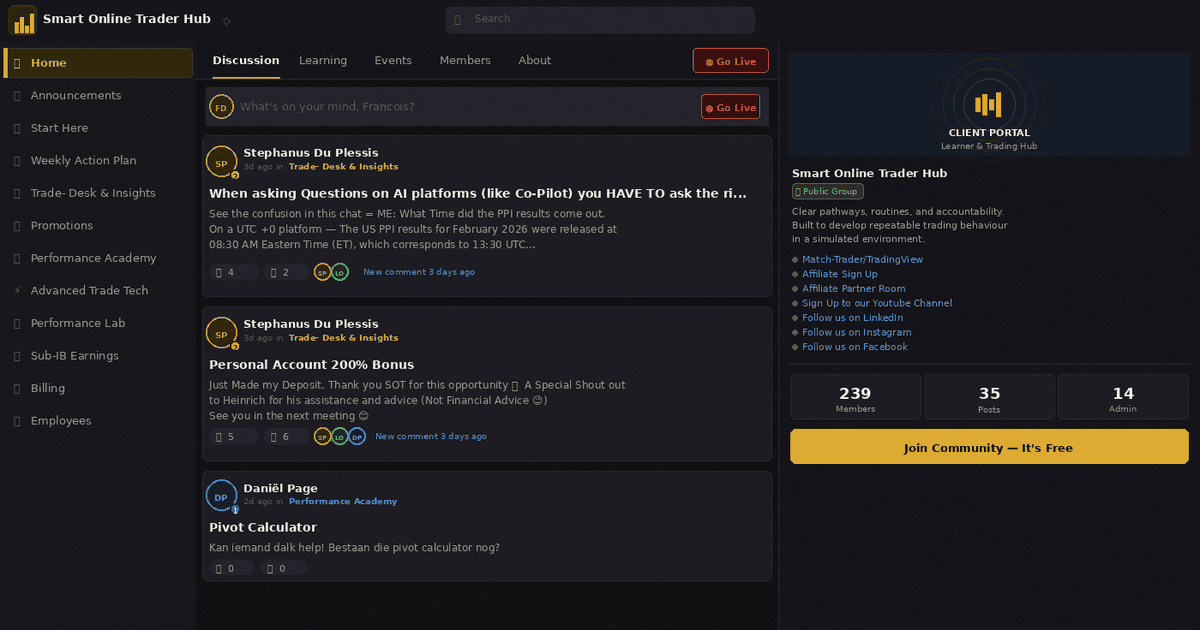
The SOT Client Portal & Community Hub is the Layer 4 infrastructure that makes everything else in the Trader Development Stack compound 1 and access is completely complimentary. This is not a generic forum or a social media group. It is a purpose-built, structured performance environment with the following channels and features available to all members at no cost.
The Trade Desk & Market Insights channel is where Luhan Oosthuizen, SOT’s in-house Senior Analyst and Prop Firm Trader Guru, posts daily professional analysis every trading session. Alongside him, Francois Du Plessis – a licensed FSP with an FSCA CAT2 designation – shares expert market insights backed by regulated, accountable expertise. The quality of insight available in this channel alone is worth registering for the Hub.
The Performance Academy channel is dedicated to traders preparing for or actively completing a Performance Lab evaluation. Get answers to evaluation-specific questions, share your progress, and learn from the direct experience of traders who have already passed.
Community Accountability and Peer Groups provide the structured peer interaction designed to keep you accountable to your process – not just your profits. This is the environment where the daily habits that make a funded trader are built and maintained.
Live Session Recordings and Replays mean your learning is never dependent on being available at a specific time. Every session is archived and accessible inside the Hub whenever you need it.
The Course Library with Assessments and Certification connects directly to your Performance Academy learning environment. Each module includes assessments, milestone badges, and formal certificates on completion – so your development is measurable, verifiable, and something you can be proud of.
It costs nothing to join. Register for the SOT Community Hub here and introduce yourself to the community.
Capital Access Pathway: The Layer That Makes the Stack Worth Building
The final layer is the one every trader is ultimately working toward – and the one most traders approach completely backwards. Capital access is not the reward for having a strategy. It’s the reward for having a complete, functional development stack.
The prop firm evaluation model – when approached correctly – is not a gamble. It is not a lottery. It is a structured assessment of whether your first four stack layers are operational. Prop firms are not testing whether you can get lucky over 30 trades. They are testing whether you have a process that is repeatable, risk-controlled, and consistent. The evaluation criteria are almost exactly the output metrics of a well-built development stack.
Maximum daily drawdown limits – that’s Layer 2 (risk architecture). Consistency requirements – that’s Layer 3 (performance intelligence). The ability to perform under pressure over an extended period – that’s Layer 4 (accountability and mental stability). The underlying profitability – that’s Layer 1 (knowledge and skill).
When traders fail evaluations repeatedly, the standard response is to change their strategy. In reality, their strategy is rarely the problem. The problem is that Layers 2, 3, and 4 don’t exist. They have knowledge but no execution environment. They have a strategy but no performance intelligence system. They have potential but no accountability architecture. The evaluation reveals the gaps in the stack.
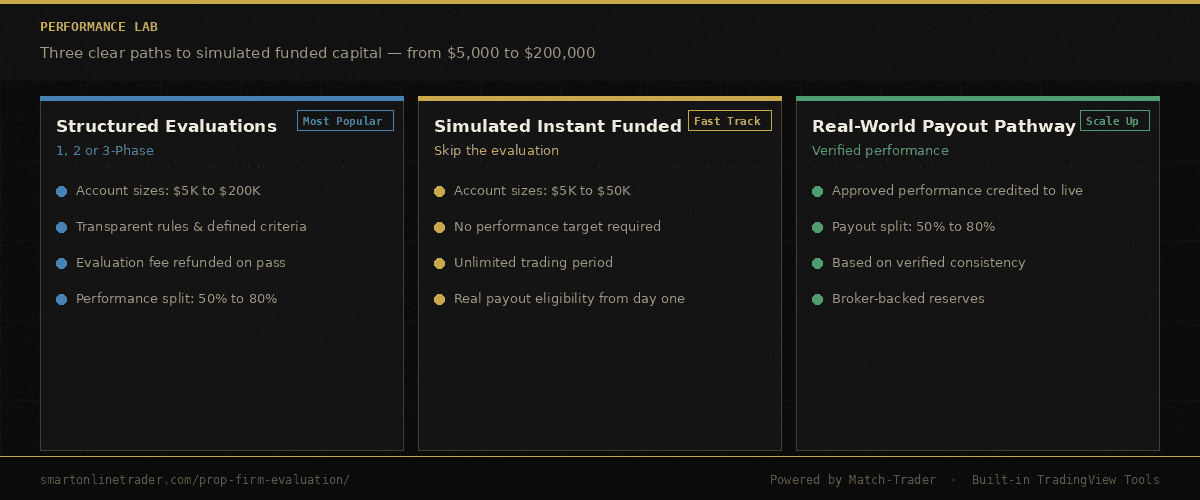
The Performance Lab offers three clear paths to simulated funding, each designed to match a different stage of trader readiness.
Structured Evaluations are available in 1, 2, or 3-phase formats with account sizes ranging from $5,000 to $200,000. Rules are fully transparent, criteria are defined before you begin, and your evaluation fee is refunded in full upon successful completion. Performance share splits run from 50% up to 80%.
Simulated Instant Funded Accounts are for traders who want to skip the evaluation phase entirely and begin inside a professionally supported simulation immediately. No performance target is required, trading periods are unlimited, and real payout eligibility begins from day one. Account sizes run from $5,000 to $50,000.
The Real-World Payout Pathway means that approved performance on your simulated account is credited to a live account, with pay-out splits from 50% up to 80% based on verified, consistent performance.
All three paths run on the Match-Trader platform – a modern trading interface with built-in TradingView analysis tools, demo and live trading in a single interface, and infrastructure designed for the plan → execute → journal → review workflow that the Trader Development Stack is built around.
The Real Answer to How to Develop a Trading Plan That Works: Build the Stack First
The reason the Trader Development Stack is transformative – and the reason the top 5% perform so differently from the majority – is not that each individual layer produces large gains. It’s that the layers compound each other.
Layer 1 (knowledge) without Layer 2 (execution environment) produces a trader who knows what to do and still does the wrong thing under pressure. Layer 2 without Layer 3 (performance intelligence) produces a trader who follows their process but can’t identify when the process needs updating. Layer 3 without Layer 4 (accountability) produces a trader who has data but no one to help them interpret it honestly. And all four layers without Layer 5 (capital access) produces a trader who has built something excellent with no means to scale it.
But when all five layers are operational and aligned, something qualitatively different happens. Your knowledge generates a process. Your process generates performance data. Your performance data generates insight. Your insight is sharpened by accountability. And your accountable, consistent, intelligent performance unlocks the capital to make it meaningful.
This is not a faster version of what most traders are doing. It is a fundamentally different architecture of how a trading career is built.
“The question is never ‘what is your strategy?’ The question is ‘what is your stack?’ Because the stack is what survives a drawdown, survives a crisis of confidence, and survives long enough to prove the strategy works.”
Smart Online Trader was built around this architecture from the ground up. The Performance Academy addresses Layer 1 – with a 13-module curriculum, specialist-created course content, assessments, and certification across three progressive membership tiers. The execution frameworks built into the programme address Layer 2.
The Performance Lab is an external audit of Layers 1 through 4 in live conditions, with transparent rules, refundable evaluation fees, and a direct pathway to simulated funded accounts with real pay-out splits. The SOT Client Portal & Community Hub is the connective tissue of Layers 3 and 4 – the place where Luhan Oosthuizen’s daily professional analysis, Francois Du Plessis’s FSP-licensed market insights, your peer accountability network, and your live session library all exist in one complimentary, purpose-built space.
Not sure which layer you need to build first? Start with the Interactive Trade Readiness Guide – a structured self-assessment that maps your current position and recommends the most appropriate pathway before you invest a single rand.
Stop asking what strategy is working. Start asking: which layers of your stack are missing?
The answer will tell you exactly where your next breakthrough is waiting.
Frequently Asked Questions: How to Develop a Trading Plan That Works
Do I need a lot of capital to start building a proper trading plan?
No – and this is one of the most common misconceptions that keeps traders stuck. A trading plan is a process document, not a capital document. You can build and test every layer of the Trader Development Stack on a demo account or a small live account. In fact, starting with less capital forces you to trade the process rather than chase profits, which is exactly the discipline the stack is designed to develop. When your process is consistent, the Performance Lab gives you access to simulated funded capital – starting from $5,000 all the way to $200,000 – without putting your own savings at risk. Not sure where to start? The Interactive Trade Readiness Guide will map the right pathway for your current level.
What is the difference between a trading strategy and a trading plan?
A strategy is a set of conditions that define when to enter and exit a trade. A plan is the complete operating system around that strategy – your pre-session protocol, your risk parameters, your performance tracking system, your accountability structures, and your capital access pathway. Most traders have a strategy. Very few have a plan. The Trader Development Stack is the framework for building the plan that makes the strategy executable under real-market pressure.
H3 How long does it take to develop a trading plan that actually works?
There is no universal timeline, but there is a universal sequence. You need enough structured education to build a repeatable strategy (Layer 1), enough live screen time to stress-test your execution environment (Layer 2), enough trade data to build meaningful performance intelligence (Layer 3 – typically 100 or more documented trades), and enough accountability infrastructure to identify and correct your blind spots (Layer 4). For most traders working with structured support through the Performance Academy, this sequence takes between three and nine months to complete to a fundable standard.
Is the Smart Online Trader Community Hub really free?
Yes – completely. The SOT Client Portal & Community Hub is complimentary for all members. There are no subscription fees, no locked tiers, and no hidden costs inside the community. What you receive at no cost includes daily market analysis from Luhan Oosthuizen in the Trade Desk & Market Insights channel, FSP-licensed market insights from Francois Du Plessis, a dedicated Prop Firm Evaluation support channel, community accountability peer groups, live session recordings and replays, and access to the Course Library connected to your Performance Academy membership tier. Accountability infrastructure should not be a premium add-on – it is a fundamental component of trader development, and every serious trader deserves access to it.
Can I join the Hub even if I have not started the Performance Academy yet?
Absolutely. The SOT Community Hub is open to traders at every stage – whether you are completely new to trading, mid-way through structured education, actively preparing for a prop firm evaluation, or already managing a funded account. The community is designed so that newer traders benefit from the experience of advanced members, and advanced members sharpen their thinking by mentoring others. Both directions of that relationship accelerate development. If you are unsure which tier of the Performance Academy is right for you, complete the Interactive Trade Readiness Guide first – it takes a few minutes and removes all the guesswork.
Who are the people behind the Smart Online Trader Hub?
The Hub is not run by faceless community managers. Luhan Oosthuizen, SOT’s in-house Senior Analyst and Prop Firm Trader Guru, posts daily insights in the Trade Desk & Market Insights channel – the kind of analysis that typically sits behind expensive subscriptions, delivered free to Hub members every trading session. Francois Du Plessis brings FSP-licensed and FSCA CAT2-certified expertise to the market insights he shares with the community – making him one of the very few trading educators in South Africa operating under formal regulatory oversight. Combined with structured peer accountability groups, a dedicated evaluation support channel, and a full library of live session recordings and replays, the Hub is built around people who are qualified, active, and genuinely invested in your development.
What makes Smart Online Trader different from other trading education or prop firm companies?
Most trading education companies sell content. Most prop firms sell evaluations (“challenges”). Smart Online Trader is built around the complete Trader Development Stack – structured education through the Performance Academy across three progressive membership tiers, funded access through the Performance Lab with transparent rules and refundable evaluation fees, professional-grade trading infrastructure through the Match-Trader platform with built-in TradingView tools, and the accountability and community layer through the SOT Hub – featuring credentialled daily insights from Francois Du Plessis (FSP, FSCA CAT2) and Luhan Oosthuizen (Senior Analyst and Prop Firm Trader Guru), at no cost. The goal is not to sell you a product. It is to give you the complete infrastructure of a professional trading career.
Build Your Stack. Join Traders Who Are Building Theirs.
Access to the Smart Online Trader Client Portal & Community Hub is completely complimentary – no catch, no subscription, no hidden cost. Register now and get immediate access to daily professional market analysis from Luhan Oosthuizen and Francois Du Plessis, a dedicated prop firm evaluation support channel, community accountability peer groups, live session recordings and replays, and a Course Library that tracks your certified progress through the Performance Academy.
Not sure where to start? Take the Interactive Trade Readiness Guide – a free, structured self-assessment that tells you exactly which pathway is right for your current level before you commit to anything.