
Financial Education: How To Truly Make Money Work
Somewhere on your feed today, a stranger in a rented studio told you what to do with your money. He spoke with total confidence. He had a microphone, a whiteboard and a view. What he almost certainly did not have was any accountability for what happens to you if he is wrong.
Yet South Africans have never had more access to financial “experts”, and never been more exposed to the consequences of trusting them blindly. The uncomfortable truth is simple. No expert, licensed or self-appointed, can care about your money the way you can. Experts can advise. Only understanding protects. This article is about the one asset that outperforms every tip you will ever receive: knowing how money actually works.
The Cost of Outsourcing Your Understanding
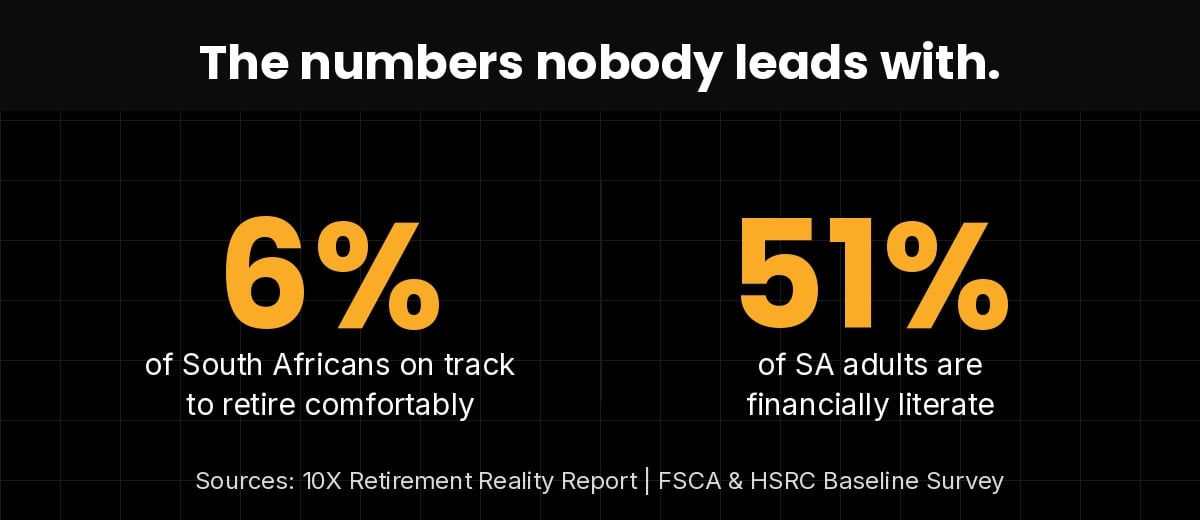
Indeed, the numbers describe a country that works hard for money it does not fully understand. According to the FSCA and HSRC baseline survey, roughly 51% of South African adults are financially literate. That means nearly half of us make lifelong financial decisions without the basic toolkit. The same research found that only 26% of people have emergency savings, and even those savings would last around three months. A third of South Africans have no retirement plan at all.
Moreover, the endgame of that gap is measurable. The 10X Investments Retirement Reality Report finds that only 6% of South Africans are on track to retire comfortably, a figure National Treasury’s own research confirms. Meanwhile, the average consumer allocates around 62% of take-home pay to servicing debt. Statistics South Africa data shows the household savings rate has turned negative. As a nation, we now spend more than we earn.
None of this happened because South Africans are lazy. Most of us work extremely hard. Instead, it happened because working hard for money and understanding money are two entirely different skills, and only one of them is taught on the job. We covered the retirement side of this problem in depth in our article on trading for retirement. This article zooms out to the bigger question underneath it.
The Five Ways Money Arrives, And What Each Really Costs
When you strip away the noise, there are only a handful of ways money ever comes to you. Understanding the true cost of each one is the beginning of financial education. Every route charges you something, and the price is not always printed on the label.
1. You Earn It
First, the route almost all of us take. You develop knowledge in your trade or profession, you show up, and you exchange time and skill for a salary. It is honest, it is reliable, and it has a ceiling built into its design: your time. Want more money? Work more hours. But more hours means a higher marginal tax rate on that extra income, fewer evenings with your family, hobbies that quietly disappear, and health that absorbs the strain. Earning is the foundation of every financial life, but it is a foundation, not a strategy. A salary was never designed to make you wealthy. It was designed to make you available again next month.
2. You Inherit It, Or Take It
Admittedly, inheritance is real for a fortunate few. But with only 6% of the previous generation retiring comfortably, most South Africans are statistically more likely to support their parents than to inherit from them. This is the well-known sandwich generation squeeze. As for taking it: every generation produces people who try to shortcut the system, and every generation watches how that ends. We mention it only for completeness. There is no financial plan on this route, only a countdown.
3. You Gamble For It
The lottery, the casino, the sports book, and if we are honest, the “hot tip” from someone who cannot explain why it will work. The mathematics here is not shy. Your odds of winning the South African Lotto jackpot are roughly one in twenty million. The house does not hide its edge. It publishes it, and it builds towers with it. Ask yourself one question before allocating money to any opportunity. What is my realistic luck ratio here, and would I accept those odds anywhere else in my life? Gambling is entertainment with a price of admission. The moment it becomes a financial strategy, the price becomes your future.
4. You Invest It
By contrast, this is where money finally starts working instead of you. Shares, bonds, property, retirement funds, index trackers: the legitimate universe is wide. For most people a properly structured, professionally advised investment portfolio is the backbone of long-term wealth. But investing has its own literacy test, and most people fail it quietly. Your returns must outperform your personal inflation rate, the rising cost of the life you actually live, which for many households runs hotter than the headline CPI number. Otherwise you are only preserving the illusion of growth.
Furthermore, markets reprice violently around external events: wars, pandemics, financial crises. The 2008 crash chronicled in The Big Short became a film for one reason. A handful of people understood mortgage markets deeply enough to see what the banks themselves missed. The lesson of that story is not opportunism. When the shock arrived, the informed were positioned and the uninformed absorbed the losses. Understanding is not optional equipment in markets. It is the difference between being the audience and being a participant. Always consult an authorised financial services provider before making investment decisions, and arrive at that meeting educated enough to ask real questions.
5. You Trade It
And then there is online trading: the route with the most noise, the most sellers of dreams, and the most honest data available if you know where to look. So let us look at it properly, because this is where financial education either happens or fails completely.
The Honest Number: Why Most Traders Lose
Here is the statistic the lifestyle influencers will never open with. Analysis by European regulators found that between 74% and 89% of retail CFD trading accounts lose money. Average losses per client ranged from 1,600 to 29,000 euros, according to the European Securities and Markets Authority. US regulator data tells the same story. That is why regulators require brokers to publish their loss percentages on their own websites.
We lead with that number deliberately. In short, if a trading educator does not tell you this in the first conversation, you have learned everything you need to know about them.
Why They Really Lose: Structure, Not Intelligence
But the number deserves a second look, because it hides the most useful insight in this article. The majority do not lose because trading is unlearnable. They lose for reasons that are boringly consistent and thoroughly documented.
The list is short. First, excessive leverage, used without understanding. No risk management framework. Position sizes that turn normal market movement into account-ending events. And above all, untrained psychology: revenge trading after a loss, overconfidence after a win, decisions made by emotion and rationalised afterwards. The failure is almost never intelligence. It is structure. Most losing traders never had a system. They had an app and an emotion.
Yet that distinction matters enormously, because unstructured behaviour is fixable. Odds are not fixed like a roulette wheel. They respond to preparation, process and practice environment. The same regulators who publish the loss statistics also mandated demo accounts, leverage limits and risk warnings. The evidence shows the harm concentrates among the unprepared.
The Fix Is Not a Secret. It Is a System
Notably, every field that involves high-stakes decisions under pressure solved this problem the same way. Aviation, medicine, professional sport: none of them used secrets. They used structured education, simulated practice, measured feedback and experienced mentors. Nobody hands a student pilot a Boeing on day one. They earn hours in a simulator where mistakes cost nothing but teach everything.
The Four Components That Actually Work
Similarly, trading is no different, and the fix has the same components. First, real education. Not a weekend of chart patterns, but a curriculum covering how markets work, what moves them, how risk is measured and how a trading plan is built. Second, simulated environments. You practise with simulated capital until the process is proven, so the expensive lessons are free.
Third, behavioural training. As we unpacked in our article on trading psychology, the majority of trading outcomes are decided between the ears, not on the chart. Fourth, mentorship and community. People ahead of you on the path can compress your learning curve and hold you accountable when discipline slips.
Of course, none of this guarantees profit. Nothing does, and anyone who says otherwise is selling you the dream, not the system. What structure changes is the quality of your decisions and the survivability of your learning period. That is the honest, unglamorous, evidence-based fix.
Become a Student of Money, Not Just a Producer of Labour
Finally, here is the reframe that ties all five routes together. Most people spend their entire lives as producers, producing labour, hours and output for someone else’s balance sheet, while consuming almost nothing of the financial system’s knowledge. They fund the system daily and understand it never.
Financial education inverts that. Instead, it turns you into a consumer of financial knowledge. You study how money moves, what banks, funds and markets actually do with the money you produce, and how disciplined participants position themselves. Crucially, you do not stop earning. Rather, you stop only earning. Your path might be conventional investing through an authorised advisor, building a second business in trading, or simply becoming impossible to fool. Either way, the entry fee is the same. Therefore, learn how money works before you decide who to trust with yours. Trust, without understanding, is just hope with paperwork.
How Smart Online Trader Approaches This
In short, everything above explains why Smart Online Trader was built the way it was. It is a trader development institution, not a tip service. Our position has not changed and will not: we sell the system, not the dream.
It Starts With the Hub
The Smart Online Trader Client Portal and Community Hub is where your development begins. You get daily pre-market sessions at 09:00 SAST every weekday, a community that takes trading seriously, and a structured path from your first lesson onward. It is built for people who want a system, not a slogan.
From there, education deepens. You get structured courses with a quiz for every module and certification on completion. You get expert-led mentoring from people who trade and teach, rather than perform for cameras. And you get member channels where market analysis comes with credentials attached, not filters.
Practice Where It Is Safe, and Claims You Can Check
Meanwhile, practice happens where it should: in simulated environments, through structured evaluations, so your learning period is survivable by design. And our claims stay verifiable. Our reviews live on independent platforms where we cannot edit them. Our mentors’ credentials are stated precisely. The loss statistics you read in this article came from us, not from our critics.
Above all, we really do care whether you develop. Our entire model only works if you stay, grow and succeed over years, not if you buy once and disappear. That is the difference between an institution and a funnel.
Ultimately, the move from producer to student of money does not require quitting your job, a lump sum, or luck. It requires one decision. The person most responsible for your financial understanding is the one reading this sentence. Give that person a structured place to learn.
Start With Understanding
Join the Smart Online Trader Client Portal and Community Hub, sit in on the daily 09:00 SAST pre-market sessions, and start becoming a student of money.
JOIN THE HUBFrequently Asked Questions
What is financial education and why does it matter?
Financial education is the practical understanding of how money is earned, saved, invested, borrowed and grown, and how financial products and markets actually work. It matters because research shows only around 51% of South African adults are financially literate. The consequences show up as unsustainable debt, absent emergency savings and unprepared retirements.
Is it true that only 6% of South Africans can retire comfortably?
Yes. The 10X Investments Retirement Reality Report found only 6% of South Africans are on track to retire comfortably, a figure consistent with National Treasury research. Around 71% of economically active South Africans have no formal retirement plan or only a vague one.
What percentage of online traders lose money?
Analysis by European regulators found that between 74% and 89% of retail CFD accounts lose money, and regulated brokers must publish their own loss percentages. The primary documented causes are excessive leverage, absent risk management and untrained trading psychology. These are structural and behavioural factors, not lack of intelligence.
Can trading losses be avoided with the right education?
No education can guarantee profits or eliminate risk, and you should be sceptical of anyone who claims otherwise. What structured education, simulated practice and mentorship demonstrably change is the quality of decision-making and risk control during the learning period. These are the exact factors regulators identify behind most retail losses.
Should I trust financial influencers on social media?
Apply three tests. Are their claims verifiable on independent platforms, do they state their credentials and licensing precisely, and do they lead with risks or bury them? Confidence is not a credential. The safest position is to become educated enough that no single voice, including ours, can mislead you.
Where can I start learning with Smart Online Trader?
Start in the Smart Online Trader Client Portal and Community Hub. It gives you daily weekday pre-market sessions at 09:00 SAST, a serious trading community, and a structured path into the courses and mentoring. Advanced tools, full courses and mentoring channels are included in the paid membership tiers.
Does Smart Online Trader provide financial advice or trade insights?
No. Smart Online Trader is not a licensed financial services provider and provides education only. There is no financial advice, no trade- and market insights presented as recommendations, and no profit promises. All trading references relate to simulated environments, and members are always advised to consult an authorised FSP before making financial decisions.
Smart Online Trader and its employees are not licensed Financial Services Providers (FSPs). This content is for educational purposes only and does not constitute financial or investment advice. Always consult an authorised FSP before making any trading or investment decisions. All trading references relate to simulated environments unless explicitly stated otherwise.
