
Trust & Transparency
Is Forex Trading Legal in South Africa? What FSCA Regulation Means for You
Francois Oosthuizen - 16 November 2026
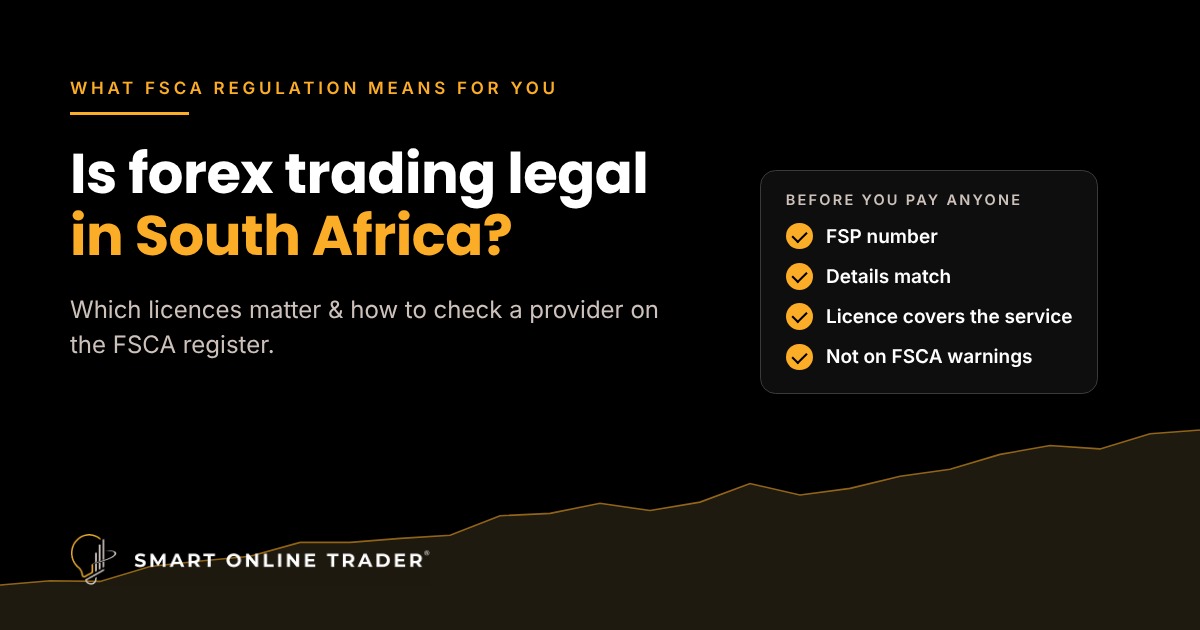
Yes, forex trading is legal in South Africa. No law stops an adult from trading currencies, and many South Africans do so online through contracts for difference (CFDs). What the law does control is who may offer you that service. Anyone who gives financial advice, arranges trades or manages money for you must be authorised by the Financial Sector Conduct Authority (FSCA), and a firm that issues CFDs to you must hold its own licence as well. Checking those licences before you pay anyone is the most important step you can take.
This guide explains what FSCA regulation means for you in practice: which licences matter, how to check a provider on the FSCA register, and the warning signs of unregistered schemes. If you are new to forex itself, start with our plain-language guide: What Is Forex Trading? A Guide for South Africans.
Is Forex Trading Legal in South Africa? The Short Answer
Trading forex is legal. Offering forex services to the public without the right authorisation is not.
That difference matters because many of the problems the FSCA warns the public about do not come from the market itself. They come from people who were never allowed to offer the service in the first place: unlicensed "account managers", social media groups selling trade calls, and platforms that disappear with deposits.
The law that sets this line is the Financial Advisory and Intermediary Services Act (FAIS Act). Section 7 says a person may not act, or offer to act, as a financial services provider (FSP) without a licence. CFDs on currencies are financial products under the Act, so the rule applies to anyone who advises you on them, places trades for you or manages an account on your behalf.
What the FSCA Does
The FSCA is South Africa's market conduct regulator. In everyday terms, it decides who may sell financial products and services to the public, sets the rules for how they must treat clients, and acts against those who break them.
For forex traders, three parts of its work are useful to know:
- Authorisation. The FSCA licenses financial services providers and keeps a public register you can search.
- Warnings. It publishes public warnings about people and businesses offering financial services without authorisation. In September and October 2026 alone, its news page listed warnings against several forex "institutes", forex trading companies and impersonators of licensed firms.
- Enforcement. It can fine, debar and withdraw licences. In October 2024 the FSCA fined a person R1 015 315.87 and debarred him for 10 years for providing trade calls without an FSP licence.
What the FSCA does not do is protect you from market losses. A licensed provider can still offer products that lose you money. Regulation tells you that a firm is allowed to operate and must follow conduct rules. It does not make trading safe.
Which Licences a Forex Provider Needs
Different roles in forex need different authorisation. A simple way to think about it:
- A firm that issues CFDs to you, as the other party to your trade, must be authorised as an over-the-counter derivative provider (ODP) under the Financial Markets Act, and hold an FSP licence.
- A firm or person that opens accounts, places trades or arranges products for you needs an FSP licence covering the right product category.
- Anyone who sends you trade calls or tells you what to buy and sell needs an FSP licence, because advice is a financial service.
- Anyone who trades on your account for you, including copy trading and "account management", needs an FSP licence for discretionary services (Category II).
Two points surprise many beginners.
An FSP licence alone does not allow a firm to issue CFDs. The Financial Markets Act Regulations of 2018 require firms that regularly issue or sell over-the-counter derivatives, such as CFDs, to be authorised as ODPs. In March 2024 the FSCA fined a company R10 million for offering CFDs without that authorisation, and fined the authorised FSP it worked under as well.
Trade calls and account management are regulated services. If someone offers to "trade for you", sends paid buy and sell calls or runs a copy-trading account you can join, ask for their FSP number and check that it covers what they are doing.
How to Check a Provider on the FSCA Register
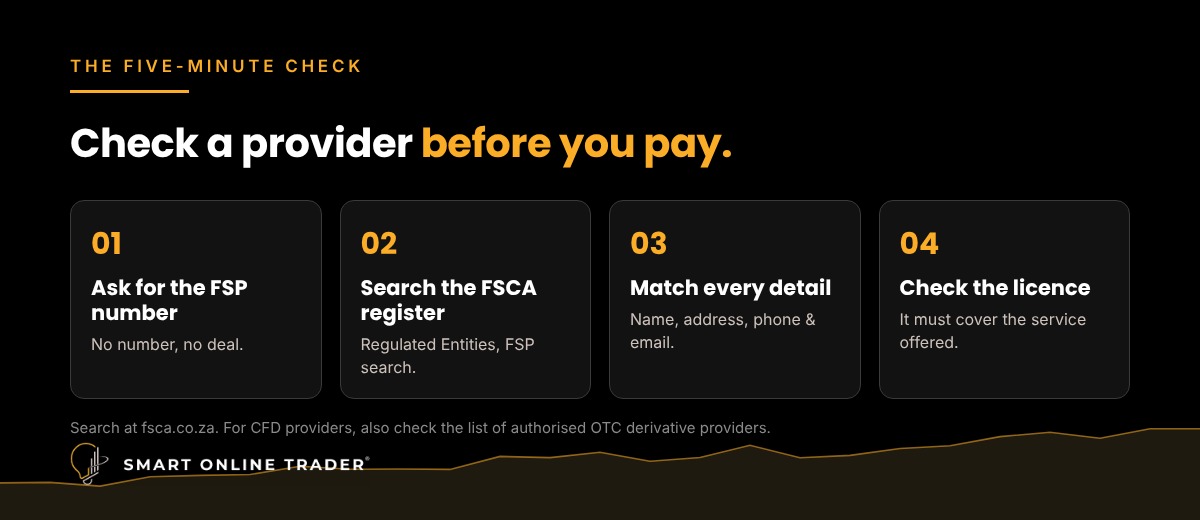
Checking takes about five minutes. Do it before you send any money, and repeat it whenever a provider asks you to pay somewhere new.
- Ask for the FSP number. Authorised providers must show their authorisation status in their documentation, usually as "an authorised financial services provider, FSP number ...". If a provider cannot or will not give you a number, stop there.
- Search the FSCA register. On the FSCA website, open Regulated Entities and use the FSP search. Search by FSP number or by the company's registered name.
- Check that the details match. Compare the company name, FSP number, physical address and contact details with what the provider gave you. Scammers often use the name and number of a real, licensed firm and change only the phone number, email address or bank account.
- Check the licence covers the service. The register shows the product categories a provider is licensed for and whether it may give advice, arrange trades or manage accounts. A licence for insurance, for example, does not cover forex.
- For CFD providers, check the ODP list. The same Regulated Entities page lists authorised OTC derivative providers.
- Read the warnings. Search the FSCA's warnings and media releases for the company and the people involved.
- Contact the official details yourself. Call or email the provider using the details on the FSCA register, not the number in the message you received, and confirm that the person contacting you really works there.
A worked example: someone messages you on Instagram offering to "manage" your trading account. They send a company name and an FSP number, and the number appears on the FSCA register. On closer inspection, the registered company has a different phone number and email address, and its licence does not include discretionary services. Those are two separate reasons to walk away, even though the FSP number itself was real.
Red Flags of Unregistered Forex Schemes
The FSCA's warnings describe the same patterns again and again. Treat any of these as a reason to stop and check:
- Promised returns, such as turning R5 000 into R50 000 in a month. No legitimate provider can promise what the market will do.
- An offer to trade or manage your account for you from someone who is not licensed for discretionary services.
- Paid trade calls in WhatsApp, Telegram or Instagram groups from people with no FSP number.
- Payment into a personal bank account, or in crypto, instead of a company account in the provider's registered name.
- Pressure and urgency: limited spots, "deposit today" or a bonus that expires tonight.
- Extra fees to withdraw, often called taxes, release fees or verification fees. Paying them almost never releases the money.
- Lifestyle marketing instead of clear information about the company, its people and its licences.
- Impersonation. Fraudsters copy the names, logos and even FSP numbers of real firms, and in some cases pretend to be the FSCA itself.
If something does not add up, report it to the FSCA through the contact details on its website. Our guide to a regulated trading environment and how to protect your funds covers what to look for in how a provider holds your money.
Offshore Brokers & Moving Money Abroad
Many forex platforms advertised to South Africans are based overseas. Some also hold an FSCA licence, and some do not. If a firm is not authorised in South Africa, you have far less recourse through South African regulators and ombuds schemes if something goes wrong.
Sending money offshore is also subject to exchange control rules set by the South African Reserve Bank (SARB). Your bank or authorised dealer applies those rules, including the annual allowances for individuals, which can change from year to year. Before funding an account abroad, ask your bank which allowance the transfer counts against and what documents it needs.
What Regulation Does Not Do
FSCA authorisation is the minimum standard, not a recommendation. It does not mean a product suits you, that the costs are reasonable or that you will make money. CFDs are leveraged products, and most retail traders lose money on them.
That is why choosing a licensed provider is only half the job. The other half is understanding what you are trading, managing risk from your first trade and never trading with money you cannot afford to lose. Read our risk warning & disclaimer for the main risks in plain language.
The same thinking applies to education. Smart Online Trader is an education provider, not a licensed financial services provider: we teach how markets and risk work, and we never tell members what to trade. If you are comparing courses, our guide on how to choose an online trading course in South Africa lists the questions to ask before you pay.
Regulatory information in this article was checked against FSCA and SARB publications on 16 November 2026.
Frequently asked questions
Join The Hub, free
Explore the free Bootcamp, readiness tools & resources for yourself.
Join The Hub freeREAL REWARDS
The Rewards & Rebate Programme
“Two rewards for qualifying Trader Essentials & Premium Performance Tracker members, paid monthly or upfront.”
Month 7
Qualify at the end of Month 6 for the Month 7 Halfway Reward: Trader Essentials members receive 30 days of the Premium Members channel & Strategy Suite; Premium Performance Tracker members receive a seat at the quarterly Halfway Masterclass with Damian & Luhan.
Month 13
Qualify at the end of Month 12 and renew for year 2 to receive the invoice totals paid during your 12 months as Rebate Credit to a Simulated Funded Account by the end of Month 13. The credit is non-withdrawable. Profits are shared 50/50 with the Preferred Broker; only your 50% share is withdrawable, subject to its terms.
Simulated environment throughout. Effective 12 November 2026 and subject to the Rewards & Rebate Programme terms.