
Markets & Mindset
What Is Forex Trading? A Plain-Language Guide for South Africans
Francois Oosthuizen - 9 November 2026
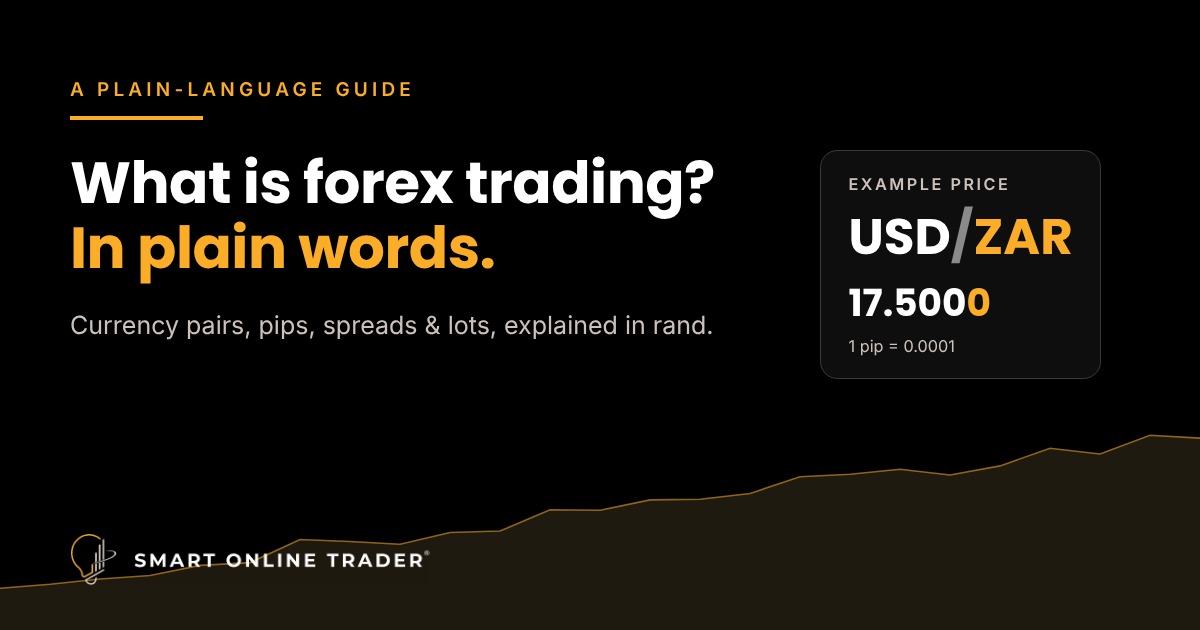
Forex trading is buying one currency while selling another, in the hope that the exchange rate between them moves in your favour. The forex (foreign exchange) market is the largest financial market in the world, and individual traders usually take part online, through a broker, often using contracts for difference (CFDs) rather than physical cash. It is open to beginners, but it carries a high risk of loss, so it is worth understanding properly before any money is involved.
This guide explains what forex trading is in plain language: how currency pairs work, what pips, spreads and lots mean in rand, who trades and why, what moves prices, and why so many beginners struggle.
What Is Forex Trading in South Africa?
Every time a currency is exchanged, someone is buying one currency and selling another. A South African importer paying a supplier in US dollars sells rand and buys dollars. A tourist leaving for London does the same with pounds. Banks, companies, investment funds and central banks do this on a far larger scale every day.
According to the Bank for International Settlements (BIS), global foreign exchange trading averaged USD 9.6 trillion a day in April 2025, and the US dollar was on one side of 89% of all trades. Most of that volume comes from institutions, not individuals.
For a beginner in South Africa, forex trading usually means opening an account with a broker and taking positions on currency prices through a trading platform. You are not collecting banknotes. You are speculating on whether one currency will rise or fall against another, with profits and losses settled in your account.
How Currency Pairs Work
Currencies are always quoted in pairs, because you can only value one currency in terms of another.
Take USD/ZAR. The first currency (USD) is the base currency. The second (ZAR) is the quote currency. A price of 17.5000 means one US dollar costs R17.50. The figures in this guide are examples, not current rates.
- If you buy USD/ZAR, you expect the dollar to strengthen against the rand.
- If you sell USD/ZAR, you expect the dollar to weaken against the rand.
Pairs are usually grouped into three kinds:
- Major pairs include the US dollar and another large economy's currency, such as EUR/USD or GBP/USD. They tend to be the most actively traded.
- Minor or cross pairs leave out the US dollar, such as EUR/GBP.
- Exotic pairs combine a major currency with the currency of a smaller or emerging economy, such as USD/ZAR. They often have wider spreads and can move sharply.
Pips, Spreads & Lots, Explained in Rand
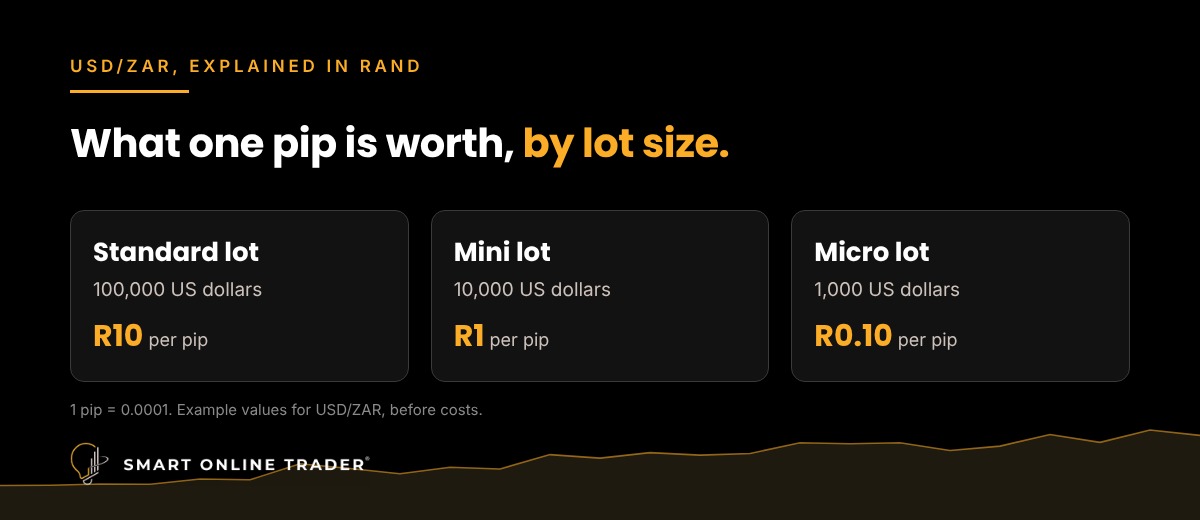
Three terms come up in your first lesson, and each one affects what a trade costs and how much you can lose.
Pip. A pip is the standard unit of price movement. For most pairs, including USD/ZAR, it is the fourth decimal place: 0.0001. If USD/ZAR moves from 17.5000 to 17.5010, it has moved 10 pips. A 10-cent move, from R17.50 to R17.60, is 1,000 pips, which shows how quickly the rand can move.
Spread. The spread is the difference between the buying price and the selling price. For example, if USD/ZAR is quoted at 17.4950 to sell and 17.5050 to buy, the spread is 100 pips. Spreads differ between providers and change with market conditions. You pay it every time you open a trade, so every position starts slightly negative.
Lot. A lot is the size of a position. A standard lot is 100,000 units of the base currency, a mini lot is 10,000 and a micro lot is 1,000. On USD/ZAR, one pip is worth R10 on a standard lot, R1 on a mini lot and R0.10 on a micro lot.
A worked example puts these together. Say you buy a micro lot (1,000 dollars) of USD/ZAR at 17.5000.
- If the price rises to 17.6000, you gain 1,000 pips × R0.10 = R100, before costs.
- If it falls to 17.4000, you lose the same R100, plus the spread you paid to open.
Now add leverage, which lets you control a position larger than your deposit. A 1,000-dollar position is worth about R17,500. With leverage of 1:100, the broker might hold only about R175 of your money as margin. A 10-cent move against you then costs R100, more than half of that margin. Leverage magnifies losses exactly as much as gains, which is why position size matters more than any strategy.
Who Trades Forex & What Moves Prices
Different participants trade for different reasons:
- Banks trade on behalf of clients and for themselves, and they set many of the prices other traders see.
- Companies exchange currency to pay suppliers and receive income from abroad, and often protect themselves against exchange rate swings.
- Investment funds buy and sell currencies when they invest in other countries.
- Central banks, such as the South African Reserve Bank, manage reserves and set interest rates that affect their currency.
- Individual traders speculate on price changes, usually through brokers and CFDs.
Prices move when the balance between buyers and sellers changes. The main drivers are:
- Interest rates. Higher interest rates, or the expectation of them, tend to make a currency more attractive to hold. Central bank decisions are among the most closely watched events.
- Economic data. Inflation, employment and growth figures change expectations about the economy and future interest rates. The monthly US jobs report is a well-known example.
- Risk appetite. When global investors become cautious, they tend to move money towards currencies seen as safer. Emerging market currencies, including the rand, often weaken in those periods.
- Commodities & trade. South Africa exports commodities such as gold and platinum group metals, so their prices and the country's trade balance can influence the rand.
- News & politics. Elections, policy changes and unexpected events can move a currency in minutes.
The forex market trades around the clock from late on Sunday to late on Friday, South African time. Activity is usually highest when the major financial centres are open, especially when London and New York overlap in the late afternoon and early evening in South Africa.
Why Most Beginners Struggle with Forex Trading
Forex looks simple on a chart, which is part of the problem. When the European Securities and Markets Authority (ESMA) restricted CFDs for retail clients in 2018, it noted that 74% to 89% of retail accounts typically lose money. The reasons are usually the same:
- Too much leverage. Small price moves become large losses relative to the account.
- No written plan. Entering on a feeling instead of predefined rules makes every decision emotional.
- No limit on losses. Without a stop loss or a daily loss limit, one bad day can undo months.
- Ignoring costs. Spreads, commissions and overnight financing add up, especially for frequent traders.
- Trading the news without understanding it. Prices can jump and spreads can widen sharply around major releases.
- Learning on live money. Practising with virtual funds first is cheaper than learning from real losses.
None of these are solved by a better indicator. They are solved by understanding the market, managing risk and practising with discipline.
How to Learn Forex Trading Properly
If you are asking where you can learn forex trading, start with an order that protects you:
- Learn the basics above until pips, spreads, lots, leverage and margin are second nature.
- Check who you are dealing with. Any broker or adviser should be authorised by the Financial Sector Conduct Authority (FSCA). Our guide to trading for beginners in South Africa shows how to check a provider on the FSCA register.
- Write your risk rules before your first trade: how much you will risk on one trade and when you stop for the day.
- Practise in a simulated account and keep a journal of every decision.
- Only then trade small amounts you can afford to lose.
A structured forex trading course can put this in the right order and give you people to ask when something does not make sense. If you are comparing options, our guide on how to choose an online trading course in South Africa lists the questions to ask before you pay. You can also explore the Smart Online Trader Performance Academy, which teaches forex and market foundations step by step, from beginner level upwards.
Frequently asked questions
Join The Hub, free
Explore the free Bootcamp, readiness tools & resources for yourself.
Join The Hub freeREAL REWARDS
The Rewards Rebate Programme
“What you invest to learn becomes what you trade with.”
Premium
A USD 5,000 simulated Prop Firm Evaluation for Premium Performance Tracker members, unlocked once you score 65 or more on the Trade Readiness Compass & have logged 20 live trades in the Trade Journal, never before month 3.
Month 13
On every tier, members who meet the programme terms receive the invoice totals they paid credited to a Simulated Funded Account. Profits are shared 50/50 & are withdrawable; the credit itself is non-withdrawable.
Simulated environment throughout. Effective 1 June 2026 and subject to the Rewards Rebate Programme terms.