Performance Academy
Trading for Beginners in South Africa: Where to Start
By Francois Oosthuizen · · Updated
If you are new to trading in South Africa, start with three things before you put any money at risk. Learn how trading works and what it really costs in rand. Check that anyone who will hold your money or tell you what to trade is authorised by the Financial Sector Conduct Authority (FSCA). Then practise in a simulated account until you can follow your own rules, and only after that trade small amounts you can afford to lose.
That order matters more than any strategy. This guide walks through each step in South African terms: the real costs in rand, what FSCA authorisation means for you, when the major markets are open in South African time, and a learning path that does not rely on luck.
What Trading Involves for a Beginner in South Africa
Trading means buying and selling financial instruments, such as currency pairs, share indices, commodities or company shares, to try to benefit from changes in price. Many beginners trade through contracts for difference (CFDs), which let you take a position on a price without owning the asset itself.
Trading is not the same as long-term investing. An investor might hold a unit trust for ten years. A trader may open and close a position within hours or days, so costs, timing and risk control matter far more.
Six terms come up from your first lesson:
- Pip: the smallest standard price step in a currency pair, for example 0.0001 in EUR/USD.
- Spread: the gap between the buying and the selling price. You pay it on every trade.
- Lot: the size of a position. A standard lot in forex is 100,000 units of the first currency in the pair.
- Leverage: exposure larger than your deposit. It magnifies losses as well as gains.
- Margin: the part of your own money set aside to keep a leveraged position open.
- Stop loss: an order that closes a position at a set price to limit the loss.
What Trading Costs in Rand
Before you open any account, list every cost you will carry. For most beginners in South Africa they fall into five groups:
- Spreads & commissions, charged on every trade, either built into the price or added separately.
- Overnight financing, usually charged on leveraged positions held past the provider's daily cut-off.
- Currency conversion. Many trading accounts, courses and tools are priced in US dollars, so the rand amount you pay moves with the exchange rate.
- Platforms, data & tools, some free, some monthly subscriptions.
- Learning, whether that is a structured course or the time it takes to teach yourself properly.
Small costs add up. Say you open a position worth $1,000 on USD/ZAR and the spread is 0.0100 rand per dollar. The spread alone costs about R10 before the price has moved. Open and close twenty positions like that in a month and spreads cost about R200, whether you win or lose. These figures are only an illustration: spreads differ between providers and change with market conditions.
The larger cost is how much you lose when trades go against you. Compare two beginners who each start with R5,000 and then lose ten trades in a row, which happens to experienced traders too:
- Risking 1% of the account on each trade, the first beginner loses about R478 and still has about R4,522.
- Risking 10% on each trade, the second loses about R3,257 and has about R1,743 left.
Same trades, same skill. The only difference is the risk rule, which is why risk management comes before any strategy.
What FSCA Regulation Means for Beginners
The FSCA was established in 2018 under the Financial Sector Regulation Act as South Africa's regulator for market conduct and the fair treatment of customers in the financial sector. For a beginner, that turns into one habit: before you deal with any company that will hold your money, give you financial advice or tell you what to buy or sell, confirm that it is licensed.
Checking takes a few minutes:
- Ask the company for its full legal name and its FSP (financial services provider) number.
- Go to the FSCA website (fsca.co.za), open Regulated Entities and choose Check if a firm is authorised to reach the FSP search.
- Confirm that the name and number match what you were given, and that the contact details are the same. The FSCA regularly warns about people who impersonate licensed firms, so a familiar name on its own is not enough.
- Look through the FSCA's latest news for public warnings about the company or the people behind it.
A trading education provider is not the same as a financial services provider. Smart Online Trader teaches how markets work and how to make your own decisions. It is not a licensed financial services provider, so it does not tell you what to trade and does not manage your money.
Walk away from anyone who promises guaranteed returns or a monthly income, pushes you to deposit quickly, asks you to pay into a personal bank account, or cannot be found on the register. If you are comparing courses, our guide on how to choose an online trading course in South Africa lists the questions to ask before you pay.
Market Hours in South African Time
South African time does not change during the year, but the United Kingdom and the United States move their clocks twice a year. The UK clocks went back on 25 October 2026 and the US clocks on 1 November 2026, so from November 2026 until the end of March 2027 the main trading hours look like this in South African time (SAST):
- Johannesburg Stock Exchange: 09:00 to 17:00.
- London Stock Exchange: 08:00 to 16:30 UK time, which is 10:00 to 18:30 SAST.
- New York Stock Exchange: 09:30 to 16:00 New York time, which is 16:30 to 23:00 SAST.
- London & New York together: 16:30 to 18:30 SAST, a stretch when activity in major currency pairs tends to be high.
The currency market itself trades around the clock from late on Sunday to late on Friday, South African time, through banks and providers around the world. Activity rises when the big financial centres open. When the UK and US move their clocks forward again in March, the London and New York times above move one hour earlier in SAST.
For a beginner, the practical point is simple. Choose practice hours that fit your life and your energy. Trading late at night after a full working day is when rules tend to slip.
Where to Start: A Realistic Learning Path
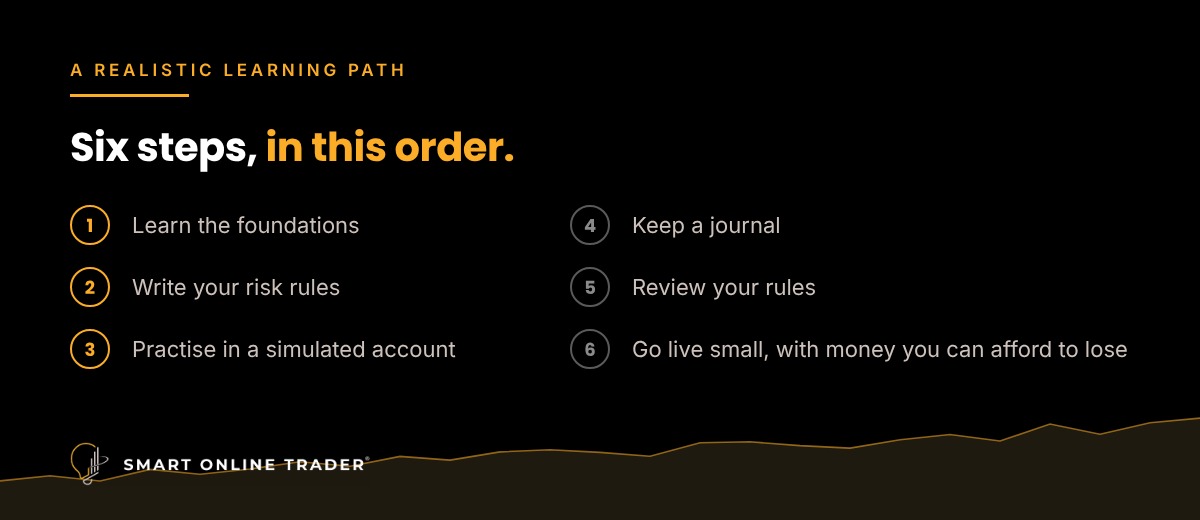
There is no shortcut, but there is a sensible order. This path works whether you learn on your own or on a course:
- Learn the foundations. How markets work, what moves prices, the terms above and how different order types behave.
- Write your risk rules before your first trade. Decide the most you will risk on one trade, the most you will lose in a day before you stop, and what you will do after a run of losses.
- Practise in a simulated account. Use virtual money so mistakes cost nothing while you learn the platform and test your rules.
- Keep a journal from day one. Record why you entered, where your stop loss was, what happened and how you felt. Our guide on how to journal trades shows what to record.
- Review before you go live. After a meaningful number of practice trades, for example 30 to 50, check one thing above all: did you follow your own rules?
- Move to small live amounts only with money you can afford to lose. Real money feels different, so keep the same rules and keep journaling.
If you would like this path laid out for you, Nebula, the Smart Online Trader foundation membership, follows the same order through the full 12-module Performance Academy, self-paced, with the Smart Online Trader Hub community alongside it. Not sure which route fits your experience? Find My Path asks four short questions and explains which route suits you, with the reasons.
You can also join the free Smart Online Trader community to ask questions and follow discussions before you decide on anything.
Frequently Asked Questions
How much money do I need to start trading in South Africa?
You can learn and practise with no money at risk by using a simulated account with virtual funds. Minimum deposits for live accounts differ between providers. Whatever the minimum is, only trade with money you can afford to lose, and start small while you test your rules with real money.
Is trading legal in South Africa?
Yes, when you deal with firms that are licensed by the Financial Sector Conduct Authority (FSCA). Before you deal with any provider, ask for its FSP number and check it with the FSP search on the FSCA website. Be wary of anyone offering to trade for you or tell you what to trade who cannot be found on the register.
What time does the forex market open in South Africa?
The currency market trades around the clock from late on Sunday to late on Friday, South African time. From November to March, the London and New York business hours overlap from about 16:30 to 18:30 SAST. From late March to October, that overlap moves one hour earlier.
Can I learn trading for free in South Africa?
You can learn the basics for free with simulated accounts and free community resources, such as the Smart Online Trader Hub. A structured course adds a clear order, support and accountability. Before you pay for one, check who runs it and what it teaches.
What should a beginner learn first?
Start with how markets work, the basic terms, and risk management. Risk rules, such as how much you will risk on one trade and when you stop for the day, matter more than any strategy in your first months. Strategies come after you can follow your own rules consistently.