
Markets & Mindset
Leverage Explained: Why It Magnifies Losses as Well as Gains
Francois Oosthuizen - 23 November 2026
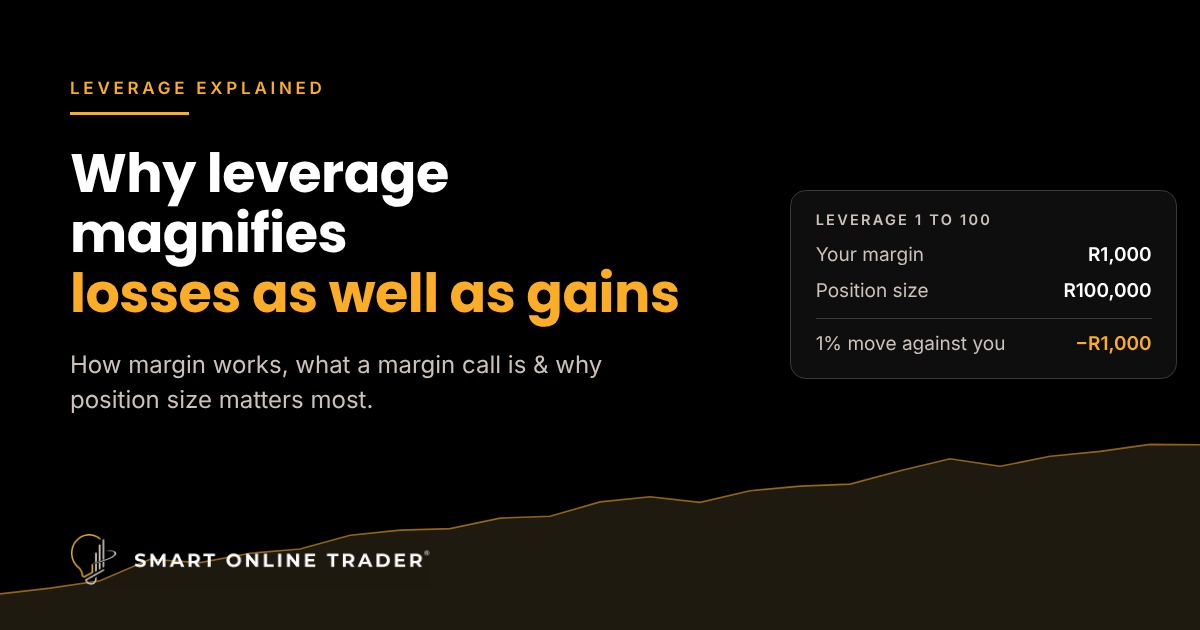
Leverage lets you control a trading position that is much bigger than the money you put down. With leverage of 1 to 100, R1,000 of your own money can open a position worth R100,000. That sounds like an advantage, but it works in both directions: every rand of profit or loss is calculated on the full R100,000, not on the R1,000 you committed.
This guide explains what leverage in trading is, how margin works, what a margin call is, and why the size of your position matters far more than the leverage your account allows. The examples use rand so you can see the numbers clearly.
What Is Leverage in Trading?
Many South Africans who trade currencies online do so through contracts for difference (CFDs). A CFD lets you take a position on a price moving up or down without owning the underlying currency, share or commodity. Because you never pay for the full position, the provider asks you to set aside only a part of its value. That part is called margin, and the relationship between the full position and the margin is called leverage.
Leverage is usually written as a ratio:
- 1 to 30 means you set aside R1 for every R30 of position, a margin of about 3.3%.
- 1 to 100 means R1 for every R100, a margin of 1%.
- 1 to 500 means R1 for every R500, a margin of 0.2%.
The higher the ratio, the less of your money is tied up for each position, and the bigger the position you can open with the same balance. The provider is not lending you profit. It is lending you exposure, and the exposure is what you are paid or charged on.
How Margin Works: A Worked Example in Rand
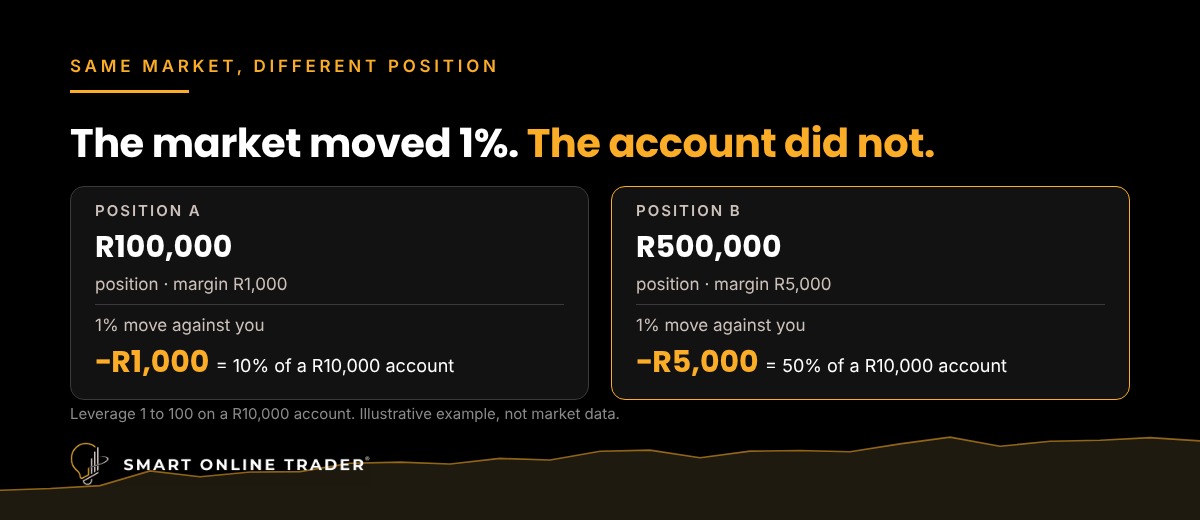
Imagine Thandi has R10,000 in her trading account. Her account allows leverage of 1 to 100, so every R100,000 of position needs R1,000 of margin.
Position A: R100,000. Thandi sets aside R1,000 as margin. If the price moves 1% against her, she loses 1% of R100,000, which is R1,000. That is 10% of her account from a 1% move.
Position B: R500,000. The account allows it, so she sets aside R5,000 as margin. Now a 1% move against her costs R5,000, half of her account. The market moved only 1%, but her balance fell 50%.
The same arithmetic works in her favour when the price moves the other way, and that is exactly why leverage is so often sold as a benefit. Nothing about the market changed between Position A and Position B. Only the size of the position changed, and with it the size of every gain and every loss.
This is the central point of this article: leverage does not change how much the market moves. It changes how much each move is worth to you.
Margin Calls & Stop-Outs: What Happens When the Market Moves Against You
While a position is open, your provider keeps checking whether your account still has enough money to support it. It does this with a figure called the margin level:
margin level = account equity ÷ margin in use × 100
Equity is your balance plus or minus the profit or loss on open positions. Each provider sets two thresholds:
- Margin call. When the margin level falls to a set point, often 100%, you are warned that your account can no longer support new positions. Some providers send a message; some simply block new trades.
- Stop-out. If the margin level keeps falling to a lower point, for example 50%, the provider starts closing your positions automatically, often starting with the largest losing position, at whatever price is available.
Go back to Thandi's Position B. She has R10,000 and R5,000 in margin. Her margin level is 200% at the start.
- After a loss of R5,000 (a 1% move), her equity is R5,000. Her margin level is 100%: margin call.
- After a loss of R7,500 (a 1.5% move), her equity is R2,500. Her margin level is 50%: if that is her provider's stop-out level, the position is closed and the loss becomes final.
A move of one and a half percent took away three quarters of her account. The exact margin call and stop-out levels differ between providers, so read them in your account terms before you place a trade, not after.
Two more things matter here. Prices can jump past your stop-loss or stop-out level, for example over a weekend or after a major economic release, so the loss can be larger than planned. And some providers offer negative balance protection, which means your account cannot go below zero, while others may not. Ask the provider in writing which applies to you.
Why Position Sizing Matters More Than Leverage
Many beginners ask, "What is the best leverage for a beginner?" It is the wrong first question. Leverage only decides how much margin a position needs. The amount you can lose on a trade is decided by two things you control: the size of the position and the distance to your stop-loss.
A simple approach used in structured trading education looks like this:
- Decide your risk per trade first. Many educators suggest risking a small, fixed share of your account on any single trade, for example 1%. On R10,000 that is R100.
- Decide where your stop-loss belongs based on the chart, not on how much you would like to win. Say it is 0.5% away from your entry price.
- Work out the position size. R100 ÷ 0.5% = R20,000. That is the position that risks R100 if the stop-loss is hit.
With leverage of 1 to 100, a R20,000 position needs R200 of margin. With leverage of 1 to 500, it needs R40. The position, the stop-loss and the R100 at risk are exactly the same in both cases. The higher leverage did not make the trade riskier; it only made it easier to open a position that is far too big.
That is why we treat leverage as a ceiling, not a target. The calculators on our trading tools page help you work through position size and the numbers behind a trade before you place it.
What Regulators Say About Leverage
Leverage is one of the main reasons regulators pay close attention to CFDs. In March 2018 the European Securities and Markets Authority (ESMA) reported that national regulators' analyses found 74% to 89% of retail CFD accounts typically lose money, with average losses per client of €1,600 to €29,000.
From 1 August 2018, ESMA restricted how CFDs could be offered to retail clients in the European Union. The measures included leverage limits of 30 to 1 for major currency pairs, 20 to 1 for non-major pairs, gold and major indices, and 2 to 1 for cryptocurrencies; a rule that positions are closed when margin falls to 50% of the required level; and negative balance protection, so retail clients cannot lose more than they put in.
Those rules were set for the European Union, not South Africa, so the leverage and protections offered to you may be very different. In South Africa, a company that issues CFDs to you must be authorised by the Financial Sector Conduct Authority (FSCA). Our guide on whether forex trading is legal in South Africa explains how to check a provider on the FSCA register before you open an account.
Before You Use Leverage: A Short Checklist
- Do you know your provider's margin call and stop-out levels, and whether negative balance protection applies?
- Have you decided your maximum risk per trade in rand before looking at the leverage on offer?
- Is your position size worked out from your stop-loss, not from your available margin?
- Do you know the other costs on a leveraged position, such as the spread and overnight financing, which can be charged on the full position value rather than on your margin?
- Have you practised the calculations until they are routine?
If any answer is no, start with learning rather than with a live account. If terms like pips, lots and spreads are still new, our plain-language guide to what forex trading is is a good place to begin. The Smart Online Trader Performance Academy then covers risk and position sizing step by step, before any strategy.
Frequently asked questions
Join The Hub, free
Explore the free Bootcamp, readiness tools & resources for yourself.
Join The Hub freeDownload the Smart Online Trader app
REAL REWARDS
The Rewards & Rebate Programme
“Two rewards for qualifying Trader Essentials & Premium Performance Tracker members, paid monthly or upfront.”
Month 7
Qualify at the end of Month 6 for the Month 7 Halfway Reward: Trader Essentials members receive 30 days of the Premium Members channel & Strategy Suite; Premium Performance Tracker members receive a seat at the quarterly Halfway Masterclass with Damian & Luhan.
Month 13
Qualify at the end of Month 12 and renew for year 2 to receive the invoice totals paid during your 12 months as Rebate Credit to a Simulated Funded Account by the end of Month 13. The credit is non-withdrawable. Profits are shared 50/50 with the Preferred Broker; only your 50% share is withdrawable, subject to its terms.
Simulated environment throughout. Effective 12 November 2026 and subject to the Rewards & Rebate Programme terms.