
The most expensive mistake in trading is not a losing trade. Instead, it is risking real money before you understand what you are doing. Every week, new traders open an account, fund it, and place a trade on a hunch, then wonder why it went wrong. So here is the honest truth about trading for beginners: your first and smartest investment is not a deposit. It is your own knowledge.
At Smart Online Trader, we built the Nebula beginner tier around exactly that idea. First you learn the foundations, then you prove you understand them, and only then do you put a plan into action. In this guide to trading for beginners, we walk through what that foundation covers, why it matters, and how you earn a certificate that marks your progress.
Why Trading for Beginners Should Start With Education, Not a Deposit
Markets reward understanding and punish guesswork. Because of that, jumping straight into live trades is a little like driving before you have learned the rules of the road. You might get lucky for a while. Eventually, though, the gaps in your knowledge catch up with you.
Education changes the odds. When you understand risk, markets, and execution, you stop reacting to every price move and start making calm, informed decisions. Moreover, you protect your capital while you learn, because you practise in a simulated environment first, with no real money on the line. That is the whole point of trading for beginners done properly: build the skill before you take the risk.
The Foundations Every Beginner Trader Needs
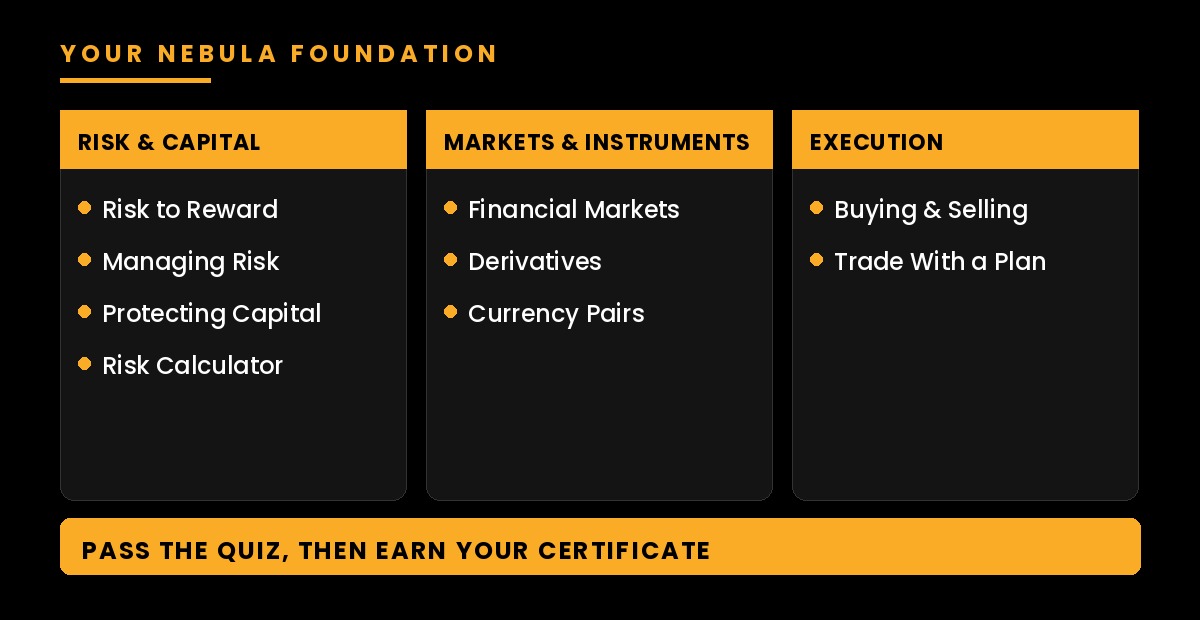
Trading for beginners works best as a clear path, so Nebula opens with a Trading Basics foundation of ten lessons, grouped into three clear themes. Together, they take you from protecting your money, to understanding the markets, to placing your first trade with confidence. The image below shows the full path at a glance.
Risk and Capital: Protect Your Money First
Good traders think about what they can lose before they think about what they can gain. So the foundation starts here. You learn the risk to reward concept, which simply compares what you risk against what you aim to gain. Then you cover managing and distributing risk, protecting your capital, and using the risk calculator to size each trade sensibly. In short, these lessons teach you to survive first, because a trader who protects their capital lives to trade another day.
Markets and Instruments: Know What You Trade
Next, you learn the landscape. The introduction to the financial markets explains how markets actually work and who moves them. From there, you explore the different types of derivative trading, and then you demystify currency pairs in forex trading. As a result, you stop seeing a confusing wall of tickers and start recognising instruments you genuinely understand. That clarity is what lets you choose what to trade, rather than gambling on the first thing you see.
Execution: Place a Trade With a Plan
Finally, you put it into practice. You master buying and selling, and then you learn to execute a trade from a defined plan, with your entry, your exit, and your risk decided in advance. Because you plan the trade before you place it, you remove emotion from the moment that matters most. Ultimately, that is the habit that separates a disciplined trader from someone chasing the market.
What About Trading Signals?
Somewhere in your first weeks, you will hear the word signal, so it is worth understanding clearly. A signal is simply a suggested entry or exit point for a trade. Our lesson on executing a trade with a defined plan teaches you to identify your own entry and exit points and to act on your own informed decision, rather than following anyone blindly.
That distinction matters for a reason. Smart Online Trader is an education provider, not a licensed Financial Services Provider, so we teach you to read the market and decide for yourself. Any ready-made market analysis comes from a licensed, regulated provider such as ATFX SA (FSCA FSP 44816), the kind of authorised firm allowed to provide it. In short, you build the skill here, and any formal analysis comes from a properly licensed source.
Test Your Knowledge, Then Earn Your Certificate
Learning only counts once you can prove it. So the Trading Basics foundation ends with a quiz that tests your wit and your wisdom across everything you have covered. When you pass, you earn a certificate that marks the milestone. It is a small thing on the surface, yet it means something real: you did not just watch the lessons, you understood them. Better still, you now have a foundation you can build on with genuine confidence.
Where Trading for Beginners Begins: The Nebula Tier
Nebula is our beginner membership tier, and it exists for one reason: to give new traders a proper start. First, you work through the foundation and earn your certificate. Then, as your skill grows, you can step up to Trader Essentials and Premium Performance Tracker, where our technical trading strategies library and deeper courses await.
Throughout, two habits carry you forward. You practise everything in a simulated environment first, and you record each trade in your Trade Journal so you learn from real data. Discipline matters just as much as knowledge here, which is why our work on trading psychology runs alongside the lessons. In other words, Nebula makes trading for beginners about more than placing orders. It teaches you to trade like a professional in training.
Join The Hub, free
Explore the modules, lessons and Trade Journal at no cost. Start the Nebula foundation for yourself, then choose the membership tier that fits your goals.
Download the Smart Online Trader App
Android / Play Store
iOS / App Store
The Rewards Rebate Programme: Months 7 and 13
Here is what makes the SOT system more than an education. Stay the course, and the programme rewards your commitment at two clear milestones.
REAL REWARDS
The Rewards Rebate Programme
“What you invest to learn becomes what you trade with.”
Month 7
A simulated $5,000 Prop Firm Evaluation activates, included with your membership. So your training meets its first real test.
Month 13
Your membership value returns to you as credit in a Simulated Funded Account, with a 50/50 split on the profits you generate.
Simulated environment throughout. Effective 1 June 2026 and subject to the Rewards Rebate Programme terms.
Frequently Asked Questions
Where should trading for beginners start?
It should start with education, not a deposit. First, learn risk, markets, and execution, and practise in a simulated environment. Then, once you understand the foundations, you can approach live decisions with a clear plan rather than a guess.
What does the Nebula foundation cover?
The Trading Basics foundation covers ten lessons across three themes: risk and capital, markets and instruments, and execution. In addition, it ends with a quiz, and you earn a certificate when you pass.
Do I need any experience to join Nebula?
No. Nebula is our beginner tier, so it assumes you are starting from scratch. Better still, you practise everything in a simulated environment first, with no real capital at risk while you learn.
Does Smart Online Trader give trading signals?
No. We are an education provider, so we teach you to read the market and make your own decisions. Any ready-made market analysis comes from a licensed, regulated provider such as ATFX SA (FSCA FSP 44816), not from an education provider.
Do I earn a certificate?
Yes. When you pass the Trading Basics quiz, you earn a certificate that marks your progress. It shows you have understood the foundation and are ready to build on it.
What comes after the beginner tier?
As your skill grows, you can step up to Trader Essentials and Premium Performance Tracker. There, you unlock deeper courses and the full technical trading strategies library, along with the Trade Readiness Compass.
How do I start?
First, download the Smart Online Trader app or join The Hub online. Then explore the free modules and your Trade Journal. Finally, enrol in Nebula to begin the Trading Basics foundation.
Smart Online Trader and its employees are not licensed Financial Services Providers (FSPs). This content is for educational purposes only and does not constitute financial or investment advice. No trading strategy guarantees a profit, and all trading carries the risk of loss. Always consult an authorised FSP before making any trading or investment decisions.
