
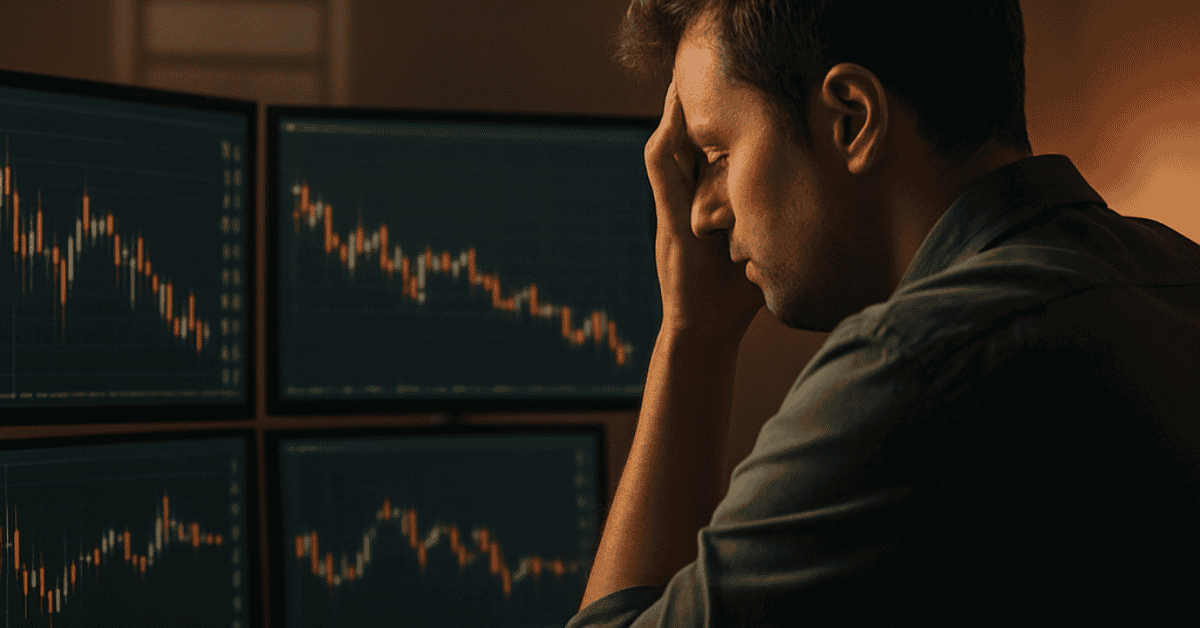
Decision Fatigue – One Of The Culprets When Your 7th Trade Is Worse Than Your First. How to Build Systems That Could Reduce That Fatigue Load.
.Imagine this: You start your trading day sharp, focused, calm. You break down the charts, mark your levels, analyse the trend, and pick your first trade of the day. It goes well – whether it wins or loses, you executed it cleanly. You feel in control.
Fast-forward a few hours: You’re five, six, seven decisions deep. You’ve scanned dozens of candles, debated longs vs shorts, moved stops, sized positions, ignored distractions, battled internal urges, reassessed bias, and maybe taken two or three trades already.
Now you see a new setup forming. You think you’re analysing it the same way you did the first one… But you’re not. Not even close.
Your brain is slower, discipline is weaker, emotional resistance is lower, attention span is shorter and your judgement is compromised. And you don’t even realise it.
This is the invisible force that quietly ruins traders – not lack of skill, not market volatility, not poor systems – but a much sneakier enemy: Decision Fatigue.
IMPORTANT NOTICE: Educational content only – not financial- or investment advice. Outcomes vary, apply these ideas as performance training (including in simulated environments).
It’s the silent assassin of your trading performance. And most traders have absolutely no idea it’s destroying them… until their results show it.
Decision Fatigue: The Psychological Leak No One Talks About
If you’ve ever found yourself:
- Overtrading late in the session
- Revenge trading after a loss
- Entering “meh” setups you would never take in the morning
- Letting bad trades run
- Closing good trades early
- Breaking your rules “just this once”
- Feeling mentally foggy or emotionally unstable after a few hours
…you’ve experienced decision fatigue.
But to understand how dangerous it truly is for traders, we need to unpack what it does to your brain on a biological level.
Your Decision-Making Power Is a Finite Battery
Every decision you make – whether it’s choosing a trade or choosing what to eat – drains your brain’s executive function.
This “executive function” is largely associated with the prefrontal cortex, the part of your brain responsible for:
- Logic
- Risk assessment
- Impulse control
- Long-term planning
- Discipline
- Patience
It’s the same part of your brain that keeps your trading stable and rational.
But it has a limited daily capacity. Every decision takes a withdrawal from the account.
And in trading, you make dozens – sometimes hundreds – of micro-decisions per session:
- Is this trend legitimate or a fake-out?
- Should I enter here or wait?
- Do I move my stop-loss?
- Do I scale in?
- Is the news going to affect this?
- Does this candle confirm or invalidate my bias?
- Should I skip this?
- Do I close early because it’s stalling?
Each one sounds small. But mentally, they are expensive.
By the time you’re making your 7th trade decision, the battery is already drained. And here’s the terrifying part: You don’t notice the battery draining. But your results do.
The Quality of Your Trading Decisions Declines Sequentially
Your first trade of the day is often your cleanest. Your last trade of the day is often your sloppiest.
Why? Because decision fatigue reduces:
- Willpower: You stop fighting urges (FOMO, revenge trading, overtrading).
- Analytical sharpness: Your chart-reading becomes more emotional and less logical.
- Emotional stability: You become more reactive, more fearful, more irrational.
- Patience: You take setups too early or too late.
- Risk management discipline: You size incorrectly or fail to manage stops.
- Rule-following behaviour: You start improvising, which is code for self-sabotage.
The 7th trade isn’t worse because the setup is worse. It’s worse because your mind is degraded.
Decision fatigue doesn’t attack your strategy. It attacks you, the executor of the strategy.
The Myth of “I Just Need More Discipline”
Most traders blame themselves: “I need more discipline.”
But what you actually need is fewer decisions.
Discipline is not a personality trait – it’s a resource. And decision fatigue depletes it.
Even elite traders with decades of experience don’t rely on discipline alone. Why? Because they know the brain has limits.
Retail traders try to brute-force their way through entire sessions using willpower – and then wonder why they crumble after a few hours.
Professionals do the opposite. They build systems that minimise decision-making and maximise consistency.
That’s the difference between trading like a professional, and trading like prey.
Why Decision Fatigue Hits Traders Harder Than Almost Any Other Profession
Trading has a unique combination of factors that make decision fatigue hit like a sledgehammer:
- Uncertainty every second: Doctors, pilots, and engineers work with more structured decision protocols; markets don’t give that luxury, and ambiguity drains mental energy rapidly.
- Emotional risk in every decision: You’re not just analysing; you’re risking capital and personal exposure (or performance outcomes in simulation), and high stakes = high cognitive load.
- Rapid-fire information flow: Charts are constantly moving, and that constant flux forces continuous micro-decisions.
- Long periods of boredom punctuated by burst decisions: This mismatch is exhausting and makes poor decisions more likely over time.
- Self-control is required all the time: Your brain is constantly saying “don’t chase,” “don’t overtrade,” “don’t interfere with your stop,” “stick to your plan,” and self-control burns mental fuel faster than analysis.
- The illusion of opportunity: Every candle can feel like a chance to act, and your brain has to fight temptation repeatedly.
That’s not normal. Humans didn’t evolve to handle that kind of decision environment. So without systems, your brain collapses under the weight.
This Is Why Many Traders Lose After a Winning Streak
Ever notice this pattern? Win → Win → Win → Dumb Loss → Tilt → Bigger Loss
This is not always a strategy failure. It’s not always a skill failure. It’s decision fatigue masquerading as stupidity.
Your first few winning trades use up concentration. Then, just when you think you’re performing well, the mental crash hits.
Your brain goes into:
- Autopilot
- Impulsive mode
- Overconfidence
- Sloppy execution
And you ruin the day.
It’s not that you’re a bad trader. It’s that you’re trading after your brain has clocked out.
How To Build Systems That Reduce Decision Load – The professional-grade approach many traders benefit from
If you want to trade like a pro, stop trying to “work harder” and start designing an environment where fewer decisions are required.
Here’s how:
1) Pre-Session Automation – Decide Before The Market Opens: Professional traders make most of their decisions before the session even begins. Your pre-session routine should determine:
- Which markets you’re trading
- The direction you’re biased toward
- Your kill zones
- Your key levels
- Max number of trades
- Risk per trade
- High-probability setups for the day
- What would invalidate your plan
When you start the session, you should already know: “If A happens, I do B. If C happens, I do nothing.” Not: “Let me see how I feel in the moment.” That is the gateway to self-destruction.
2) Reduce The Number of Setups You Trade: Most traders think more setups = more opportunity. Wrong. More setups = more decisions = more fatigue = worse outcomes. Trade fewer patterns – but master them. Reduce choice, improve precision.
3) Set a Daily Trade Limit: This is the simplest, most effective fatigue-control tool. Example:
- Max 3 trades per day
- Max 1 loss in a row before stopping
- Max 2 wins before walking away
Not because the market requires it, but because your brain does.
4) Use Checklists Like a Pilot: Pilots don’t rely on memory. Surgeons don’t rely on memory. Elite traders shouldn’t either. Create a checklist:
- Trend aligned?
- Level respected?
- Volume confirming?
- Liquidity taken?
- Risk-to-reward acceptable?
- Time-of-day appropriate?
If the setup doesn’t pass the checklist, you don’t take it. This removes emotion and reduces decision burden.
5) Standardise Your Trade Management: Stop improvising in real-time. This is where most traders leak discipline. Define in advance:
- When you move stops
- When you take partials
- How you trail the trade
- When you exit early
- When you do NOTHING
Every micro-decision you automate saves your brain for the decisions that actually matter.
6) Schedule Mandatory Breaks: Every high-performance profession uses rotation and rest. Traders? They sit for 6 hours straight staring at blinking candles and wonder why they lose sanity. Take breaks:
- 5 minutes every 45 minutes
- 15 minutes every 2 hours
- Breathe
- Hydrate
- Reset your focus
You return sharper.
7) Trade Less Frequently, With Higher Quality: The more often you trade, the worse your average trade becomes. Your edge is in precision – not volume. Great traders are snipers, not machine-gunners. Fewer decisions = fewer mistakes.
8) Build a Mechanical System – Even If You Trade Discretionary: Your system should be rule-based, structured, checklist-driven, and objective. Even if you use discretion, limit it to specific, predefined situations. Discretion without rules is chaos.
9) Stop Watching Every Candle: Constant monitoring is mental torture. Zoom out. Set alerts. Watch key levels – not noise. Your brain cannot handle infinite micro-decisions without slipping into emotional mode.
10) End the Session Early When You’re Mentally Spent: Professionals stop when they’re done – not when the market is done. Your mental state determines your trading quality. If you’re fatigued, stressed, annoyed, emotional, bored, or overly hyped: Stop trading. The market will be here tomorrow. Your capital should be too.
The Real Secret: The Market Doesn’t Beat You – Your Brain Does
Retail traders lose not because the market is too complex – but because the human mind is too fragile for constant, high-stakes decision-making.
Experienced traders stay consistent not because they’re smarter – but because they’ve designed systems that protect their brain from itself.
That’s the essence of elite trading.
The market is a battlefield. Your strategy is the weapon. But your MIND is the soldier. If the soldier is exhausted, the weapon doesn’t matter!
Reduce decisions. Automate your process. Limit your exposure to mental drain. And you may find it easier to stay consistent over time.
Decision fatigue is the silent killer of trading accounts. But once you understand it, and build systems to defeat it, you support the performance level every trader dreams of.
Reference: Cognitive fatigue affects judgement and performance; see “Don’t Make Important Decisions Late in the Day.” Read
