
How To Win the future of online trading safely starts with an uncomfortable truth: the next decade won’t reward the loudest strategies – it will reward the most governed behaviour.
Online trading is moving from a “tools-and-tactics” era to a design-and-governance era. In other words, your edge won’t come only from what you know about charts – it will come from the environment you trade in, the guardrails around you, and your ability to remain consistent when the platform is trying to get your attention.
That shift is already visible in regulation and research: authorities are focusing on digital engagement practices (nudges, notifications, gamification), and whether app design increases trading frequency and risk-taking.
Definition Box
Digital Engagement Practices (DEPs): digital techniques used by platforms to influence user behaviour – such as notifications, prompts (“nudges”), default settings, and gamification-style features.
The Big Trend: Platforms Will Add Guardrails (Not Just Features)
For years, the retail industry competed on:
- lower friction,
- faster onboarding,
- more leverage,
- more alerts,
- more “fun.”
Now regulators and consumer-protection frameworks are pushing the opposite direction: more clarity, fewer harmful design tricks, and better outcomes for retail users.
A clear example is the UK FCA repeatedly warning that trading apps must review game-like design features and meet higher consumer protection expectations.
IOSCO has also published major work on DEPs, explicitly naming gamification and nudges as part of the modern market-intermediary landscape.
Translation: the future won’t be “no rules.” The future will be rules baked into the experience.
Why This Matters: Behaviour Is the Real Risk Asset
Most traders don’t fail because they lack information.
They fail because their behaviour becomes unstable under pressure:
- a small drawdown triggers urgency,
- urgency triggers overtrading,
- overtrading triggers risk creep,
- risk creep ends the account.
DEPs can intensify that loop. The FCA’s research on DEPs used by trading apps found these practices can increase trading frequency and consumer risk-taking.
So the future question isn’t “What indicator should I use?”
It’s: What environment keeps my behaviour stable?
What’s Likely to Change in the Next 3 to 5 Years
1) Less “casino UX,” more consumer-duty UX
Design patterns that feel like gaming-leaderboards, streaks, confetti, constant push prompts – are increasingly treated as a consumer-risk concern. The FCA has publicly said it keeps trading apps under review over gaming concerns, tying expectations to Consumer Duty outcomes.
Expected direction: clearer disclosures, calmer interfaces, fewer manipulative nudges, and more testing of customer outcomes.
2) More product intervention and leverage constraints (globally)
Europe has already used product intervention to restrict CFDs and add protections like leverage limits and negative balance protection.
And national regulators continue to extend product interventions to other high-risk instruments (example: ESMA opinions on national measures).
Expected direction: more restrictions on incentives, clearer warnings, and tighter controls on products that amplify losses.
3) “AI that predicts you,” not AI that predicts markets
A lot of retail AI marketing suggests market prediction. That’s mostly noise.
The more realistic future is AI used for:
- detecting overtrading patterns,
- flagging risk drift,
- identifying emotional cycles,
- enforcing cooling-off periods,
- adapting education prompts based on behaviour.
Regulators have also been exploring conflicts around predictive engagement technologies – though it’s worth noting the SEC formally withdrew certain proposed rules in June 2025, showing how these initiatives can evolve or reset over time.
Expected direction: AI becomes a behavioural risk-management layer – first for platforms, then for serious traders.
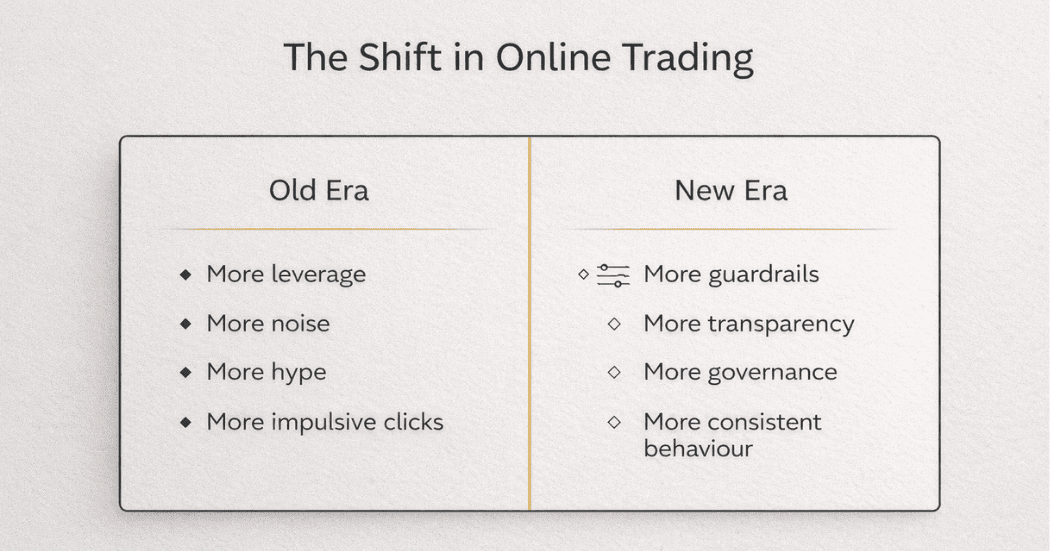
The New Edge: Governance Beats Confidence
In the old era, traders chased confidence:
- “I need to believe more.”
- “I must get better quality signals.”
- “I need to get instant profits.”
In the new era, the winners will be the traders who operate inside a governed system:
- fixed risk ceilings,
- pre-commitment rules,
- stop-trading triggers,
- journaling and accountability,
- fewer discretionary decisions.
Because when the platform nudges you to act, governance is what stops you from reacting.
What This Means for Traders
If you want to thrive in the future, shift your identity from “I’m a trader” to:
“I’m an operator of a system.”
Here’s the practical pivot:
The Behaviour-Governed Trading Stack
- A pre-session plan (what you will trade, and what you will not)
- Hard risk limits (per trade + per day)
- A mistake protocol (what you do after a rule slip)
- A stop-trading decision tree (clear triggers, no negotiation)
- A weekly scorecard (process metrics, not P&L obsession)
This is the direction serious platforms and serious traders are converging toward: fewer impulsive actions, more controlled behaviour.
If you want a structured, behaviour-first approach (not hype), start here: https://smartonlinetrader.com/
Key Takeaways
- The future of online trading is moving toward governance, guardrails, and better consumer outcomes.
- DEPs (nudges/gamification/notifications) can increase trading frequency and risk-taking, so design matters.
- Product intervention (like CFD restrictions) shows the long-term direction: tighter retail protections.
- AI’s most practical role is behaviour monitoring, not market prediction.
- The durable edge will be process consistency, not confidence.
FAQs People Also Ask
1) What is the future of online trading likely to look like?
More rules and guardrails inside platforms, stronger consumer-protection expectations, and more scrutiny of app design features that drive harmful behaviour.
2) What are digital engagement practices (DEPs)?
DEPs are design and communication techniques like nudges, notifications, defaults, and gamification used to influence user behaviour on digital platforms.
3) Why are regulators paying attention to trading app design?
Because some DEPs can increase trading frequency and risk-taking and may harm consumer outcomes—especially for vulnerable users.
4) Will leverage limits and product restrictions increase?
In many jurisdictions, the direction has been toward tighter retail protections – Europe’s CFD measures are a major example of product intervention in practice.
5) Will AI replace human traders?
AI is more likely to become a behavioural layer, helping detect risk drift, overtrading, and emotional decision cycles, than a reliable market-prediction machine.
6) What should a retail trader focus on to survive the next decade?
A governed process: risk limits, fewer discretionary decisions, journaling, and stop-trading rules, so behaviour stays stable even when emotions change.
If you want to build a trading routine that prioritises structure, risk discipline, and consistent execution (not hype), explore Smart Online Trader’s education and mentoring pathways.
Compliance Notice:
This article is for educational purposes only and does not constitute financial advice, a recommendation, or a solicitation to trade. Trading involves risk and outcomes vary. Always ensure you understand product rules, fees, and risks before participating.
