
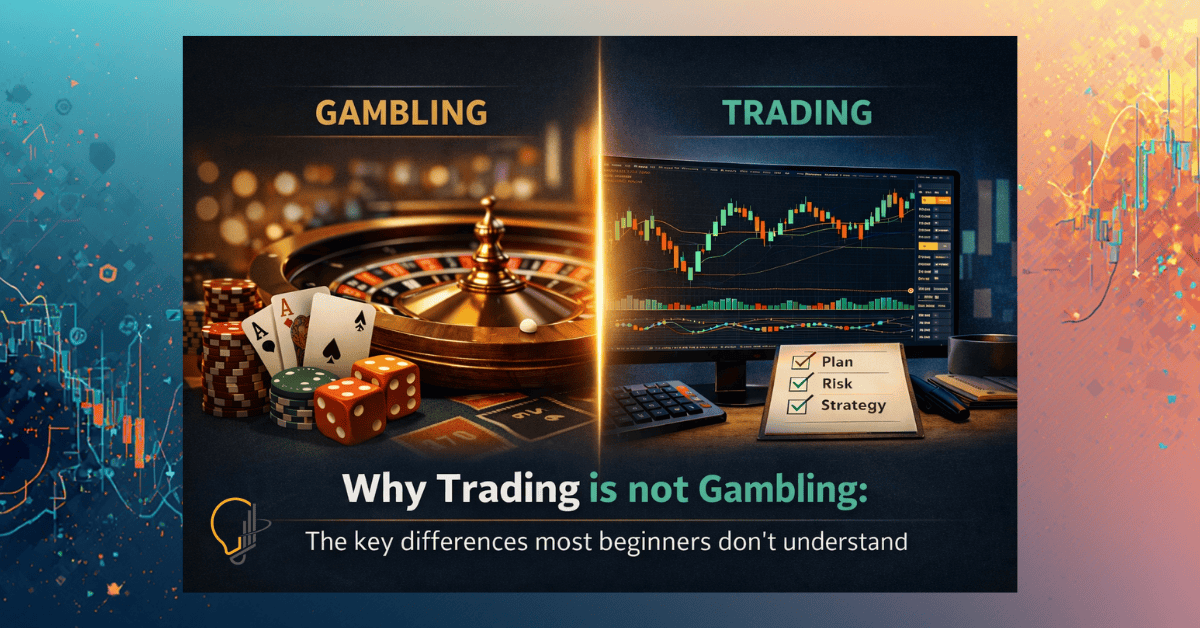
Trading vs Gambling. The key differences most beginners don’t understand. If you’re skeptical about trading, you’re not wrong to be cautious.
The internet is flooded with screenshots of luxury cars, overnight profits, and people claiming trading is “easy money.” Add the very real stories of scams, blown accounts, and people losing savings – and suddenly trading looks no different from walking into a casino and hoping for the best.
But here’s the uncomfortable truth most people never explain properly:
Trading can look like gambling – but professional trading is fundamentally different.
The confusion comes from not understanding where the line is.
Let’s clear that up.
Definition Box
Gambling is a wager where outcomes are primarily driven by chance and fixed odds set by the house.
Professional trading is a risk-managed decision process based on repeatable rules, where outcomes are uncertain but managed through probability, position sizing, and disciplined execution.
Why Trading Feels Like Gambling at First
Beginners usually experience trading in the worst possible way:
- No structured education
- Lack of risk rules
- Fail to plan
- Decisions driven by fear or excitement
In that state, trading is gambling.
Clicking “buy” because someone on social media said a market will “moon” is no different from betting on red at a roulette table. The outcome becomes random because your decision-making is random.
This is where most people get burned – and where the fear comes from.
But that’s not what professional trading actually looks like.
Gambling Depends on Luck. Trading Depends on Probability.
Gambling often works like this:
- You don’t control the odds
- The house always has an edge
- Outcomes are independent and mostly random
- You can’t meaningfully improve your probability with skill
Trading, done properly, works differently:
- You define your risk before entering
- You trade based on repeatable setups and rules
- Outcomes are uncertain, but not “purely random”
- Skill improves execution quality and consistency over time
A professional trader doesn’t ask, “Will this trade win?”
They ask: “Does this setup give me a statistical edge over the next 50 to 100 trades?”
That shift in thinking is everything.
Risk Is the Core Difference Most Beginners Miss
In gambling, risk is fixed and unavoidable. You place a bet and accept whatever happens.
In trading:
- You choose how much you’re willing to lose
- You decide where you’re wrong before entering
- One loss does not wipe you out
- Survival is the first priority
A disciplined trader might risk 1% (or less) of their capital on a single trade. That means even a losing streak doesn’t automatically end their journey.
Scams rarely talk about risk.
Professionals obsess over it.
If you want a practical starting point, begin with a structured risk foundation like the Essential Trading Risk and Safety Checklist before you worry about strategies.
Scammers Promise Certainty. Traders Accept Uncertainty.
This is a big one.
If someone promises:
- Guaranteed profits
- “No-loss” systems
- Daily fixed income
- Secret indicators
That’s not trading. That’s manipulation.
Real trading accepts uncertainty upfront:
- Losses are expected
- Drawdowns are normal
- Consistency is built over time – not overnight
Ironically, accepting uncertainty is what reduces long-term damage, because it forces you to plan for risk instead of pretending it doesn’t exist.
Trading Is a Skill, Not an Event
Gambling is an event:
You win or lose, and it’s over.
Trading is a process:
- You journal trades
- Review mistakes
- Refine execution
- Improve discipline
No professional trader judges success based on one trade. They judge it based on behavior, consistency, and adherence to rules.This is why proper education focuses less on “signals” and more on decision-making under pressure – something we emphasize inside the Smart Online Trader ecosystem.
Why Skepticism Is Actually a Strength
If you’re afraid of being scammed, that’s good.
If you’re cautious about risk, that’s healthy.
The goal isn’t to remove fear – it’s to replace blind fear with informed control.
When you understand:
- how risk is managed
- why losses happen
- what realistic expectations look like
Trading stops feeling like a gamble and starts feeling like a structured skill – similar to running a business where not every decision is profitable, but the system is designed to survive and improve over time.
Many beginners struggle to separate emotion from probability. Independent educational platforms like Investopedia’s trading education explain this distinction clearly: gambling relies on fixed odds and chance, while trading – when done correctly – is built around managing risk, applying repeatable rules, and accepting uncertainty as part of the process.
If you’re new, the safest first step is learning risk, position sizing, and rule-based execution before trying to “be right.”
If you want guided structure and accountability, explore mentoring support via Smart Online Trader’s mentor pathway.
The Bottom Line
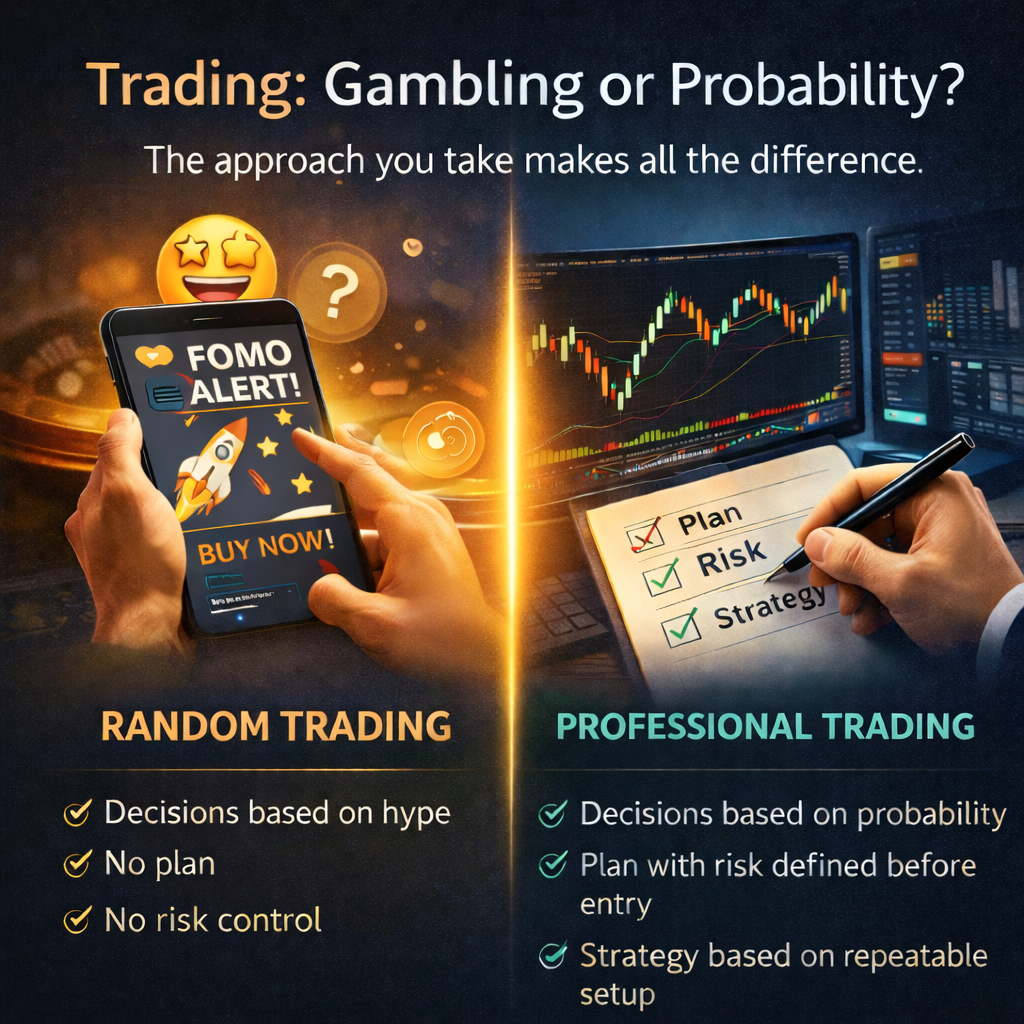
Trading becomes gambling when:
- There’s no plan
- No education
- No risk control
- And emotions run the show
Trading becomes professional when:
- Risk is defined first
- Decisions are repeatable
- Losses are managed
- And discipline matters more than excitement
The real danger isn’t trading itself.
The danger is entering it without understanding the difference.
If you take one thing away from this:
Any approach that avoids talking about risk, losses, and psychology isn’t protecting you – it’s setting you up.
And knowing that already puts you ahead of most beginners.
Frequently Asked Questions (FAQ)
Is trading safe for beginners?
Trading always involves risk. However, risk can be controlled. Beginners who start with proper education, small risk, and strict rules dramatically reduce the chance of catastrophic loss. Most people who get hurt skip structure entirely.
Can I lose all my money when trading?
Yes, if you trade without risk management. Professional traders limit how much they can lose on any single trade. When risk is controlled, losses are manageable and survivable. Blown accounts are almost always the result of over-risking, not bad luck.
How do I know if a trading opportunity is a scam?
Be cautious of anyone who:
- Guarantees profits
- Claims “no losses”
- Shows only wins and never losses
- Pressures you to act quickly
- Avoids explaining risk
Legitimate trading education focuses on process, discipline, and risk – not hype or urgency.
Do I need a lot of money to start trading?
No. What you need more than money is time and discipline. Many traders start small specifically to focus on learning, not earning. Starting small protects you while you build skill.
How long does it take to become profitable?
There is no fixed timeline. Some people improve within months; others take years. Profitability depends less on intelligence and more on consistency, emotional control, and following rules under pressure. Anyone promising fast, guaranteed results is not being honest.
If you want a safer path, start with a governed routine: plan > execute > journal > review. Structure beats hype – every time! Learn more about the structured pathway at Smart Online Trader.
