
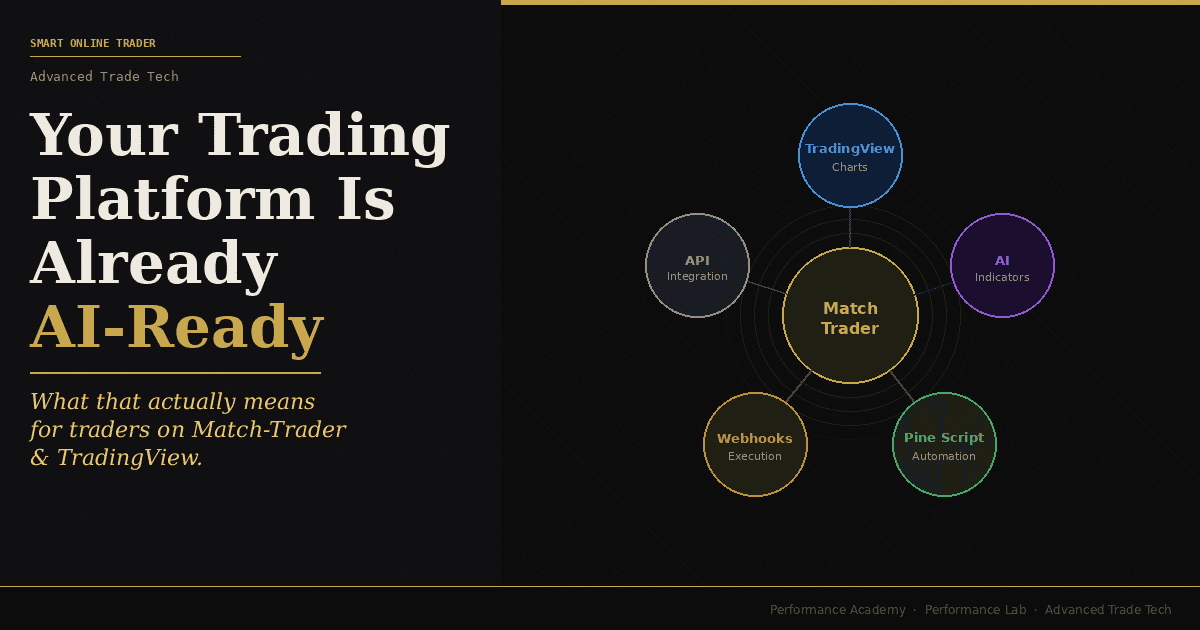
AI tools in trading is already used in the platform our Students and Traders use. Here’s what that actually includes:
If you have been wondering how to use AI tools in trading without falling for the hype, the answer is closer than you think – and it starts with the platform you are already using. The conversation around artificial intelligence in financial markets has reached a deafening level in 2025 and 2026.
Every trading educator, every prop firm marketing team, and every fintech startup is talking about AI. Most of what they are saying is either exaggerated, misunderstood, or – in the worst cases – dangerously misleading for retail and evaluation traders.
This article cuts through all of it. We are going to look at what AI in trading genuinely is, what Match-Trader’s technology actually enables right now, which AI tools layer onto it in ways that add real value to your process. And, critically, which AI applications you should avoid entirely if you are trading in a structured or funded environment.
Everything in this article is verified, factual, and grounded in what is available today.
The AI Trading Revolution – What the Numbers Actually Say
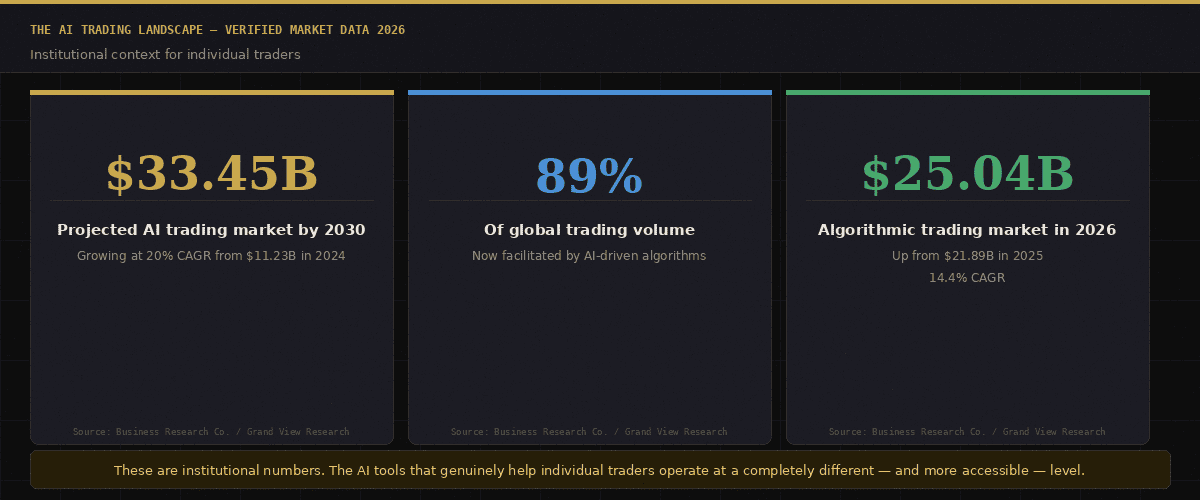
The scale of AI’s presence in financial markets is real and it is large. The global AI trading platform market was approximately $11.23 billion in 2024 and is projected to reach $33.45 billion by 2030, growing at roughly 20% per year.
The algorithmic trading market – which includes AI-driven execution systems – is already at $25.04 billion in 2026. AI-driven algorithms now facilitate close to 89% of global trading volume.
Those are institutional numbers. They describe the infrastructure of hedge funds, investment banks, and high-frequency trading desks – systems built by teams of quantitative analysts and engineers with budgets measured in the tens of millions.
When a retail or prop firm trader hears “AI in trading” and imagines they can replicate that edge with a $50-per-month subscription to an app, they are looking at a fundamentally different category of technology.
That does not mean AI is irrelevant for individual traders. It means the honest question is not “can AI trade for me?” but rather “which AI tools genuinely assist my process, reduce my errors, and strengthen my decision-making?” Those are two very different questions, and they have very different answers.
The good news is that for traders operating on a modern platform like Match-Trader, with TradingView fully integrated, the AI toolkit available to you right now is more powerful than most traders realise – as long as you know where to look and how to use it correctly.
What Match-Trader Actually Is – And Why It Puts You Further Ahead Than You Think
Before discussing AI integration, it is worth establishing what Match-Trader genuinely is – because it is widely misunderstood by the traders using it.
Match-Trader is not simply a prop firm challenge platform. It is a full trading technology ecosystem developed by Match-Trade Technologies, a company with over a decade of experience in financial technology. In 2025 alone, Match-Trade onboarded over 160 brokers and prop firms onto the platform and reached 1.8 million registered trader accounts globally.
The platform has been recognised as the Best Multi-Asset Trading Platform by Forex Awards and Ultimate Fintech awards, and it is the technology powering some of the fastest-growing funded trading firms in the world, including the broker that powers the Smart Online Trader Performance Lab, QuickTrade.World.
One Platform. Everything Synced.
What makes Match-Trader technically superior to legacy platforms like MetaTrader 4 is its architecture. It is built as a Progressive Web App, which means your trading environment – your charts, your open positions, your account data, your settings – are synchronised across your desktop, browser, and mobile device in real time. There is no separate app for your phone and a different one for your desktop. Everything is the same account, the same interface, the same live data, everywhere you log in. This matters for AI integration because any tool or automation you configure in your charts is immediately available across every device you use.
The TradingView Integration That Changes Everything
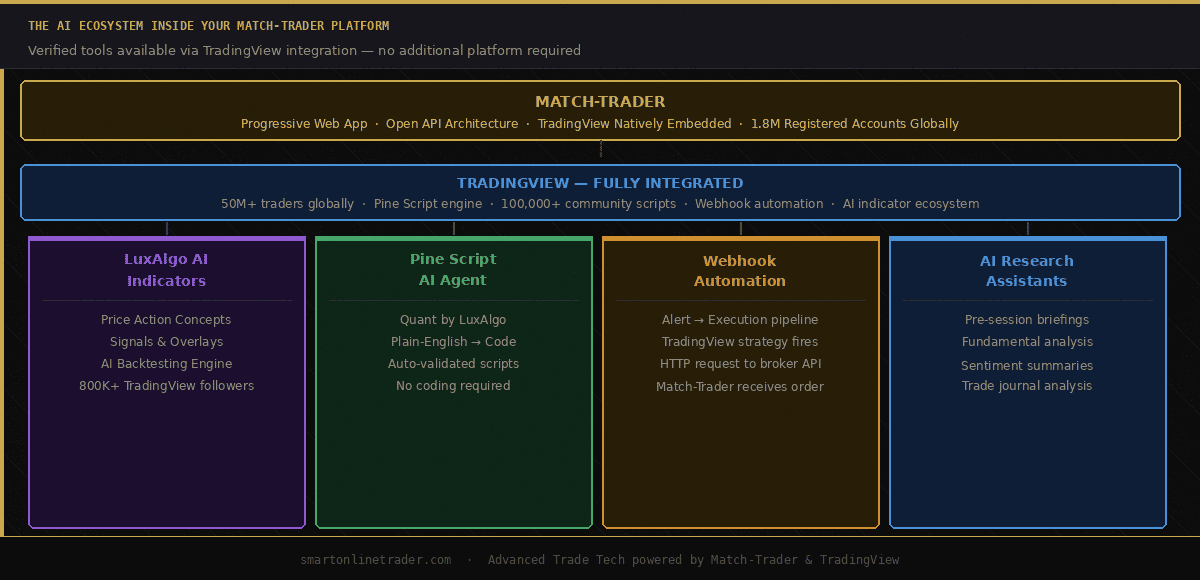
Here is the fact that most traders do not fully appreciate: every Match-Trader deployment includes TradingView charts fully integrated into the platform – not as an external link or a secondary tab, but genuinely embedded, with prices reflecting exactly what you see in the market watch window. This is the same TradingView used by over 50 million traders globally. And TradingView is where the most sophisticated AI indicator ecosystem in retail trading currently lives.
Match-Trader also provides open API access – meaning external systems, tools, and platforms can connect to it directly. This open architecture is the technical foundation that makes AI integration not only possible but already operational for traders who know how to use it.
The AI Gateway Hidden Inside Your Charts
Because TradingView is natively embedded in Match-Trader, every AI-powered tool available on TradingView is available to you inside the platform you are already using. You do not need a separate AI subscription that sends signals to a different platform. The pipeline already exists.
AI Indicators Available on TradingView Right Now
The most widely used AI-powered indicator ecosystem on TradingView is LuxAlgo, which is the most followed premium indicator provider on the platform with over 800,000 followers. LuxAlgo’s suite of tools includes several genuinely AI-powered components that are relevant to prop firm and evaluation traders:
Price Action Concepts identifies market structure shifts, order blocks, liquidity grabs, and changes in character and breaks of structure. For traders who work within smart money concepts or institutional order flow frameworks – which is the foundation of most evaluation-ready strategies – this is a tool that automates the identification of what you are already looking for manually on your charts.
Signals and Overlays provides buy and sell signal generation, trend strength dashboards, volatility analysis, and volume data – all in one script. The key point that LuxAlgo themselves emphasise is that their tools are designed as decision support instruments, not decision-making replacements. The algorithm gives you more conviction in the trade. The trade decision remains yours.
The AI Backtesting Engine, available on LuxAlgo’s higher-tier plans, allows you to test your strategy rules against historical data without writing any code – identifying which conditions produced profitable outcomes and which produced losses across different market conditions and timeframes. For an evaluation trader who needs to arrive at their challenge with a proven, consistent process, this is one of the most practically useful AI tools in the ecosystem.
Pine Script – Your AI Strategy Builder
TradingView’s built-in programming language, Pine Script, gives traders the ability to build their own custom indicators and automated strategy rules. Historically this required coding knowledge. That barrier has been largely removed.
LuxAlgo’s Quant is an AI agent specifically trained on Pine Script – not a general-purpose AI that sometimes gets the code right, but a purpose-built AI architect for TradingView indicators that validates code against official Pine Script standards before you ever see it, auto-corrects logic errors during generation, and produces functional, deployable scripts from plain-language descriptions. A trader can describe their entry and exit conditions in plain English and receive a working indicator within minutes, without writing a single line of code.
The practical implication for a structured trader is significant. If you have a confluence-based strategy – for example, entering only when market structure is bullish, price is at an identified order block, and session timing is correct – you can build that as a coded rule set, backtest it against historical data, and then configure it to generate alerts rather than hunt for setups manually across multiple charts.
Webhooks – The Automation Bridge
When a TradingView alert fires – from a Pine Script strategy, an AI indicator, or a manual price level – it can send an automated HTTP request to a connected broker system via a webhook. Because Match-Trader has an open API, this pipeline is technically functional. It means a TradingView strategy alert can trigger an automated order execution on your Match-Trader account.
This is where a critical and honest conversation must happen – because this capability, used incorrectly, is one of the fastest ways to fail a prop firm evaluation.
Four AI Applications That Genuinely Add Value for Prop Firm Traders
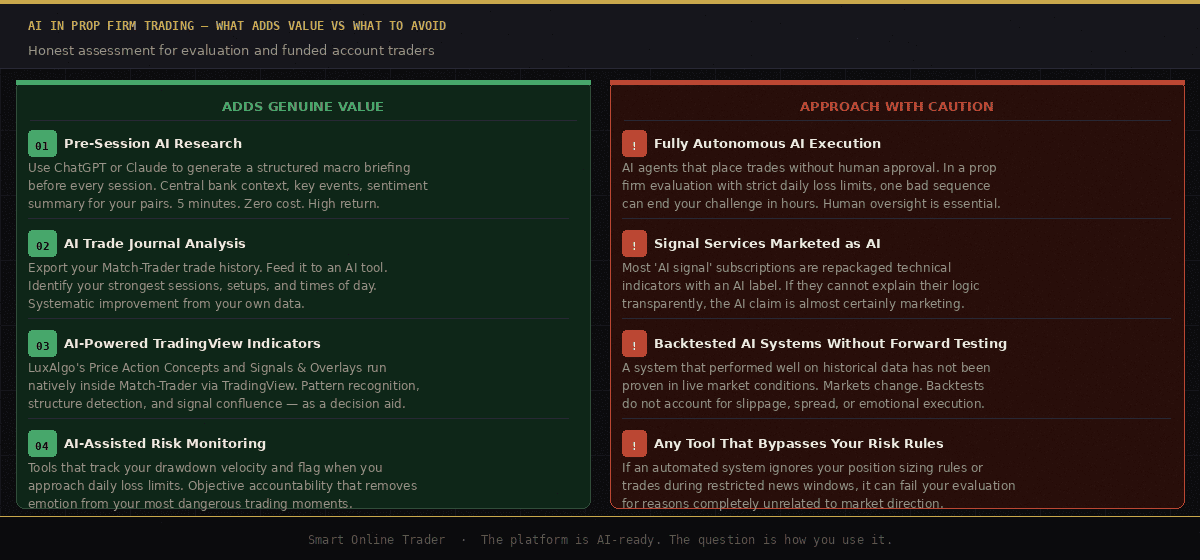
Knowing which AI tools are actually useful requires understanding what causes most prop firm evaluation failures. The primary failure modes are not bad strategies – they are emotional deviation from strategy, violation of risk rules, and inconsistent execution under pressure. Any AI tool that reduces those failure modes has genuine value. Any AI tool that adds automation without discipline has the potential to accelerate those failures.
AI as Your Pre-Session Research Assistant
This is the highest-value, lowest-risk application of AI for any trader. Before every session, you need to understand the macro context, the key economic events, and the likely liquidity conditions in the sessions you are trading. Tools like ChatGPT, Claude, and Perplexity can compress hours of fundamental research into a structured pre-session briefing in minutes.
A practical example: prompt an AI assistant with the specific currency pairs you trade, the key central bank events scheduled for the week, and ask it to summarise the current macro bias for each pair and flag any news events that could create abnormal volatility during your trading session. You now have a professionally structured briefing that would have taken a junior analyst an hour to compile – done in under three minutes. This does not tell you where to enter. It tells you what environment you are entering into, which is the most important context a trader can have.
AI-Powered Trade Journal Analysis
A trade journal is only as valuable as the insights you extract from it. Most traders journal their trades but never systematically analyse the patterns in those journals. AI changes this. Export your trade history – which Match-Trader makes available through your account dashboard – and feed it into an AI tool with a structured analysis prompt.
Ask it to identify which sessions produced your highest win rates, which setup types had the best risk-reward outcomes, which days of the week or times of day correlated with your largest losses, and whether your position sizing was consistent across trades.
This is not AI making trading decisions. This is AI doing in seconds what would otherwise require hours of spreadsheet analysis – surfacing the patterns in your own data that tell you exactly where your process is strongest and where it is breaking down.
For an evaluation trader building toward a funded account, this kind of forensic self-analysis is the difference between iterating randomly and improving systematically.
Sentiment Analysis – Reading the Room Before the Market Opens
Sentiment tools aggregate data from news sources, economic reports, and in some cases social media and institutional flow data, to give traders a directional read on market sentiment before price has moved. This is not signal generation – it is context enrichment.
Knowing that sentiment around a currency pair is overwhelmingly bearish before a high-impact news event tells you something your chart cannot tell you. Combined with your technical analysis on the TradingView charts embedded in Match-Trader, sentiment data creates a more complete picture of the conditions you are about to trade into.
AI Risk Monitoring and Performance Pattern Recognition
Perhaps the most underused application of AI for individual traders is real-time risk monitoring. Tools that track your drawdown velocity – how quickly you are losing relative to your normal trading rhythm – and flag when you are deviating from your typical behaviour patterns can serve as an objective accountability layer.
For a prop firm evaluation trader with a 5% maximum daily drawdown limit, a tool that alerts you when you have consumed 60% of that limit in a single session is not AI making trading decisions. It is AI protecting the rules you already agreed to follow.
The AI Applications to Avoid as a Prop Firm or Evaluation Trader
Fully automated AI execution – where an AI agent identifies setups and places trades without human approval – is the most misunderstood and most dangerous AI application for prop firm traders. Here is why.
Prop firm evaluations test whether you have a consistent, rule-governed, human-controlled process. They have strict daily drawdown limits, maximum total loss limits, and in many cases consistency requirements that penalise abnormal position sizing or erratic trade frequency.
An automated AI system can violate all of these in a matter of hours if the market conditions shift outside the parameters it was trained on – and markets regularly do exactly that.
More practically: if an AI bot fails your evaluation, you have paid the evaluation fee and gained nothing. If it fails a funded account, you lose the account and potentially your credibility with the firm. The risk-reward calculation of fully autonomous AI execution in a prop firm environment is unfavourable for almost every retail trader.
The AI tools that add genuine value are the ones that make you a better, more informed, more disciplined human trader – not the ones that attempt to remove the human from the equation entirely.
The Real Answer to How to Use AI Tools in Trading: Human Judgment Plus Machine Intelligence
The most honest summary of where AI in trading genuinely delivers value is this: AI excels at processing large amounts of data quickly, identifying patterns across historical datasets, removing emotion from analytical tasks, and flagging conditions that require human attention. Humans excel at contextual judgment, risk assessment in novel conditions, and adapting to market dynamics that no training dataset has ever seen.
The traders who are building sustainable, funded careers in 2026 are not the ones who handed their accounts to an algorithm. They are the ones who use AI to compress their research time, sharpen their performance analysis, and reinforce the discipline that keeps them within their risk rules – while retaining full, informed control over every trade they place.
The SOT Community Hub – Where AI Meets Expert Human Intelligence
Understanding the tools is one thing. Knowing how to integrate them correctly into a structured trading process – and having access to people who have already done it – is what separates a trader who experiments with AI from one who actually benefits from it.
The SOT Client Portal & Community Hub is where that integration happens, and access is completely complimentary for all members.
Inside the Hub, Luhan Oosthuizen – SOT’s in-house Senior Analyst and Prop Firm Trader Guru – shares daily professional market analysis in the Trade Desk & Market Insights channel every single trading session.
This is human intelligence at its most practical: the contextual judgment and experience-based reading of market conditions that no AI tool currently replicates reliably for structured, evaluation-ready traders.
Alongside him, Francois Du Plessis, a licensed Financial Services Provider holding an FCSA Category 2 licence – provides regulated, accountable market insights that sit within a formal governance framework. In a landscape full of unlicensed “AI-powered trading systems” making bold claims, having access to FSP-licenced analysis at no cost is a distinction worth paying attention to.
The Hub also provides a dedicated Prop Firm Evaluation Support channel for traders preparing for or actively completing a Performance Lab evaluation, structured peer accountability groups, a full Course Library with assessments and certification linked to your Performance Academy membership tier, and live session recordings and replays on demand.
The right combination of AI tools and human expertise does not require choosing between them. It requires building both layers into your process – and having a community of serious traders and credentialled mentors around you while you do it.
Join the SOT Community Hub — It’s Completely Free
How to Start Building Your AI-Assisted Trading Stack on Match-Trader Today
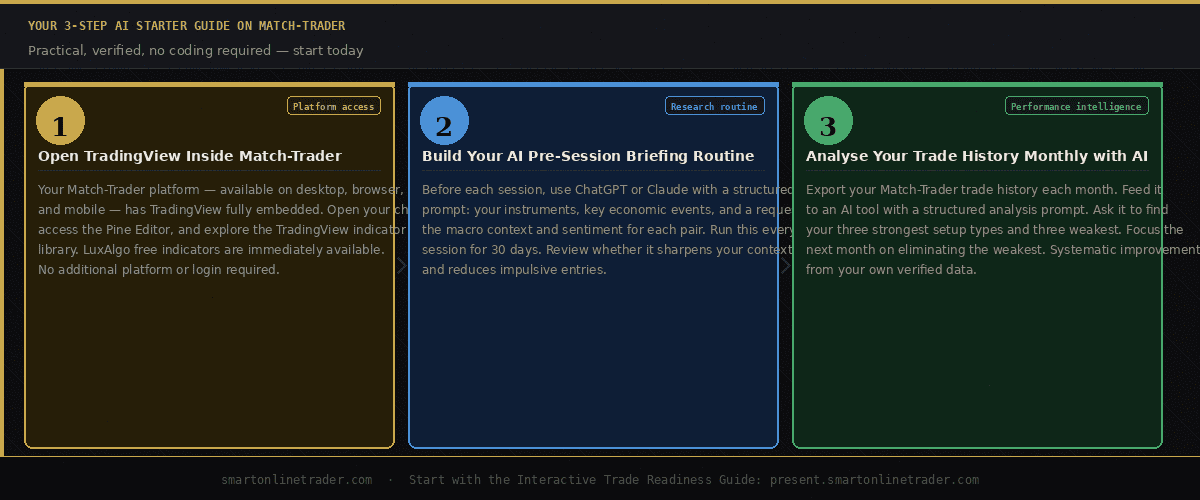
The practical starting point is simpler than most traders expect.
Step one: Open your Match-Trader platform – available on desktop, browser, and mobile via the Advanced Trade Tech platform – and explore the TradingView chart library. The Pine Script editor is accessible within TradingView, and the LuxAlgo indicator suite is available for subscription directly on the TradingView platform. Because TradingView is genuinely integrated into Match-Trader, any indicator you add to your TradingView account is visible inside your Match-Trader charts.
Step two: Establish one AI pre-session research routine. Choose an AI assistant – ChatGPT, Claude, or Perplexity – and build a repeatable morning briefing prompt specific to the instruments you trade. Use it every session for 30 days. Review whether it improves the quality of your context before entering the market.
Step three: Export your trade history monthly and run a structured AI analysis on it. Identify your three strongest setup types and your three weakest. Focus the next month on eliminating the weakest and maximising the strongest.
None of this requires coding skills. None of it requires a large financial investment. It requires the same thing that separates funded traders from struggling ones – a structured, disciplined, process-driven approach to every session.
Not sure where to start with your overall trading readiness? Before you commit to anything, the Interactive Trade Readiness Guide assesses your current level and maps the most appropriate pathway: Foundation, Structured mentoring, or Evaluation-readiness.
Frequently Asked Questions: How to Use AI Tools in Trading
Does Match-Trader have built-in AI features?
Match-Trader does not currently market a built-in AI feature by name. But its architecture makes it one of the most AI-compatible platforms available to retail and prop firm traders. Its full TradingView integration gives traders access to the entire TradingView AI indicator ecosystem. These tools include LuxAlgo’s suite, directly within their trading interface. Its open API architecture allows external AI tools and automation systems to connect to it directly.
The platform also features smart pattern recognition in its charting update, trailing stop loss automation, and analytical capabilities that continue to expand with each monthly release. In practical terms, if you know which AI tools to layer onto Match-Trader via TradingView, you are operating in a more sophisticated AI-assisted environment than most retail traders have access to on any platform.
Can I use automated AI trading bots on the Performance Lab prop firm evaluation?
This requires careful consideration and we recommend reviewing the Performance Lab evaluation terms directly before using any automated system. As a general principle across the prop firm industry, evaluation programs are designed to test whether a human trader has a consistent, rule-governed process.
Fully automated systems, where an AI places trades without human approval, can violate consistency rules, position sizing rules, and daily loss parameters in ways that end an evaluation rapidly. The AI applications we recommend for evaluation traders are the ones that assist and inform human decision-making, not the ones that replace it.
Is TradingView’s Pine Script difficult to learn for non-technical traders?
For traders who want to code their own indicators from scratch, Pine Script has a learning curve. However, tools like LuxAlgo’s Quant AI agent have largely removed the need for manual coding. Quant allows traders to describe their indicator or strategy concept in plain English and generates a validated, deployable Pine Script file automatically – no coding required. For traders who want to use existing AI-powered indicators rather than build their own, the process is even simpler: subscribe to the indicator on TradingView, add it to your chart, and it works immediately within your Match-Trader environment.
What is the most practical first AI tool for a developing trader on Match-Trader?
Start with an AI pre-session briefing routine. Before each trading session, use ChatGPT or a similar tool to summarise the macro context, key economic calendar events, and sentiment conditions for the instruments you trade. This costs nothing beyond a free AI subscription, takes under five minutes, and immediately improves the quality of context you bring to each session. Once that habit is established, add an AI-powered indicator on your TradingView charts – LuxAlgo’s free indicators are a solid starting point. And use it as a confirmation layer for your existing technical analysis, not as a standalone signal generator.
Is the SOT Community Hub a good place to learn about AI tools for trading?
Yes. The Hub is a structured performance environment – not a generic forum – and it brings together traders at every stage of development. Daily insights from Luhan Oosthuizen in the Trade Desk & Market Insights channel and regulated market analysis from Francois Du Plessis (FSP, FCSA CAT2) give you access to professional-grade human intelligence that contextualises the market conditions you are trading in every session.
The peer accountability groups and live session library provide the structured environment in which discussions about tools, platforms, and AI integration happen organically among traders who are actively working through the same questions you are. And it costs nothing to register and join.
Build Your AI-Assisted Trading Stack. Join Traders Who Are Building Theirs.
The Smart Online Trader Client Portal & Community Hub is where serious traders come to build every layer of their trading infrastructure – including the AI tools that genuinely add value. Access is completely complimentary. No subscription. No hidden cost.
Join the Hub – It’s Completely Free
Explore the Performance Academy
