
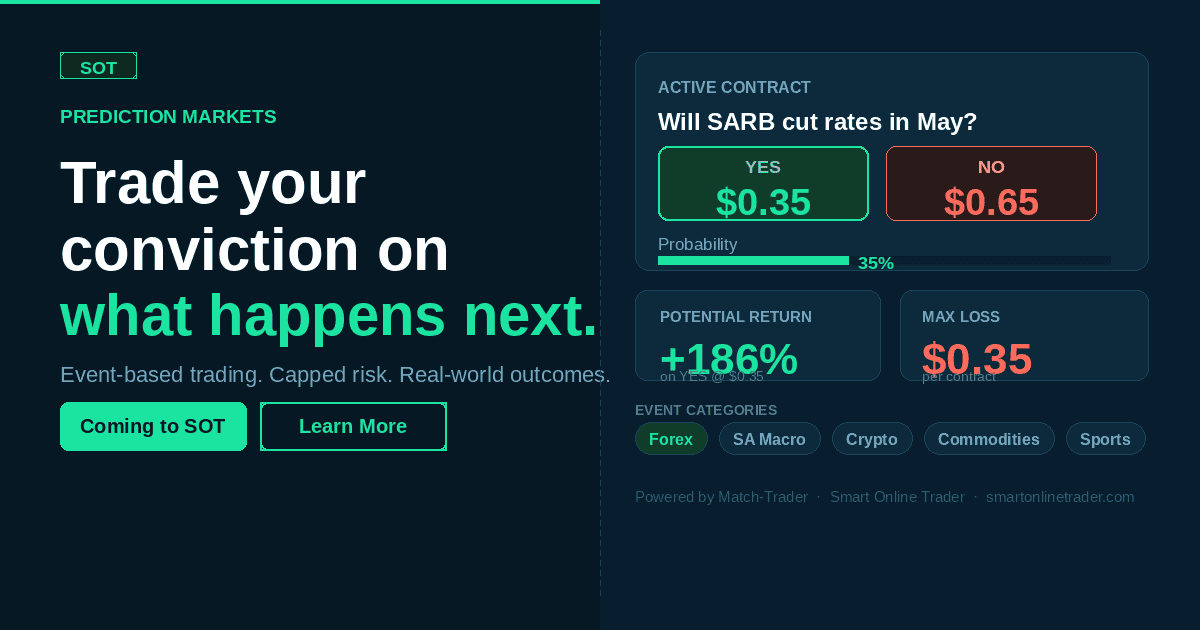
Prediction Markets Trading: What It Is, How It Works, and Why Smart Online Trader Is Bringing It to You First
If you have ever watched a major interest rate decision come out of the Fed, looked at the rand react to a South African election result, or followed geopolitical events unfolding in real time and thought, “I knew that was going to happen”? Then prediction markets trading was built for traders exactly like you.
This is not a gimmick. It is not gambling dressed up in a suit. Prediction markets are a legitimate, fast-growing segment of the global financial trading ecosystem. The world’s sharpest macro traders, hedge funds, and institutional players have been using them for years to position around real-world outcomes.
Now, they are coming to the Smart Online Trader ecosystem, and we are going to make sure you understand exactly what they are, why they matter, and how to use them intelligently before we go live.
What Is Prediction Markets Trading?
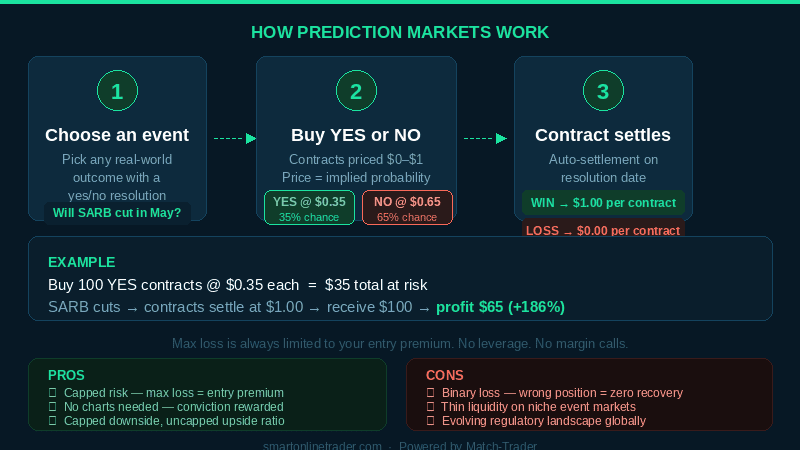
A prediction market is a trading environment where participants buy and sell contracts based on the outcome of real-world events. Each contract is binary – it comes in the form of a YES or NO share. Going for YES means you believe the event will occur. Going for NO means you believe it will not.
Each contract carries a value between $0 and $1, and that price reflects the market’s collective view of probability. If a “YES” contract is trading at $0.40, the market is saying “… there is a roughly 40% chance that the event will happen”. If the event occurs, that “YES” contract settles at $1 – delivering a $0.60 profit on your $0.40 entry. If the event does not occur, the contract settles at $0 and your $0.40 entry is lost.
The brilliance of the mechanism is its simplicity. You are not reading charts, managing complex position sizing, or interpreting lagging indicators. You are applying your understanding of the world, which include macro economics, geopolitics, central bank behaviour, commodity cycles etc., to take a structured position on what you believe will happen. And the market rewards you if you are right.
Share prices are not static. They fluctuate as new traders enter and exit or as beliefs change over time, with common drivers including news, polls, and credible leaks. This means, prediction markets behave like live financial instruments, they can be traded in and out of before resolution, just like a standard position.
What Kind of Events Can You Trade?
There is a wide range of topics: elections, financial markets, crypto, sports, technology, entertainment, weather, and more. If it matters in the real world, there is probably a market for it.
For traders in the Smart Online Trader community specifically, the most relevant event categories will include:
Forex macro events: Central bank interest rate decisions, CPI data releases, Non-Farm Payrolls, and GDP announcements. These are events every serious trader already tracks. Prediction markets simply give you a direct way to express your conviction on the outcome itself, independently of how price action on the underlying pair behaves in the seconds and minutes after the release.
South African macroeconomic events: SARB rate decisions, budget announcements, CPI and PPI prints, and political developments that move the rand. These are events uniquely relevant to the South African trading community, and they represent a genuine edge opportunity for traders who understand the local landscape deeply.
Commodity markets: This include oil, gold, platinum, and agricultural commodities. Questions like “Will gold close above $3,200 on Friday?” or “Will Brent crude trade above $85 by month-end?” sit exactly at the intersection of macro insight and structured trading.
Crypto milestones: This invloves Bitcoin price levels, ETF inflows and regulatory decisions. Crypto-native traders who have followed on-chain prediction platforms like Polymarket will find this environment immediately familiar.
Global politics and geopolitics: Elections, summits, sanctions, and policy outcomes. For macro traders, these are the events that drive currency regimes and commodity trends for months at a time.
Sports and cultural events; This is for traders who want a lower-stakes, high-engagement introduction to the prediction markets environment. These markets are an excellent onboarding mechanism before stepping into higher-conviction macro positions.
The Pros of Prediction Markets Trading
Capped Risk by Design
Event contracts are user-friendly in that risk is capped. The maximum loss is the initial premium paid for the contract. Unlike leveraged Forex or CFD positions where adverse moves can exceed your original margin, a prediction market position can never lose more than you put in. For traders who struggle with risk management, this structure is inherently self-disciplined.
No Charts Required – Just Conviction
Prediction markets reward research, contextual intelligence, and macro insight rather than technical analysis. This opens genuine trading opportunity to traders whose strength is fundamental analysis, economic understanding, or domain expertise in specific sectors. Your edge as a South African trader who follows SARB closely, understands rand dynamics, or tracks commodity supply chains is a real, monetisable advantage in this environment.
The Wisdom of the Crowd
One of the key draws of prediction markets is the aggregation of opinions on outcomes. The “wisdom of the crowd” concept suggests that collective forecasting can be more accurate and reliable than the opinion of a single thought leader or expert group. On prediction market platforms, this is reflected in contract pricing – a contract trading at 70 cents for YES implies a 70% probability of that outcome. Monitoring prediction market prices is itself a valuable intelligence tool, independent of whether you take a position.
Real-Time Probability Intelligence
Professional traders and institutions already use prediction market pricing as a leading indicator. Watching a prediction market price on an upcoming rate decision move sharply in one direction before the announcement can signal positioning and conviction that no chart pattern can reveal. Adding this layer of intelligence to your existing trading methodology is a genuine edge upgrade.
Explosive Growth and Institutional Validation
The two biggest players in the space, Polymarket and Kalshi, generated a combined volume of more than $37 billion in predictions placed in 2025, and the two platforms raised an estimated $3.6 billion in equity investment last year from some of Wall Street’s and the venture-capital world’s largest names. This is not a fringe market. Citizens Financial Group projects that revenues of prediction-market firms will reach more than $10 billion by 2030 from around $2 billion annually at present. Traders who develop fluency in this environment now are positioning ahead of a structural shift in how global markets interact with real-world events.
A Natural Extension of the Trading Skillset
For prop firm traders already familiar with managing risk around news events, trading prediction markets is a natural extension rather than an entirely new discipline. Your understanding of event volatility, your knowledge of consensus expectations, and your ability to read macro narratives all translate directly into this environment.
The Cons of Prediction Markets Trading. Be Clear-Eyed
Binary Outcomes Mean Zero Recovery on Wrong Positions
If the event does not resolve in your favour, the contract settles at zero. Unlike a stop-loss on a Forex trade that still returns most of your capital, a wrong prediction market position loses the full entry premium. Position sizing discipline is therefore non-negotiable.
Liquidity Can Be Thin on Niche Markets
Thin markets can look like easy money on the screen, but a few small trades can move the price dramatically, meaning you may not always be able to get in or out anywhere near the last traded price. Sticking to higher-volume event categories, major economic releases, well-followed political events, mainstream sports, reduces this risk significantly.
Timing and Information Asymmetry
There is a real chance you are not competing against another small-time trader – market makers who buy and sell contracts on the same events at different prices can represent a structural disadvantage for retail participants. This is why education, methodology, and information discipline matter as much in prediction markets as they do in Forex. Knowing what you know, and being honest about what you do not, is the core skill.
Regulatory Landscape Is Still Evolving
Prediction markets face a complex and uneven global regulatory picture. Some jurisdictions have blocked access to major platforms, and the legal classification – as financial derivatives, gambling instruments, or securities – remains contested in several regions. Smart Online Trader’s Broker-Partner is integrating prediction markets through the Match-Trader platform infrastructure, within the framework of its existing operational and compliance structure. We will communicate full details of access, eligibility, and terms as the integration is finalised.
Emotional Discipline Still Required
The binary nature of these contracts – and the visibility of a position moving against you in real time – creates genuine psychological pressure. The traders who perform best in prediction markets are those who have done the preparation work, set their entry sizing before the position is live, and do not chase positions or second-guess their research mid-trade. Sound familiar? It is the same discipline that separates profitable prop firm traders from the rest.
Why Smart Online Trader Is the First Online Trading Education Provider to Offer This
Here is the honest reality of the online trading education industry: most providers are still fighting over the same territory – Forex fundamentals courses, prop firm preparation programmes, technical analysis templates. The differentiation is largely cosmetic.
Smart Online Trader was built on a different premise. The vision has always been a fintech ecosystem, not just a course catalogue. The Performance Academy, Performance Lab (our Prop Firm Evaluation environment), and Advanced Trade Tech (Match-Trader powered platform infrastructure) exist as an integrated stack – each layer reinforcing the others, and each layer expanding what is possible for traders within the ecosystem.
Prediction markets are the next layer of that stack.
Match-Trader has released a brand-new prediction markets solution that gives brokers direct access to what is rapidly becoming one of the most significant trends in trading. The launch comes as event-based contracts across finance, crypto, politics, sports, entertainment, and other sectors are pulling in serious trading volumes, and retail traders are entering this space at scale.
The system comes with the full infrastructure needed to support a competitive prediction markets offering. Events are grouped by category, with all outcome options appearing together and probability charts updating in real time as positions accumulate and market sentiment shifts. Settlement is fully automatic: winning positions close at 1, losing positions at 0, with no manual action required.
The trading process stays simple by design: yes/no decisions, one-click execution, and instant fills, with a mobile-first, responsive experience across all devices.
What this means for you as a Smart Online Trader member is significant: you will be able to trade prediction markets on the same platform infrastructure you already use. Your Performance Lab evaluation environment and your prediction markets activity will exist within a single, integrated ecosystem. The education, the performance data, the community intelligence through the Smart Online Trader Client Portal & Community Hub, and now event-based trading – all under one roof.
No other online trading education provider in South Africa – or, to our knowledge, globally, is offering this integration.
The first brokers are already active in the prediction markets space, and the window for first-mover advantage is closing fast. Match-Trader is not waiting. They are building the capability now so that when prediction markets become mainstream for retail traders, we are already three steps ahead.
What Comes Next
We are currently in the final configuration and testing phase of the Prediction Markets module integration. Before we go live, we want to hear from you.
Which event categories matter most to your trading? Would you use prediction markets as a standalone strategy or as a complementary layer alongside your existing Forex and prop trading activity? What questions do you need answered before you engage?
Head to the Smart Online Trader Clinet Portal & Community Hub and drop your input in the Insider Preview thread. Members who engage now will receive priority access and first-look briefings before the public launch.
This is not a feature announcement. It is the beginning of a new trading category for the SOT ecosystem – and you are at the front of the line.
Frequently Asked Questions About Prediction Markets Trading
Is prediction markets trading the same as sports betting?
No, although the two share surface-level similarities. Sports betting operates against a bookmaker who sets fixed odds and takes a margin. Prediction markets operate peer-to-peer, with prices set by the collective activity of all participants. The contract pricing reflects genuine market consensus, not a house edge. Critically, prediction markets cover a far broader range of events — macroeconomic releases, political outcomes, commodity price levels, crypto milestones — that have direct relevance to professional traders rather than being purely entertainment-driven.
Do I need technical analysis skills to trade prediction markets?
Technical analysis is not a requirement. Prediction markets reward research quality, macro understanding, and contextual intelligence. Traders with strong fundamental analysis skills – those who follow central bank policy, understand economic data cycles, or track geopolitical developments – often find this environment more aligned with their existing edge than chart-based trading.
What is the maximum I can lose on a prediction market position?
The maximum loss on any prediction market position is the premium paid to enter the contract. If you buy a YES contract at $0.35 and the event does not occur, you lose $0.35 per contract. Unlike leveraged Forex or CFD positions, a prediction market contract cannot lose more than the initial entry amount, which creates a built-in risk cap.
When will Smart Online Trader’s prediction markets environment go live?
Our Broker-Partner and Match-Trade Technologies are currently in the final stages of integrating the prediction markets module through the Match-Trader platform infrastructure. Members who engage in the Smart Online Trader Client Portal & Community Hub now will receive priority access and advance briefing before the public launch. Follow the Smart Online Trader Client Portal & Community Hub for all updates.
Will I need a separate account or platform to access prediction markets?
No. The prediction markets environment will be integrated into the existing Match-Trader platform infrastructure that powers the Smart Online Trader ecosystem. The intention is a seamless, single-platform experience – no new logins, no separate apps, no additional onboarding friction.
