
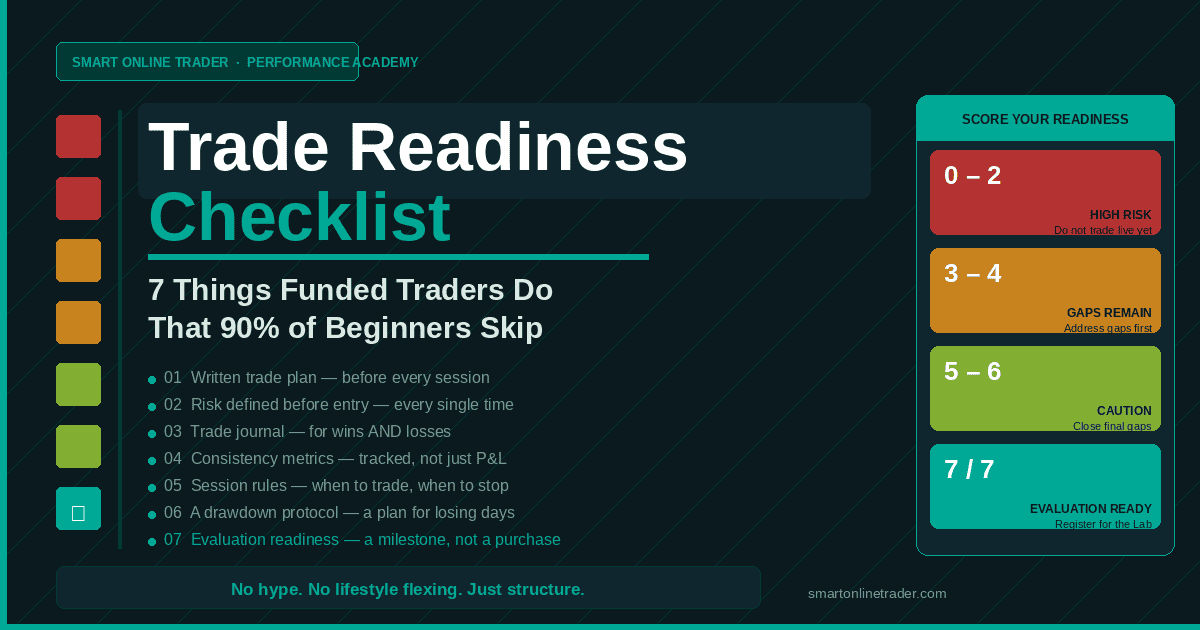
The Smart Online Trader Trade Readiness Checklist exists because of a single uncomfortable truth: most traders do not fail because of a bad strategy. They fail because they have information without structure, know what a support level is and understand risk-to-reward ratios in principle. They can name the major economic data releases.
But none of that knowledge is organised into a repeatable, governance-driven framework – and when the market moves against them, the whole thing collapses. This checklist is the structural audit that every serious trader needs to complete honestly before risking a single rand in a live account or attempting a prop firm evaluation challenge.
The numbers are not comfortable. Across the prop firm industry, between 75% and 90% of traders fail their evaluation challenges. Not because the rules are unfair. Not because the markets are rigged against retail traders. They fail because they are attempting a professional performance test without the professional infrastructure in place to support it. They are, in trading terms, building on sand.
The seven items in this checklist represent the structural foundation that separates the traders who pass evaluations and hold funded accounts from those who cycle through challenges and wonder what they are doing wrong. Work through each one honestly. Tick only when you have consistent, documented evidence – not good intentions. Any unticked item is not a failure. It is a structural gap that tells you exactly what to fix before your next attempt.
Why Structure – Not Strategy – Is the Real Problem in Retail Trading
Before working through the seven items, it is worth understanding why the trading industry has such a catastrophic failure rate. The conventional explanation is that trading is simply too hard, that markets are too unpredictable, that the odds are stacked against retail participants. That explanation is convenient – it absolves everyone of accountability.
The more accurate explanation is this: the trading education industry has spent years selling information when what traders actually needed was infrastructure.
Every course, every signal group, every YouTube tutorial delivers more technical knowledge. Entry patterns. Indicator combinations. Candlestick formations. Session times. And none of it is useless, but none of it solves the real problem. The real problem is that a trader without a written plan, without pre-defined risk, without a trade journal, and without a drawdown protocol is not a trader. They are a speculator operating on instinct under pressure. That is the exact condition under which the worst decisions are made.
Funded traders. the ones who consistently pass evaluations and generate payouts, do not necessarily use more sophisticated strategies than struggling traders. What they do differently is apply their strategy within a governance framework. They have rules, written plans and have accountability mechanisms. They have a protocol for every scenario, including the scenarios that go wrong.
This checklist audits that governance layer. Work through it now.
The Trade Readiness Checklist: All 7 Items Explained
1.Foundation: A Written Trade Plan Before Every Session
Why most traders skip this: Writing a trade plan before each session feels slow. Most traders prefer to open their platform, read the chart, and react. This feels efficient. In reality, it means every decision is made under pressure, in real time, with live capital at stake, the worst possible conditions for rational judgement.
What funded traders do instead: They write their plan the night before or pre-market. One page. It includes the session objective, which instruments they intend to trade, the specific entry conditions they will look for, their risk per trade, and a hard stop-time. The plan is law. Any deviation from the plan requires a written reason. If they cannot write a coherent reason, they do not deviate.
The written trade plan is not a prediction exercise, no trader is predicting where price will go. It is a decision tree constructed in a calm, rational state before the emotional conditions of a live session create pressure. The plan becomes the filter. If a setup does not meet the written conditions, it does not become a trade.
The action: Write tomorrow’s trade plan tonight. One page. If you cannot articulate your entry conditions, your risk per trade, and your session stop-time in writing, you are not ready to trade that session.
2. Risk: Risk Defined Before Entry, Every Single Time
Why most traders skip this: Retail traders typically calculate risk after entering a position, or worse, adjust their stop-loss placement to accommodate a position that has moved against them. The stop-loss becomes a negotiation rather than a non-negotiable boundary.
What funded traders do instead: Risk is calculated before the order is placed. Position size, stop-loss placement, and maximum daily loss are fixed numbers, not estimates. If the risk calculation does not produce a trade that fits within the pre-defined parameters, the trade does not happen. The trade is not forced to fit the risk – the risk criteria determines whether the trade is viable.
This single habit is the most direct differentiator between traders who preserve capital and traders who blow accounts. Maximum daily drawdown rules on Performance Lab challenges are not punitive, they are a mirrored version of exactly the discipline every trader should be applying to their own risk management regardless of the account type.
The action: Never place an order without calculating your exact risk in rands – not percentages, not pips, not abstract units. Rands. What is the maximum financial amount you are willing to lose on this trade? If you do not know before you place it, do not place it.
3. Accountability: A Trade Journal for Wins AND Losses
Why most traders skip this: Journalling feels like administrative overhead. It does not generate profit directly. And it forces traders to confront losses honestly, which is psychologically uncomfortable. The result is that most traders either do not journal at all, or they record their wins with detail and quietly omit the trades they would rather forget.
What funded traders do instead: Every trade is logged. Entry reason, exit reason, emotional state at entry, emotional state at exit, adherence to the written plan, and outcome. Losses are studied harder than wins. A winning trade that broke the rules is not a success, it is a lucky accident that reinforces bad habits. A losing trade that followed the plan precisely is not a failure, it is a system cost that tells you the expected value of that specific setup in those market conditions.
Within 30 days of consistent, honest journalling, patterns emerge. A trader discovers that 80% of their losing trades happen in the first 30 minutes of the session. Or that their best setups are on specific instruments. Or that their largest losses correlate with days when they had already hit their daily risk limit and continued trading. These are not insights available from a P&L statement alone – they require the journal.
The action: Log your last 10 trades today. Including the ones you would rather forget. If you cannot remember the entry reason, the emotional state, and the plan-adherence for your last 10 trades, the gap in your accountability infrastructure is already costing you.
4. Performance: Consistency Metrics Tracked, Not Just P&L
Why most traders skip this: Profit and loss is the default measurement because it is the most visible number. But measuring trading success by P&L alone is like measuring a business’s health by revenue – ignoring margin, cost, churn, and operational efficiency. A trader who has a profitable month may have done so through six large wins that masked twenty undisciplined losses. That is not a repeatable system. That is a lucky variance event.
What funded traders do instead: They track a set of leading indicators alongside P&L. Plan adherence percentage, of every trade taken, what percentage genuinely met all written plan criteria before entry? Stop-loss respect percentage, of every trade with a defined stop, what percentage were not moved or overridden? Average risk-to-reward ratio on completed trades. Win-rate by instrument and session time.
These metrics reveal whether a profitable period is the result of a repeatable, disciplined system or a series of fortunate deviations. They also reveal which specific behaviours, when fixed, will produce the greatest improvement in outcomes. The Performance Academy curriculum is built around developing exactly these tracking habits from the first module.
The action: Calculate your plan-adherence rate for the last calendar month. If you cannot calculate it because you do not have the data, that absence of data is itself a structural gap. Start tracking now. The data is more valuable than any strategy tweak.
5. Discipline: Session Rules: When to Trade and When to Stop
Why most traders skip this: Defined session rules feel constraining. The assumption is that more time in the market equals more opportunity. In practice, the opposite is true for most traders. Trading outside of high-probability sessions, revenge-trading after a significant loss, and continuing after hitting a daily drawdown limit are the behaviours that destroy accounts in concentrated bursts.
What funded traders do instead: They define their trading sessions in writing: specific hours, specific instruments, a maximum daily loss amount, and a hard rule to close the platform the moment that loss limit is reached. Not a soft guideline. A structural override. If the daily loss limit is hit at 10:30 AM, the platform is closed for the day. The session is over. No exceptions for market conditions, news events, or the feeling that recovery is possible.
This structure eliminates emotional override. The decisions are made before the session begins, when the trader is calm and rational. They are not renegotiated during the session, when the trader is under pressure and potentially below their best cognitive state.
The action: Write your session rules as a contract with yourself. Define your trading hours, the instruments you trade, and your hard daily loss limit. If you have never stopped trading for the day because of a daily loss limit, not because the session ended, but because your pre-defined limit was hit and you closed the platform as agreed, this is the structural gap that is most likely costing you.
6. Protection: A Drawdown Protocol for Losing Days
Why most traders skip this: Nobody plans to have a losing day. The result is that when it arrives, and in trading, it always does, there is no protocol. The response is improvised under pressure: increasing position sizes to recover losses faster, removing stop-losses to give trades more room, taking setups that do not meet the criteria because the emotional pressure to recover is overwhelming. Each of these responses compounds the damage.
What funded traders do instead: They have a tiered, written drawdown protocol that specifies what happens at each drawdown level, before the session begins. Typically: at -1% drawdown from peak, reduce position size by 50%. At -2% drawdown, stop trading for the day, debrief the session, and identify what went wrong before the next session begins. The protocol is non-negotiable and is set in the same calm, rational state as the trade plan.
The drawdown protocol is not pessimism. It is the acknowledgement that losing sessions are a statistical certainty in any trading system, and that the traders who survive them intact are the ones who had a pre-designed response ready before the pressure arrived.
The action: Define your three drawdown thresholds today and the exact action at each one. Write them. They must exist as a written rule, not a mental note you hope to remember when your account is 2% below its session high.
7. Readiness: Evaluation Readiness Treated as a Milestone, Not a Purchase
Why most traders skip this: Prop firm evaluations are marketed as accessible. Low entry fees, compelling funded account sizes, and the excitement of trading with professional capital are a powerful combination. Most traders register for an evaluation when they feel emotionally ready — motivated by the size of the funded account they want, or by seeing another trader’s payout on social media. That emotional readiness is structurally meaningless.
What funded traders do instead: They treat evaluation access as a milestone to be unlocked, not a product to be purchased. Before registering for an evaluation, they can demonstrate 30 to 60 days of consistent, journalled performance in a simulated environment – a track record showing plan adherence above a defined threshold, consistent stop-loss respect, and no single daily drawdown violation. The evaluation is a proof-of-concept exercise: a chance to demonstrate under controlled conditions what the journal already proves in practice.
This reframing is significant. If you approach an evaluation as a lottery ticket – register, trade hard, see what happens – you are not yet in the mindset of a funded trader. If you approach it as a structured demonstration of documented consistency, you are.
The action: Can you show 30 days of journalled, consistent trades that meet your written plan criteria before your next Performance Lab evaluation attempt? If the answer is no, that is your timeline. Build the track record first. Register second.
How to Score Your Trade Readiness Checklist Results
Work through each of the seven items above and tick honestly – only when you have consistent, documented evidence, not intentions.
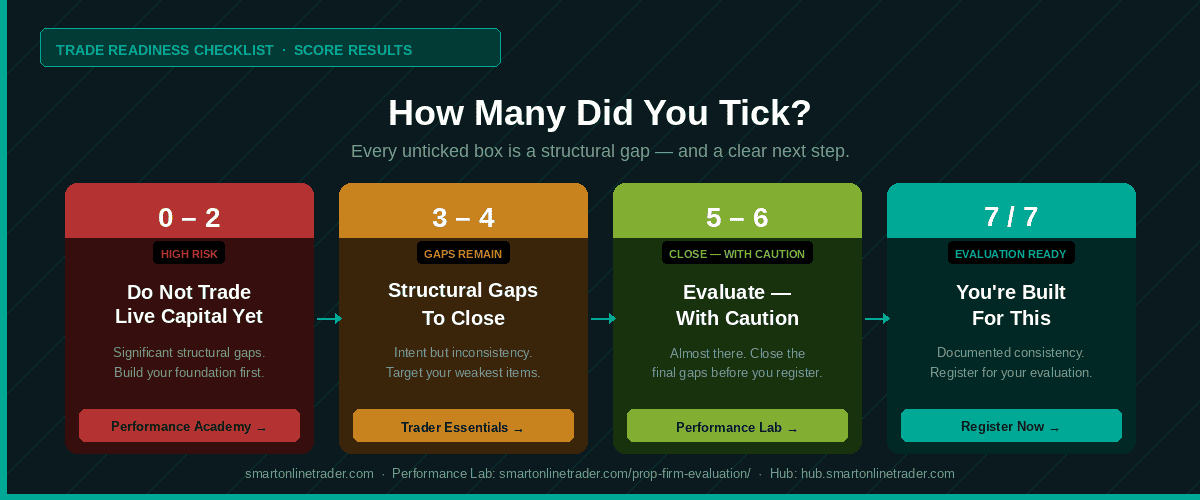
0 to 2 ticks: High risk of account loss. Do not trade live capital yet. The structural gaps are significant enough that any live or evaluation trading will almost certainly result in account loss, not because of market conditions, but because of absent infrastructure. The first step is to build the foundation layer: a written plan, defined risk, and a trade journal. The Performance Academy is specifically designed for this phase of development.
3 to 4 ticks: Structural gaps remain. You have intent but inconsistency. You understand the components of a structured approach but are not applying them uniformly. This is one of the most common, and fixable, positions. The Performance Academy curriculum targets each structural gap directly, with expert-led application rather than information delivery alone.
5 to 6 ticks: Ready to evaluate with caution. You are close. The unticked items are your only focus. Do not register for an evaluation until you can tick those remaining items with genuine evidence behind them. When you can, the Performance Lab evaluation is the appropriate next step.
7 out of 7: Evaluation ready. You have the structural foundation. You can demonstrate documented consistency. Register for your Performance Lab challenge. You are built for this.
Download the Smart Online Trader Trade Readiness Checklist: Free Inside the Hub
The Trade Readiness Checklist is available as a free PDF download exclusively inside the Smart Online Trader Client Portal and Community Hub. Existing members can access it directly. New members can create a complimentary account in under two minutes – no subscription, no payment, no catch.
When you join the Hub you also get immediate access to daily market insights from our Senior Analyst – structured accountability channels, and a community of traders working through the same disciplines.
The checklist is the starting point. The Hub is where the work gets done.
Download the Checklist – Join the Hub Free
Where the Smart Online Trader Client Portal & Community Hub Fits In
The seven items on this checklist are not things you audit once and file away. They are living practices that require accountability, peer pressure in the best sense, and ongoing calibration against real traders who are working through the same disciplines.
This is the function of the Smart Online Trader Client Portal and Community Hub, and access to it is completely complimentary. Not a trial. Not a freemium tier. Complimentary.
Inside the Hub our Senior Analysts and Prop Firm Trader specialist post market insights and trade analysis. Members work through their journalling and review in a structured community environment. Accountability check-ins are a standard feature of how the Hub operates, not an optional extra.
If you score 3 to 6 on this checklist and your primary challenge is the accountability and performance-tracking items, the Hub is the environment that closes those gaps faster than any amount of solo study. The compound effect of a community of structured traders working through the same disciplines simultaneously is a structural asset that self-study cannot replicate.
Join the Smart Online Trader Client Portal & Community Hub at no cost today. Access is completely complimentary.
A Final Word on the Checklist and the Prop Firm Industry
The prop firm industry has a problem. Its marketing presents evaluations as the starting line – the first step in a trader’s journey to professional capital. In reality, an evaluation is closer to the finish line of a specific preparation phase. It is the point at which a trader who has already built their structural foundation tests that foundation under controlled conditions.
Smart Online Trader’s position is not popular in an industry that profits from traders who keep attempting evaluations without fixing their root problems. Our position is that if you cannot score 7 out of 7 on this checklist with documented evidence behind each tick, you are not ready to register for an evaluation. That is not gatekeeping. That is honesty about what the evaluation is actually testing.
The traders who pass evaluations at the first or second attempt are not the ones who registered immediately. They are the ones who spent 60 days building a track record, closing the structural gaps, and arriving at the evaluation with evidence already assembled. The checklist is how you get there.
Your next step is the pathway finder at present.smartonlinetrader.com: a 3-minute interactive tool that maps your current position against the SOT ecosystem and tells you exactly where to start.
Frequently Asked Questions About the Trade Readiness Checklist
What is the trade readiness checklist and who is it for?
The Smart Online Trader Trade Readiness Checklist is a 7-item structural audit tool for traders at any stage of development. It is designed for complete beginners assessing whether they are ready to trade live capital, intermediate traders who have experienced losses and want to diagnose the root cause, and experienced traders preparing for prop firm evaluations. The checklist focuses on governance and infrastructure, not strategy. It tests whether you have the structural framework in place to execute any strategy consistently.
Can I use this checklist even if I have never traded before?
Yes, and it is arguably more valuable before you have traded. Working through the checklist before you open a live or demo account tells you exactly what infrastructure to build before you ever place a trade. Starting with the correct foundation in place is significantly more efficient than trading first and building the structure later while simultaneously managing losses. The Performance Academy Foundation pathway is designed precisely for this starting point.
How often should I review the checklist?
Monthly as a minimum. As your trading practice develops, your capacity to implement each item with consistency will improve, but so will your standards for what “consistent” means. A monthly audit keeps you honest about which items are genuinely embedded versus which items you believe you are implementing but applying inconsistently under pressure. Share your monthly results in the Smart Online Trader Client Portal & Community Hub for peer accountability.
I scored 5 out of 7. Should I attempt a Performance Lab evaluation now?
The recommendation is to use your two unticked items as your sole focus for the next 30 days before registering. A 5/7 score indicates you have meaningful structural foundation, but the two gaps are a known risk factor during an evaluation. Identify which two items are unticked, work on them deliberately with documented evidence, and register once you can tick all seven with consistency behind each one rather than intent. When ready, register at the Performance Lab.
What is the Performance Lab and how does it relate to the checklist?
The Performance Lab is SOT’s prop firm evaluation and simulated funding division. It offers structured evaluation challenges and simulated instant funded accounts across multiple account sizes. The checklist is the pre-evaluation readiness standard – it is the diagnostic tool that tells you whether your infrastructure is ready to withstand the conditions of a funded challenge. The Performance Lab is where you demonstrate that readiness under real evaluation conditions.
Is access to the Smart Online Trader Client Portal & Community Hub really free?
Yes! Access to the Smart Online Trader Client Portal & Community Hub is completely complimentary. There is no subscription, no trial period, and no catch. The Hub is the accountability and community layer of the Smart Online Trader ecosystem – the environment where traders work through their checklists, journals, and performance reviews with peers and mentors. It is free because the access barrier should be accountability, not cost.
Where can I download the Trade Readiness Checklist PDF?
The checklist PDF is available free inside the Smart Online Trader Client Portal & Community Hub. Existing members can access it directly after logging in. New members can create a complimentary account in under two minutes – no subscription and no payment required. Once inside, use Siya at present.smartonlinetrader.com to map your checklist score to your exact next step.
You’ve read the checklist. Now find out exactly where you stand and what your next move is:
Download the checklist PDF and join traders working through the same disciplines.
Ready to evaluate? Start your Performance Lab challenge:
