
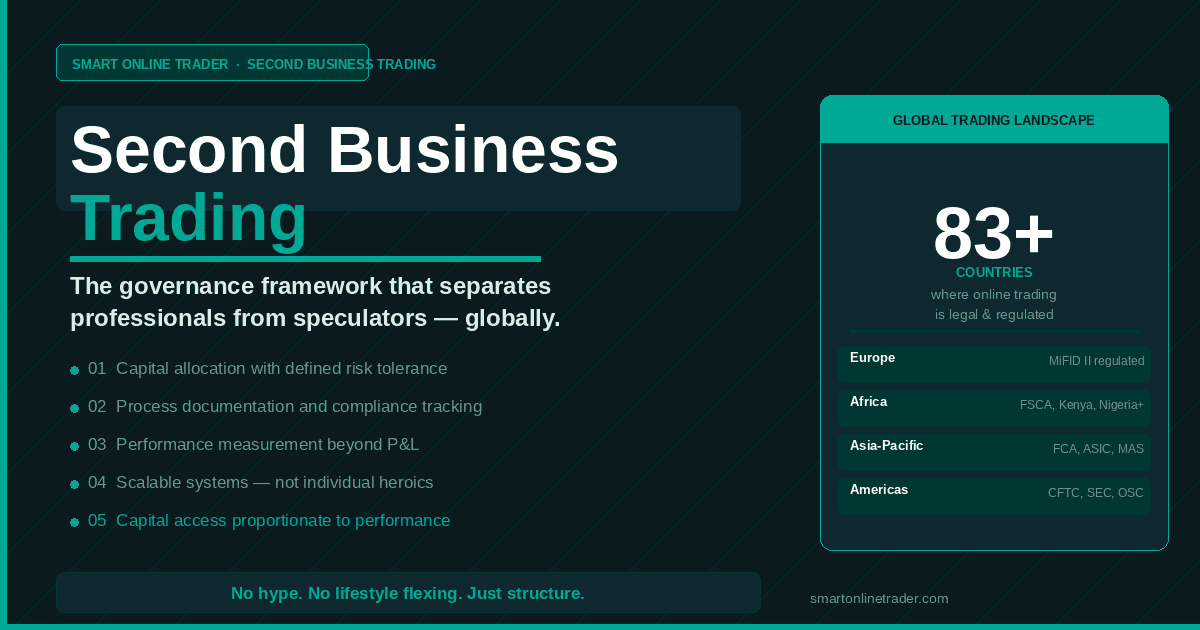
Second business trading is not a new concept, but it is one that the online trading industry has done an exceptional job of burying under lifestyle marketing, get-rich narratives, and screenshot culture. The result is that the professionals most qualified to succeed at it – corporate executives, business owners, engineers, doctors, lawyers, and entrepreneurs who already understand capital allocation, risk management, and disciplined process – have largely dismissed it as something other people do. That dismissal is costing them a significant, legitimate, and globally accessible income stream. This article is the framework they were never shown.
Online trading is legal and regulated in over 83 countries worldwide Khurramabbasi, covering most of Europe, the Americas, Africa, Asia-Pacific, and the Middle East. The market is not niche, not exotic, and not inaccessible. What has been inaccessible – until now – is a structured, professional approach to building a trading operation that functions like a business rather than a gamble.
That is the distinction this article draws. And it is the distinction that changes everything.
Why Professionals Dismiss Trading – and Why They Are Wrong
Ask a corporate professional what they think of online trading and the answer is predictable. They picture a twenty-something watching charts at 3 AM, gambling on currency moves, losing their savings, and blaming the market, they have seen the social media flexing and they have heard about people losing money on prop firm challenges. They write it off.
That picture is accurate – for the way most retail traders approach the market. It is completely inaccurate for the way a business-minded professional would approach it, given the right infrastructure and the right framework.
Here is what that professional already knows how to do: allocate capital with defined risk parameters. Follow a process with documented outcomes. Review performance data and adjust strategy. Manage emotion under financial pressure. Build systems that produce repeatable results. These are the exact competencies that separate consistently profitable traders from the 75 to 90 percent who fail their prop firm evaluations.
The problem has never been that professionals are unqualified to trade. The problem is that nobody has ever framed trading in the language they already speak.
Trading as a Second Business vs Trading as Speculation – The Critical Distinction
Every trader in the market falls into one of two categories. Understanding which category you are currently in, or planning to enter, determines everything about your outcome.
The speculator treats trading as event-based. They open their platform when they feel like it, react to news, chase setups they have not pre-qualified, and measure success entirely by whether they made money today. Their decisions are made under pressure, in real time, with no pre-defined governance framework. When they win, they attribute it to skill. When they lose, they attribute it to bad luck or bad markets. They never build a repeatable system because they are not trying to build one. They are trying to win.
The business-minded trader treats trading as process-based. They define their trading operation before they enter a single position: which markets they trade, which sessions they operate in, what their maximum risk per trade is, what their maximum daily drawdown is, what their weekly review process looks like, and what performance metrics determine whether their system is operating correctly. They treat their trading account as a business asset. Their decisions are made in advance, in a rational state, as written rules. When they win, they ask whether it was process-compliant. When they lose, they ask the same question.
The second trader is not necessarily more intelligent or more experienced than the first. They are more structured. And structure, not strategy, is what creates longevity in trading.
The Five Business Principles That Apply Directly to Trading
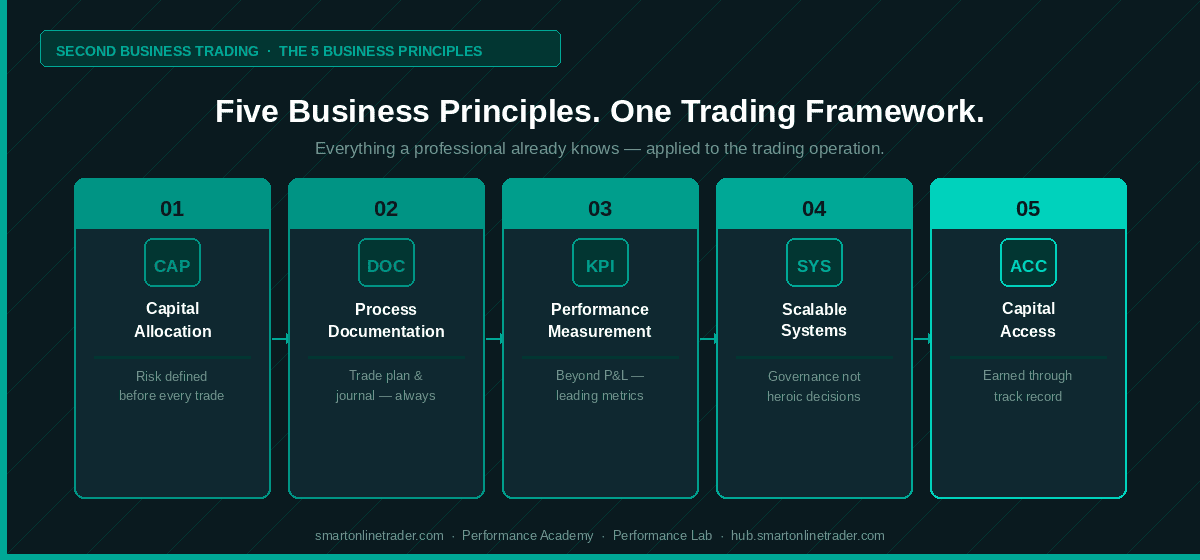
If you run a business, manage a team, or operate within a corporate structure, you already understand the following five principles. What you may not realise is that each one maps directly onto what structured, profitable trading requires.
1. Capital allocation with defined risk tolerance
Every business allocates capital with a risk framework. A marketing budget has a ceiling. A product launch has a maximum acceptable loss before the project is reviewed. Capital is deployed with a return expectation and a downside limit.
Trading works identically. Every position has a defined maximum loss – the stop-loss, has a defined maximum daily drawdown and every account has a defined risk percentage per trade. The difference between a professional trader and a retail speculator is not the strategy – it is whether those numbers are written down before the market opens.
2. Process documentation and compliance tracking
Businesses document their processes. Standard operating procedures, quality controls, compliance frameworks – these exist because repeatable results require repeatable processes. A business that operates on instinct produces inconsistent results.
Trading process documentation is the trade plan and the trade journal. The trade plan defines the conditions under which a position is entered. The journal records every trade, the entry reason, the emotional state, and the outcome. Traders who do not document their process cannot improve it — they can only hope their instincts improve over time. That hope is not a business strategy.
3. Performance measurement beyond top-line revenue
No serious business measures performance by revenue alone. Margin, cost per acquisition, customer lifetime value, churn rate – these are the metrics that reveal whether the business is structurally healthy or superficially profitable.
Trading performance measurement mirrors this exactly. Profit and loss is the revenue line. The metrics that matter underneath it are plan adherence percentage, stop-loss respect rate, average risk-to-reward ratio on completed trades, and win-rate by session and instrument. A trader who had a profitable month through three lucky large wins and twelve undisciplined losses has not demonstrated a repeatable business model. They have demonstrated a fortunate variance event. The business-minded trader knows the difference.
4. Scalable systems that do not depend on individual heroics
The best businesses build systems that do not depend on any single person making brilliant decisions under pressure. The system produces the results. The people operate the system.
In trading, this principle translates to the governance framework. A trading operation that depends on the trader being in the perfect emotional state, reading the market perfectly, and making the right call every time is not a business – it is a high-wire act. A trading operation with written session rules, a pre-session plan, defined risk parameters, and a drawdown protocol is a system. The trader’s job is to operate the system, not to make heroic decisions.
5. Access to capital that is proportionate to demonstrated performance
Businesses raise capital commensurate with their track record. A startup with three months of revenue data raises a seed round. A business with three years of audited financials raises a Series A. Capital access is earned through demonstrated, documented performance – not through promises.
The prop firm evaluation model operates on exactly this principle. A trader who can demonstrate 30 to 60 days of consistent, documented, governance-compliant trading earns access to simulated funded capital, from $5,000 up to $200,000 and beyond, without risking their own savings. The evaluation is not a lottery ticket. It is a Series A pitch: show us the track record, and we will provide the capital.
Where in the World Can You Trade as a Second Business?
One of the most common misconceptions about online trading is that it is legally complex or inaccessible outside major financial centres. The reality is considerably more straightforward.
Forex trading is legal in most countries around the world, including major financial hubs like the United States, the United Kingdom, Australia, and Japan. OpoFinance Legal and well-regulated jurisdictions include countries with robust frameworks overseen by major regulators such as the FCA in the UK, ASIC in Australia, and the CFTC in the United States. Khurramabbasi
For professionals across Africa, trading is legal and regulated in South Africa under the FSCA, in Kenya, Nigeria, Ghana, and across most of the continent. In the Middle East, the UAE, Saudi Arabia, and most Gulf states permit regulated forex and CFD trading. Across Europe, most European nations operate under MiFID II regulations Wrtrading, providing a consistent and well-protected framework for retail and professional traders alike. Latin America, Southeast Asia, and most of the Asia-Pacific region similarly permit regulated online trading with varying leverage and broker requirements.
The practical starting point for any professional is straightforward: verify that your country of residence permits retail online trading, ensure your broker is regulated by a credible authority in your jurisdiction, and confirm the tax treatment of trading income in your specific territory. In most regulated jurisdictions, trading income is treated either as capital gains or as personal income – both of which are well-understood by any financial professional.
What this means practically is that trading as a second business is not a geographic opportunity. It is a global one. The infrastructure – the education, the governance frameworks, the prop firm capital access pathway, and the professional community – is accessible from virtually anywhere on the planet with a reliable internet connection.
Who This Model Works For – and Who It Does Not
Trading as a second business is not universally appropriate. Part of the structured approach is an honest assessment of fit before committing capital or time.
It works well for professionals who have:
A stable primary income that removes the emotional pressure of needing trading profits to pay bills. Trading decisions made from financial desperation are structurally compromised from the start. The business model only functions when the trader can afford to follow the process even when the process produces a losing week.
Existing familiarity with risk management principles. Business owners, finance professionals, engineers, project managers, and corporate executives who already operate within risk frameworks adapt to trading governance more naturally than individuals who have never had to manage a defined risk budget.
Time to commit to a structured learning and development process – not hours per day, but consistent, scheduled engagement. The Performance Academy curriculum is designed to be completed alongside a full-time career, not instead of one.
A learning orientation rather than a profit orientation at the start. The business model requires a foundation-building phase – typically three to nine months – before capital access is the primary focus. Professionals who approach this phase as skill development rather than income generation progress significantly faster.
It is not suited to individuals who:
Need immediate income from trading to replace a primary salary. The foundation-building phase is non-negotiable, and the pressure of dependency destroys the process compliance that makes the model work.
Are unwilling to document their trading process. The governance framework – trade plans, journals, performance metrics, drawdown protocols – is not optional. It is the business model. Without documentation, there is no repeatable system, and without a repeatable system, there is no business.
Expect the education phase to be passive consumption. The Performance Academy is a structured, mentored application programme – not just a “video library”. The distinction matters because information without application does not produce trader development.
The Smart Online Trader Ecosystem as Your Trading Business Infrastructure
The Smart Online Trader ecosystem was built specifically for the business-minded trader. Not the speculator chasing signals. Not the weekend hobbyist watching YouTube tutorials. The professional who wants to build a trading operation that functions like a real business – with governance, accountability, capital access, and measurable outcomes.
The three business units of the Smart Online Trader ecosystem map directly onto the three phases of building a trading operation.
Phase 1: Knowledge and Governance Infrastructure: Performance Academy
The Performance Academy is the foundation layer. It delivers structured trading education with expert-led application – not only passive video content. Curriculum is built around the governance competencies that funded traders demonstrate: trade planning, risk management, journalling, consistency tracking, and evaluation readiness. Francois du Plessis (licensed FSP, FCSA Category 2) and Luhan Oosthuizen (Senior Analyst and Prop Firm Trader specialist) deliver daily market insights and mentored application through the Smart Online Trader Client Portal & Community Hub.
Phase 2: Performance Validation: Performance Lab
Once the governance framework is in place and a documented performance track record demonstrates readiness, the Performance Lab is where the business model accesses scaled capital. Structured evaluation challenges and simulated instant funded accounts are available across multiple account sizes. The evaluation is the performance audit – the Series A pitch for the trading business. Pass it, and the capital scales with the track record.
Phase 3: Platform Infrastructure: Advanced Trade Tech on Match-Trader
The trading operation runs on the Match-Trader platform with full TradingView integration – providing professional-grade charting, execution infrastructure, and AI-assisted analysis tools. This is not a retail trading app. It is the execution environment of a professional trading operation.
Sitting across all three phases is the Smart Online Trader Client Portal & Community Hub – the accountability and community layer. Complimentary access. No subscription. No catch. Because the access barrier to a professional trading community should be commitment, not cost.
How to Start Building Your Trading Business – The Structured Pathway
The pathway into trading as a second business is not complicated. It is sequential. The temptation for business-minded professionals is to skip the foundation phase and access capital immediately. That temptation is understandable – and it is the most expensive mistake in the model.
The sequence is non-negotiable: foundation first, validation second, capital third.
Step 1 – Assess your current position. Talk to Siya at present.smartonlinetrader.com – Smart Online Trader’s AI-powered “Success Profiler”. Three minutes. It maps your current position, identifies the structural gaps in your trading operation, and recommends the specific pathway that matches your starting point. No sales pressure. No obligation. A personalised diagnostic.
Step 2 – Build the governance framework. Enrol in the Performance Academy pathway that matches your assessment. The curriculum is structured around the five business principles described in this article – not generic trading tips. Expert-led application, not passive content consumption.
Step 3 – Document your performance. Before attempting a Performance Lab evaluation, build a 30 to 60-day track record of consistent, governance-compliant trading in a simulated environment. The journal is the evidence. The evidence is the pitch.
Step 4 – Access capital proportionate to your track record. Register for a Performance Lab evaluation when your documented performance demonstrates readiness – not when you feel excited or motivated. The evaluation confirms what the track record already shows.
Step 5 – Scale with the business. As your track record extends and your evaluation performance is validated, capital access scales. The business model grows with the discipline, not with the hope.
If you are a professional who wants to explore whether this model is the right fit for your specific situation, the Capital Clarity Call is the appropriate starting point – a focused, no-pressure conversation with the Smart Online Trader team about your goals, your current position, and the specific pathway that makes sense for you. Book yours at smartonlinetrader.com/.
Frequently Asked Questions About Trading as a Second Business
How much time does trading as a second business actually require?
The foundation-building phase requires consistent, scheduled engagement rather than large daily time blocks. Most professionals working through the Performance Academy alongside a full-time career allocate between one and two hours per day – pre-market preparation, a defined trading session, and a post-session review. The governance framework is specifically designed to prevent the open-ended time drain of reactive, unstructured trading. Defined session hours with a hard stop-time mean the trading operation does not bleed into the rest of your working day.
How much capital do I need to start?
The Performance Academy pathway requires only the enrolment fee for the appropriate membership tier – no trading capital is required at the foundation stage. When the Performance Lab evaluation phase begins, the evaluation fee is the entry point – not your personal trading capital. The simulated funded account model means your savings are not at risk during the validation phase. Your own capital only enters the picture if and when you choose to trade a personal live account in addition to your funded operation – and even then, position sizing within the governance framework ensures the maximum exposure is pre-defined before any trade is placed.
Is trading as a second business taxable?
In most regulated jurisdictions, trading income is a taxable event. The treatment varies by country – capital gains tax in some, income tax in others – and the specifics of your situation require advice from a qualified tax professional in your territory. What the governance framework provides is complete, documented trade records that make tax reporting straightforward rather than complicated. Every trade, every entry, every exit, every profit and loss figure is logged. The documentation that makes you a better trader also makes your tax position clean and auditable.
Can I do this if I have never traded before?
Yes, and arguably the foundation-building phase is more effective for complete beginners than for traders who have already developed undisciplined habits. Starting with the correct governance framework from the first trade is significantly more efficient than trading informally for two years, developing bad habits, and then attempting to rebuild the infrastructure. The Performance Academy Foundation pathway is specifically designed for professionals entering trading with no prior experience.
What is the difference between the Performance Academy and a standard online trading course?
A standard online trading course delivers information. The Performance Academy delivers structured application with expert oversight. The distinction is the difference between reading a business management textbook and completing an MBA programme with case studies, mentors, and performance reviews. The curriculum is built around the governance competencies that prop firm evaluations test – not around technical indicator knowledge. Information without governance produces informed speculators. Governance without information produces disciplined beginners. The Academy builds both simultaneously.
What is the Capital Clarity Call?
The Capital Clarity Call is a focused, no-pressure 20-minute conversation with the Smart Online Trader team specifically designed for professionals exploring trading as a structured second income stream. It covers your current financial position, your goals, your timeline, and the specific Smart Online Trader pathway that makes sense for your situation. There is no obligation, no hard sell, and no generic pitch. It is a diagnostic conversation – the business equivalent of a first consultation with an advisor before committing to a plan. Book it at smartonlinetrader.com/.
How does the Smart Online Trader Client Portal Community Hub support the trading business model?
The Smart Online Trader Client Portal & Community Hub is the accountability and intelligence layer of the trading operation. Access is completely complimentary. Inside the Hub, members get daily market analysis from Francois du Plessis (FSP · FCSA Category 2) and Luhan Oosthuizen (Senior Analyst · Prop Firm Trader), structured accountability channels, and a community of professionals working through the same governance framework. The compound effect of a peer group operating within the same disciplined system accelerates individual development faster than solo study. It is, in business terms, the professional network and advisory board of your trading operation.
Ready to explore whether trading as a second business is the right fit for your situation?
