
Here is a fact that quietly contradicts almost everything the trading education industry tells you.
In a 2023 study of more than 25,000 retail traders and over four million trades, roughly 65% of traders won more trades than they lost. Read that again. The majority were right most of the time. And yet 82% of them still lost money overall.
If winning trades isn’t enough to keep you profitable, then the entire premise of “just learn a better strategy and you’ll succeed” starts to fall apart. Because these traders clearly had something that worked often enough to win the majority of the time. What they didn’t have was the thing that actually determines survival.
That thing is trade readiness and almost nobody measures it before they risk real capital.
The number the industry would rather you didn’t know
Let’s start with the most credible data available, because at Smart Online Trader we’d rather show you a regulator’s number than a guru’s promise.
Europe’s financial regulator, ESMA, requires brokers to publish the percentage of their clients who lose money. Across those mandatory disclosures, between 74% and 89% of retail traders lose money trading forex and CFDs. India’s market regulator, SEBI, documented that 93% of retail derivatives traders lost money across three full years of data. Decades of research from the United States, Europe and emerging markets all land in the same brutal range: the overwhelming majority of retail traders lose, and that number has barely moved in nearly thirty years.
Thirty years of better platforms. Thirty years of cheaper data. Thirty years of more courses, more signals, more “secrets” than any trader could consume in a lifetime. And the failure rate is essentially unchanged.
That tells you something important: the problem was never a shortage of information. If information were the bottleneck, the failure rate would have collapsed years ago.
So why do traders who win more than they lose still go broke?
Go back to that 2023 study. The traders who lost money weren’t losing because they picked the wrong direction. They were winning the direction. They lost because of size and behaviour. Their winning trades averaged around +1.2%, while their losing trades averaged about -2.8%. In other words, they took small wins and large losses – the exact opposite of what survival requires.
This isn’t a strategy flaw. It’s a behavioural one, and it has a name.
In 1985, researchers Hersh Shefrin and Meir Statman identified what they called the disposition effect: the tendency to sell winning positions too early and hold losing positions too long. Trader Terrance Odean later studied 10,000 brokerage accounts and found investors were around 1.5 times more likely to sell a winner than a loser – even when holding the loser produced worse results.
Underneath it sits something even more fundamental. Nobel laureates Daniel Kahneman and Amos Tversky showed that losses hurt roughly twice as much as equivalent gains feel good. So when a trade moves into profit, the brain rushes to lock in the pleasure of a win. When it moves into a loss, the brain refuses to accept the pain and holds on, hoping. Every trader knows the rule – let winners run, cut losers short – and the data shows that most do precisely the reverse, again and again.
Here’s the part that should change how you think about all of this. In one widely cited experiment, a brokerage hid profit and loss information from its own professional advisers and showed them only the current value of each holding. The advisers immediately sold fewer winners, and client returns improved. These were professionals. The fix wasn’t more knowledge – it was removing the emotional trigger.
That is the truth the industry rarely sells, because it’s much harder to package than a setup: trading outcomes are governed by behaviour under pressure, not by access to information. And behaviour under pressure is exactly what you can – and should – measure before you trade.
A map shows the destination. A compass shows where you stand.
This is where most trader development gets the order wrong.
A trading strategy is a map. It describes a route from where you want to be to the profit you’re aiming for. Maps are useful – but a map is useless if you don’t know your own position. You can hold the finest map ever drawn and still walk in circles, because the map can’t tell you where you are standing right now.
A compass does something different and more honest. It doesn’t promise a destination. It tells you exactly where you stand and which direction you need to move. That is the single piece of information almost every struggling trader is missing about themselves.
So we built one.
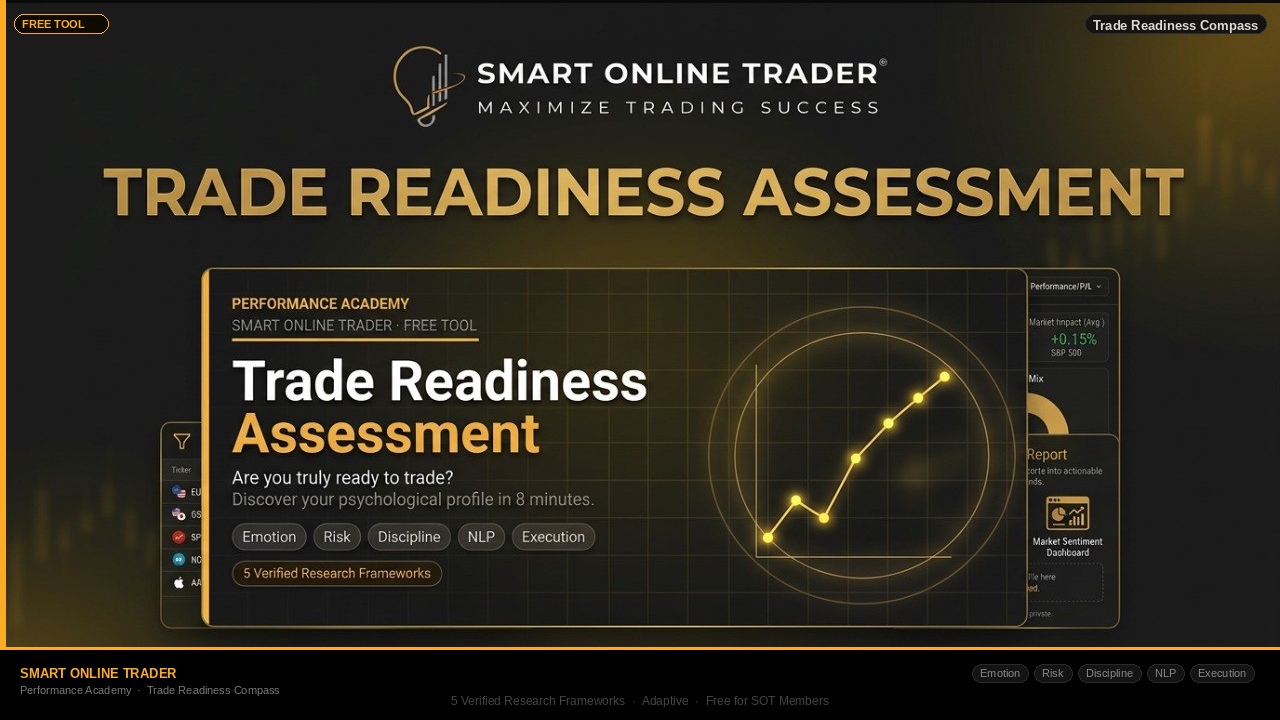
The Smart Online Trader Trade Readiness Compass is a free, structured self-assessment from the Smart Online Trader Performance Academy. In around eight minutes, it builds a clear, honest picture of your readiness across the five dimensions that the research says actually decide whether a trader survives.
It is 25 questions across five domains, drawing on five established research frameworks, with adaptive follow-up probes that adjust to your answers rather than treating every trader the same. It is not a personality quiz and it is not a sales funnel dressed up as a test. It is a diagnostic – and like any good diagnostic, its value is in telling you the truth.
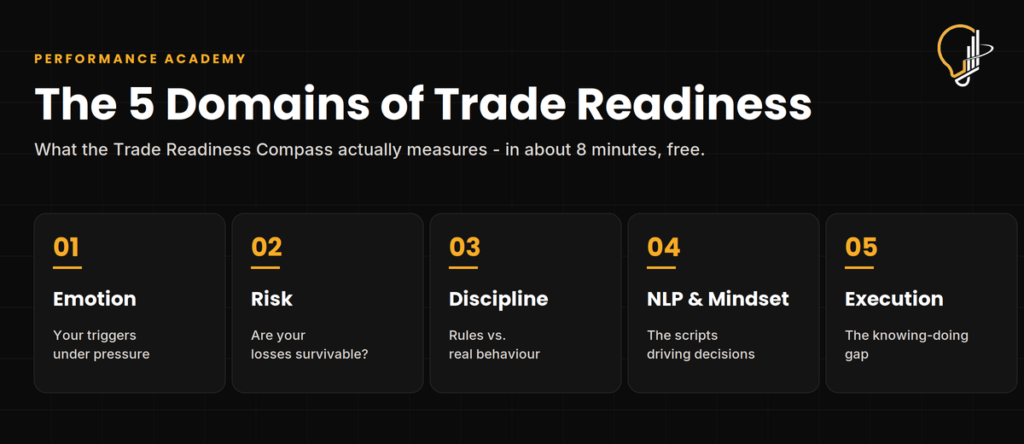
The five domains map directly onto the behavioural science above.
Emotion
This domain looks at how you respond when money is moving against you and for you. Loss aversion, fear, greed and the urge to chase are not character weaknesses – they are wiring shared by every human, including professionals. Readiness means knowing your triggers before the market finds them for you.
Risk
This is where most “winning” traders quietly lose. The +1.2% versus -2.8% asymmetry from the research is a risk-management failure, not a market-reading failure. This domain examines how you size positions, define your loss before you enter, and protect capital so that being wrong is survivable.
Discipline
The disposition effect lives here. Knowing the rule “cut losers, let winners run” is worthless if you systematically do the opposite under pressure. This domain measures the gap between the rules you believe in and the rules you actually follow.
NLP and Mindset
Your beliefs about yourself, about money and about what a loss “means” silently shape every decision you make. Cognitive patterns and self-image drive behaviour long before conscious analysis kicks in. This domain surfaces the internal scripts most traders never examine.
Execution
This is the knowing-doing gap. Plenty of traders can describe the perfect trade and then fail to take it, or take a trade they never planned. Readiness here is about whether you can carry out a plan cleanly when real consequences are on the line.
Your score is not a verdict. It’s a starting position.
When you finish, the Compass places you in one of four readiness bands:
Trade Ready (80+) – your foundations across all five domains are strong and consistent.
Conditionally Ready (65-79) – you have real strengths, with specific, identifiable gaps to close before scaling exposure.
Still Developing (45-64) – the building blocks are forming, and you now know exactly which domains need work.
Foundation Stage (0-44) – you’re early, and that is genuinely good news: you’ve found this out on a free assessment rather than on a funded account.
A low score is not a failure. It is the most valuable thing a trader can own – an accurate map of what to build, before the market charges tuition for the same lesson.
Why we built this, and why it’s free
Most of this industry profits when you don’t know your readiness. The longer you believe the only thing standing between you and success is the next course or the next signal, the more you keep buying.
Smart Online Trader is built the other way around. We profit when you actually become a capable, disciplined trader – because our model is a structured pathway, not a one-off sale. That’s why the Compass is free, why it sits at the front of the Performance Academy, and why it feeds directly into a development plan rather than a checkout page. Learn your true position first. Then build deliberately, practise in a simulated environment where mistakes cost lessons instead of capital, and progress only when the data says you’re ready.
That is the whole philosophy in one tool: sell the system, not the dream.
Take your reading
The traders who survive are not the ones who never have weaknesses. They are the ones who know their weaknesses and build systems around them before risking a cent. You can discover yours in the next eight minutes, for free, inside The Hub.
It is far cheaper to find your gaps here than to let the market reveal them one stop-loss at a time.
Take the Smart Online Trader Trade Readiness Compass free inside The Hub today.
Smart Online Trader and its employees are not licensed Financial Services Providers (FSPs). This content is for educational purposes only and does not constitute financial or investment advice. All trading references relate to skill development in simulated environments. Always consult an authorised FSP before making any trading or investment decisions.
Frequently Asked Questions
What is the Smart Online Trader Trade Readiness Compass?
The Smart Online Trader Trade Readiness Compass is a free self-assessment from the Smart Online Trader Performance Academy. In around eight minutes it measures your readiness across five research-backed domains – Emotion, Risk, Discipline, NLP and Mindset, and Execution – and places you in one of four readiness bands with guidance on what to develop next. It is a diagnostic tool, not financial advice.
How long does the Trade Readiness assessment take?
About eight minutes. The Compass uses 25 questions across five domains, with adaptive follow-up probes that adjust to your answers so the assessment stays relevant to your situation rather than treating every trader the same.
Is the Trade Readiness Compass free?
Yes. The Smart Online Trader Trade Readiness Compass is completely free for Smart Online Trader members and is available inside The Hub under the Learning tab. There is no payment required to take it or to receive your readiness band.
Why do most traders lose money even when they win more trades than they lose?
Research shows many losing traders actually have win rates above 50%. They lose because of behaviour rather than direction: winning trades are taken too small and losing trades are allowed to run too large. This pattern is known in behavioural finance as the disposition effect – selling winners too early and holding losers too long – and it is driven by loss aversion. The Trade Readiness Compass is designed to surface these behavioural tendencies before they cost you.
What does a low Trade Readiness score mean?
A low score is not a failure – it is a clear map of what to build. The four bands range from Foundation Stage to Trade Ready, and each one tells you which of the five domains needs work. Discovering your gaps on a free assessment is far less costly than discovering them while risking capital.
Which five areas does the Smart Online Trader Trade Readiness Compass measure?
The Compass measures five domains: Emotion (how you respond to gains and losses), Risk (whether your losses are survivable), Discipline (the gap between your rules and your behaviour), NLP and Mindset (the beliefs and self-image driving your decisions), and Execution (whether you can carry out a plan under pressure). Each domain is grounded in established behavioural research.
Do I need trading experience to take the Smart Online Trader Trade Readiness Compass?
No. The Compass is built for every stage, from complete beginners to experienced traders who have struggled elsewhere. Beginners get an honest starting position and a clear development path, while experienced traders often discover the specific behavioural gaps that have been quietly undermining their results.
