
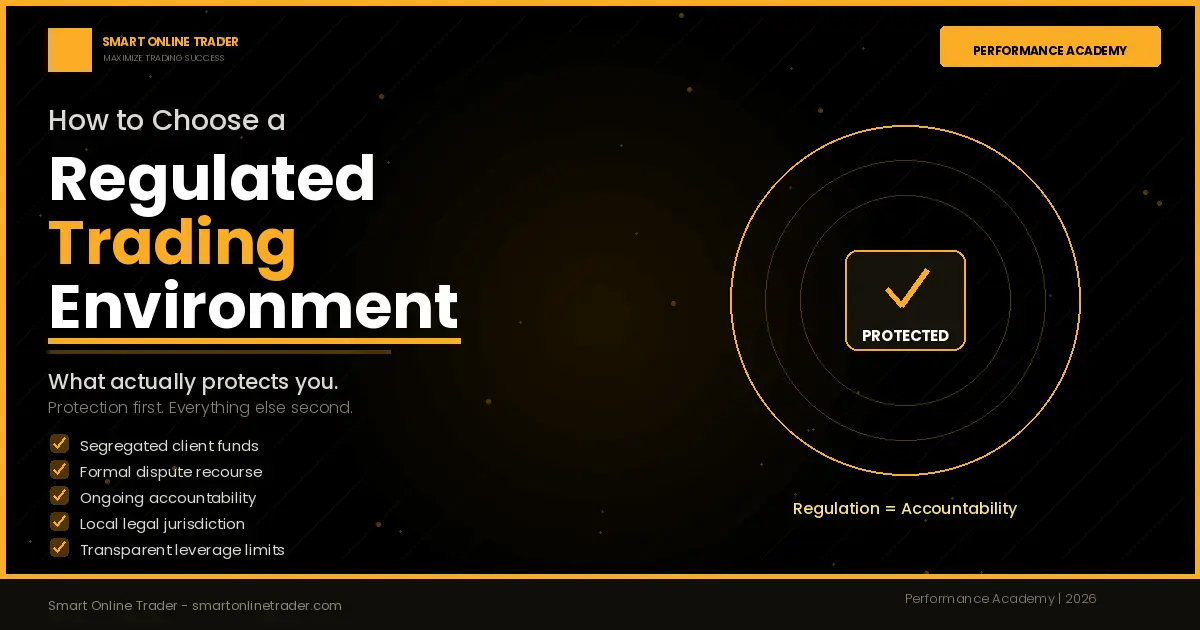
Choosing a regulated trading environment is the single most important decision a trader makes, and it is the one most traders skip entirely. They obsess over strategy, indicators, and entry signals, then hand their capital to whichever broker offered the flashiest bonus or the highest leverage. That is the wrong order of priorities. Before a single trade is placed, the environment that holds your funds, executes your orders, and stands between you and a dispute matters more than any setup you will ever take. This article explains, in plain language, what a regulated trading environment actually protects you from, how South Africa’s regulatory framework works, and the practical checklist for evaluating any environment before you commit a cent. It is written from the perspective that has guided Smart Online Trader from the beginning: protection and longevity first, everything else second.
Why the Trading Environment Matters More Than the Strategy
Here is an uncomfortable truth the industry rarely states plainly. You can have a profitable strategy, flawless discipline, and perfect execution, and still lose everything, if the environment holding your capital is not properly regulated. Regulation does not make you profitable. It does something more fundamental: it removes an entire category of risk that has nothing to do with the market.
When a trader loses money on a trade, that is market risk, and it is the risk every trader signs up for. But when a trader loses money because a broker becomes insolvent and treats client deposits as company assets, or because an unregulated operator simply disappears with the funds, that is not market risk. That is counterparty and custody risk, and a properly regulated environment is specifically designed to eliminate it. The distinction is everything. A regulated environment ensures that any loss you experience is the result of your own market decisions, not someone else’s misconduct.
How South Africa’s Regulatory Framework Actually Works
South Africa operates one of the more credible regulatory frameworks on the African continent, built around the Financial Sector Conduct Authority, known as the FSCA. Understanding how it works is the foundation for evaluating any trading environment you are considering.
The FSCA and the Twin Peaks Model
The FSCA is South Africa’s market conduct regulator for financial institutions, including forex and CFD brokers. It operates under the Financial Sector Regulation Act of 2017 and is responsible for protecting consumers of financial products and services. The FSCA was not always its own body. It evolved from the Financial Services Board, which regulated South Africa’s financial markets from 1990 until 2018. In April 2018, the country adopted a Twin Peaks model, splitting regulation into two bodies: the FSCA, focused on market conduct, meaning how firms treat their customers, and the Prudential Authority, housed within the Reserve Bank, focused on the financial soundness of institutions. The split was adopted to strengthen regulation after the 2008 global financial crisis exposed the weaknesses of single-regulator systems. The practical result is that one body watches how firms behave toward customers while another ensures those firms are financially stable enough to operate.
The ODP Authorisation Requirement
This is the single most important regulatory detail for any South African trader to understand, and it is the one most often overlooked. Since 2018, forex brokers in South Africa specifically require Over-the-Counter Derivative Provider authorisation, known as ODP authorisation, in addition to a general FSP licence. A broker can hold a general FSP licence and still not be authorised to offer derivatives such as forex and CFDs. The licence must explicitly cover derivative instruments.
This requirement has real teeth. Brokers who do not hold ODP authorisation are in contravention of the regulations and can be liquidated at the request of the FSCA. This is not theoretical. In September 2020, the forex broker JP Markets was placed into liquidation following FSCA action, firmly establishing the regulator as the primary authority over the South African forex industry. When you evaluate a trading environment, the existence of valid ODP authorisation is not a nice-to-have. It is the difference between a legal operation and one operating in contravention of the law.
The Five Protections a Regulated Environment Gives You
Stripped of jargon, here is what proper regulation actually delivers to you as a trader. These five protections are the practical substance of why the trading environment matters.
1. Segregated Client Funds
This is the cornerstone protection. FSCA-licensed brokers are required to hold client funds in segregated accounts at South African-registered banks, kept entirely separate from the broker’s own operational capital. The significance is profound. If the broker becomes insolvent, your deposit is not treated as a company asset and cannot be used to pay the broker’s creditors. Your money is your money, ring-fenced and protected, regardless of what happens to the business holding it. The FSCA monitors segregation compliance through annual audits and periodic supervisory reviews. With an unregulated operator, this protection simply does not exist, and your deposit sits commingled with company funds, exposed to every business risk the operator carries.
2. A Formal Complaint and Dispute Process
Regulated environments come with a defined avenue for recourse. If a regulated broker acts against your interests, you can lodge a formal complaint with the FAIS Ombud, the Office of the Ombud for Financial Services Providers, which exists specifically to resolve disputes between financial services providers and their clients in a fair, informal, and economical manner. The Ombud handles claims up to R800,000 and, where mediation fails, can issue a determination that carries the same legal weight as a civil court judgment. This mechanism does not exist with unregulated brokers. If an offshore operator mistreats you, your practical options for redress are limited to non-existent.
3. Ongoing Accountability and Capital Adequacy
FSCA authorisation is not a one-time stamp that a broker earns and forgets. Licensed brokers must meet ongoing capital adequacy requirements, submit regular financial returns, and employ key individuals with documented qualifications. They are subject to audits and supervisory review, and losing a licence carries real consequences, as JP Markets demonstrated. This continuous oversight means a regulated broker has a powerful, ongoing incentive to behave properly, because the cost of misconduct is the loss of the licence that lets them operate at all.
4. Local Legal Jurisdiction
FSCA-regulated brokers are required to have a physical office in South Africa, which ensures that any dispute is governed by South African law and heard in South African forums. This matters enormously in practice. With a locally regulated broker, funds are typically held at South African banks, governed by South African law, which makes both routine transfers and worst-case fund recovery dramatically simpler than with a foreign broker whose funds sit in a jurisdiction you have no practical ability to reach.
5. Transparent Leverage and Cost Disclosure
South African regulation requires brokers to enforce defined leverage limits and to disclose CFD costs transparently. Retail accounts are typically capped at 30:1 for major currency pairs, with lower caps applied to more volatile instruments. This aligns South Africa with EU-style protections. Unregulated offshore brokers frequently advertise leverage of 1:500, 1:1000, or even higher, which sounds attractive and is precisely the kind of feature that destroys retail accounts. A regulated environment’s leverage limits are not a restriction on your freedom. They are a structural protection against the single fastest way retail traders blow up their capital.
An Honest Caveat: What Regulation Does Not Do
Credibility requires honesty, and there is one important limitation worth stating plainly. South Africa does not currently operate a statutory compensation scheme for broker insolvency in the way the United Kingdom does through its Financial Services Compensation Scheme. Segregation of client funds is the primary protection mechanism, and it is a strong one, but it is not the same as a government-backed guarantee that you will be made whole in every conceivable failure scenario. This is exactly why the layered nature of regulation matters: ODP authorisation, segregation, ongoing capital adequacy, audits, and the Ombud process work together to make catastrophic failure unlikely, rather than relying on a single safety net after the fact. A trader who understands this evaluates an environment on the strength of all its protections, not on the assumption of a bailout that does not exist.
The Practical Checklist: How to Evaluate Any Trading Environment
Theory is useful only if it translates into action. Here is the practical process for evaluating any trading environment before you commit capital. It takes a few minutes and costs nothing.
Step 1: Verify the FSP Number on the FSCA Register
Every FSCA-regulated broker must publish its Financial Services Provider number on its website. Take that number to the FSCA’s official public register and verify it directly. This is the single most important step, because a common scam pattern involves operators displaying a fabricated FSP number, or copying a legitimate broker’s number onto a fake website. When cross-checked on the register, a fraudulent number either does not exist or belongs to a completely different company. Always verify the number on the FSCA’s own register, never just in the broker’s marketing materials.
Step 2: Confirm the Licence Covers Derivatives and Is Active
Check three things on the register: that the licence status is Active, not suspended, withdrawn, or under curatorship; that the licence explicitly covers derivative instruments, which is what forex and CFD trading falls under; and that the company name on the register matches the broker you are actually dealing with. A general FSP licence that does not extend to derivatives does not authorise forex trading.
Step 3: Confirm Segregation and Local Presence
Confirm that the broker holds client funds in segregated accounts at South African banks and that it maintains a physical office in South Africa. These two facts establish both the custody protection and the local legal jurisdiction that make recovery and recourse practical rather than theoretical.
Step 4: Watch for the Warning Signs
Certain signals should end your evaluation immediately: an FSP number that does not match the register, a licence status listed as suspended or withdrawn, leverage offers far above the regulated 30:1 retail cap, pressure to deposit before the broker will show proof of regulation, and any reluctance to have credentials verified. A properly regulated broker will never hesitate to have its credentials checked. Operators who push back on verification are precisely the ones to avoid.
Why This Sits at the Heart of the Smart Online Trader Philosophy
Everything Smart Online Trader has built rests on a single principle: longevity through protection and compliance, not shortcuts through hype. The entire SOT ecosystem is structured around a clear separation of stages. Traders learn and develop their skills in a fully simulated environment through the Performance Academy and the Performance Lab, where there is no real capital at risk during the development phase. Only once a trader has demonstrated genuine, governance-compliant competence does the question of live execution in a regulated environment arise.
That live execution stage is conducted exclusively through ATFX SA, the trading name of AT Global Markets SA (Pty) Ltd, which is an Authorised Financial Services Provider regulated by the FSCA under FSP No. 44816, holding the ODP authorisation and licensing that this article describes as non-negotiable. This is a deliberate design choice. The simulation and evaluation stage and the live regulated execution stage are kept entirely separate, so that a trader only ever reaches live markets through a properly regulated environment, after they are ready. Choosing a regulated environment is not a box Smart Online Trader ticks. It is the foundation the entire ecosystem is built on.
Why Smart Online Trader Partners With ATFX
Smart Online Trader understands and respects how hard our traders work for their money. That respect is exactly why, when a trader is ready for live markets, we direct them to a broker whose commitment to regulation and compliance genuinely matches our own. We do not partner lightly, and we do not partner on price. We partner on shared values, and ATFX meets that standard.
ATFX is a globally regulated broker holding nine licences across five continents from some of the most respected financial authorities in the world. These include the Financial Conduct Authority in the United Kingdom (FCA, registration number 760555), the Cyprus Securities and Exchange Commission (CySEC, licence number 285/15), the Australian Securities and Investments Commission (ASIC, AFSL 418036), and, most importantly for South African traders, the Financial Sector Conduct Authority through ATFX SA.
For South African clients specifically, live trading is conducted through ATFX SA, the trading name of AT Global Markets SA (Pty) Ltd, which is regulated by the FSCA under FSP number 44816 and is a licensed OTC Derivatives Provider, holding exactly the ODP authorisation this article describes as non-negotiable. This means a South African trader dealing through ATFX SA receives the full set of local protections covered above: segregated client funds, local legal jurisdiction, FAIS Ombud recourse, and a properly authorised derivatives provider, backed by the strength and oversight of a multi-jurisdiction global group.
This is what it looks like to deal through a genuinely regulated and licensed broker. If you are ready to explore live markets in a properly regulated environment, you can open and explore an ATFX profile here: open your ATFX trading profile. As always, take your time, do your own verification on the FSCA register, and only move to live markets once you are genuinely ready.
The Bottom Line
The trading environment you choose determines whether your losses are limited to honest market risk or expanded to include the risk that someone else mishandles your money. Regulation does not promise profit. It promises accountability, and accountability is the foundation everything else is built on. Verify the FSP number. Confirm the ODP authorisation and derivative coverage. Check for segregation and local presence. Watch for the warning signs. Do this before you place a single trade, because the most sophisticated strategy in the world cannot protect you from an environment that was never built to protect you in the first place. Protection first. Everything else second. That is not caution for its own sake. It is how serious traders, and serious institutions, think about longevity.
Frequently Asked Questions
What is the FSCA and what does it regulate?
The FSCA, or Financial Sector Conduct Authority, is South Africa’s market conduct regulator for financial institutions, including forex and CFD brokers. It operates under the Financial Sector Regulation Act of 2017 and is responsible for protecting consumers, ensuring fair markets, and taking enforcement action against firms that break the rules. It supervises how financial institutions treat their customers, while a separate body, the Prudential Authority, oversees their financial soundness.
What is ODP authorisation and why does it matter?
ODP authorisation, meaning Over-the-Counter Derivative Provider authorisation, is a specific licence required since 2018 for any broker offering forex and CFD trading in South Africa. A broker can hold a general FSP licence yet still not be authorised to offer derivatives. The licence must explicitly cover derivative instruments. Brokers operating without valid ODP authorisation are in contravention of the regulations and can be liquidated at the request of the FSCA, as happened to JP Markets in September 2020.
How do I verify that a broker is actually FSCA-regulated?
Every FSCA-regulated broker must publish its FSP number on its website. Take that number to the FSCA’s official public register and verify it directly, rather than trusting the broker’s marketing materials. Confirm that the licence status is Active, that it explicitly covers derivative instruments, and that the company name on the register matches the broker you are dealing with. A common scam involves displaying a fabricated or copied FSP number that does not match on the register.
What does segregated client funds actually mean?
Segregated client funds means the broker holds your deposit in a separate account at a South African-registered bank, kept entirely apart from the broker’s own operational money. If the broker becomes insolvent, your funds are not treated as a company asset and cannot be used to pay the broker’s creditors. The FSCA monitors this segregation through annual audits and supervisory reviews. It is the cornerstone protection of a regulated environment and does not exist with unregulated operators.
Is there a compensation scheme if a regulated South African broker fails?
South Africa does not currently operate a statutory compensation scheme for broker insolvency in the way the United Kingdom does. The primary protection mechanism is the segregation of client funds, which is strong but is not the same as a government-backed guarantee. This is why the layered protections of regulation, including ODP authorisation, segregation, ongoing capital adequacy, audits, and the FAIS Ombud process, work together to make catastrophic failure unlikely rather than relying on a single safety net after the fact.
Can South Africans legally trade with offshore or international brokers?
South Africans can legally trade with brokers not regulated by the FSCA, but those operators are not governed by South African institutions, client funds are not handled by local banks, and the local protections described in this article do not apply. International brokers may operate in South Africa, but they must be authorised by the FSCA or operate under an approved cross-border exemption to offer the local legal protections that FSCA regulation provides. Trading with a purely offshore broker means giving up segregation under local law, local dispute recourse, and local jurisdiction.
How does Smart Online Trader handle live trading and regulation?
Smart Online Trader separates the learning and evaluation stages, which are fully simulated, from the live execution stage. Skill development happens in simulation through the Performance Academy and the Performance Lab, with no real capital at risk during development. Live execution is conducted exclusively through ATFX SA, the trading name of AT Global Markets SA (Pty) Ltd, an Authorised Financial Services Provider regulated by the FSCA under FSP No. 44816. This separation ensures a trader only reaches live markets through a properly regulated environment, after they have demonstrated readiness.
Want to learn and prove your skills in a fully simulated, risk-free environment first?
Join the SOT Community Hub Free
Not sure where to start? Let Siya map your pathway in three minutes.
Ready to test your readiness for a prop firm evaluation?
IMPORTANT DISCLAIMER
Smart Online Trader and its employees are not licensed Financial Services Providers (FSPs) and do not provide financial, investment, or retirement planning advice. This content is for educational and informational purposes only and does not constitute financial advice, investment recommendations, or a solicitation to buy or sell any financial instrument. Online trading and prop firm trading involves substantial risk of loss and is not suitable for all individuals. Never trade with money you cannot afford to lose. Always consult a licensed Financial Services Provider, a qualified financial advisor, or your registered broker before making any trading or investment decision.
Francois du Plessis operates as an Authorised Representative under supervision of AT Global Markets SA (Pty) Ltd, an Authorised Financial Services Provider, FSP No. 44816, Registration No. 2013/129459/07.
