
Between February 2024 and late 2025, 80-100 prop trading firms closed globally. Before that statistic scares you off – or reassures you – read what actually happened, why it happened, and what it means for South African traders in 2026.
First, Let’s Correct the Number You Probably Heard
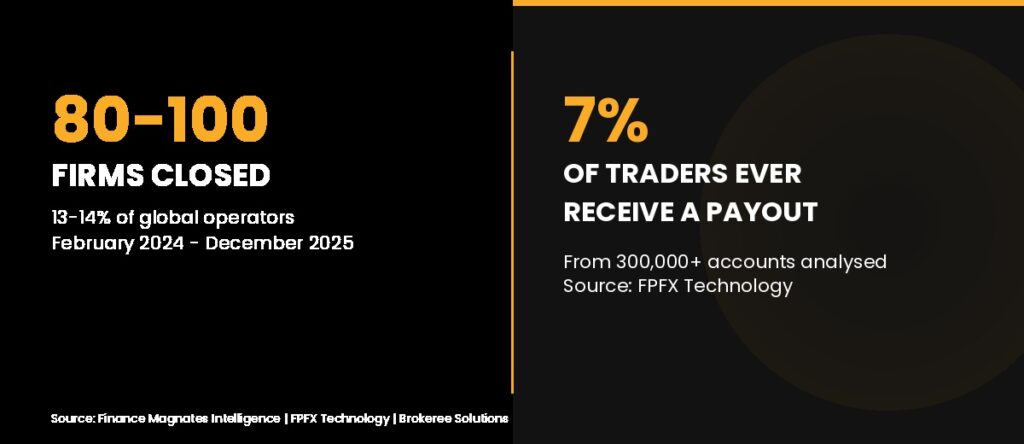
The figure circulating on social media – that 90% of prop firms have closed – is not accurate. The verified number, sourced from Finance Magnates Intelligence and cross-referenced with Brokeree Solutions’ Q1-to-Q4 2024 study of 82 firms, is closer to 13-14% of all global operators. Significant? Absolutely. But not the apocalypse the headlines described.
What made it feel like 90% is that the firms which collapsed were among the most visible in the industry. Their marketing was loudest, their social media presence was largest, and their failures were public and painful for the traders left holding unpaid withdrawals.
The distinction matters because it determines whether prop trading is a space worth your attention – or a sinking ship to avoid entirely. The answer is neither extreme, and the full picture is more useful than the headline.
What Actually Happened: The Structural Failure Behind the Collapse
The MetaQuotes Trigger
On 2 February 2024, MetaQuotes – the company behind MetaTrader 4 and MetaTrader 5, the dominant retail trading platforms – began revoking platform licences from prop firms serving US clients or operating without proper broker relationships. Within weeks, the cascade began.
True Forex Funds announced permanent closure on 13 May 2024, citing financial insolvency and leaving approximately 300 traders with an estimated $1.2 million in outstanding payouts. SurgeTrader followed on 24 May 2024. The Funded Trader paused operations on 28 March 2024, later admitting to over $2 million in denied payouts. Within nine months, MetaTrader’s market share among prop firms dropped from 48% to just 24%, according to FPFX Technology data across 300,000 accounts.
For firms that had built their entire infrastructure on MetaTrader licences they did not fully control, this was a single point of failure that proved fatal.
The Deeper Problem: A Business Model Built on Failure
The MetaQuotes crackdown was the trigger. But it only pulled the trigger on a model that was already structurally compromised.
Most of the firms that collapsed shared the same revenue architecture: they collected challenge fees from traders, and the business only worked if the overwhelming majority of those traders failed their evaluations. According to FPFX Technology data covering more than 300,000 accounts, only 7% of traders who purchase a prop firm challenge ever receive a payout. Only 14% pass their initial challenge. That means 86% of challenge fees were pure revenue – and firms were entirely dependent on that cycle continuing indefinitely.
“When you build a business model that requires your clients to fail in order for you to survive, you have not built a trading firm. You have built a fee-collection scheme with trading branding.”
When external pressure arrived – platform access cut off, regulatory scrutiny increasing, and sign-ups slowing as trader sentiment turned negative – firms running on month-to-month challenge fee revenue had nothing underneath them. They could not pay withdrawals from trading profits that did not exist. Some had never genuinely hedged or executed trades in real markets at all.
Regulatory Pressure Compounded the Damage
The CFTC filed a complaint against My Forex Funds in August 2023, alleging $310 million in fees collected from over 135,000 traders. Italy’s Consob, Belgium’s FSMA, and Spain’s CNMV all issued public warnings specifically targeting prop trading firms. The UK’s FCA charged nine individuals in May 2024 with promoting an unauthorised forex trading scheme. Regulatory pressure was building globally long before the MetaQuotes crackdown – the platform issue simply accelerated an already unstable situation.
What This Means for South African Traders Specifically
South African traders have been among the most active participants in the global prop trading space. The appeal is understandable: access to simulated capital in a country where building a meaningful trading account from rand-denominated savings is a slow process. The rand-dollar exchange rate makes US-dollar funded accounts particularly attractive as a performance vehicle.
From a legal standpoint, prop trading remains fully accessible. South African residents are legally permitted to contract with overseas prop firms. The FSCA oversees licensed brokers and financial services providers, but prop firms – which do not manage client funds in the traditional sense – generally fall outside that regulatory perimeter. There is no law preventing South African traders from participating in prop firm evaluations. Trading income from international prop firms must be declared to SARS under the progressive income tax structure of 18% to 45%.
What the 2024 collapse changed is not the legal landscape. It changed the due diligence requirement. With over 240 entities now on the CFTC’s RED List and the industry having demonstrated that well-marketed firms can collapse and leave traders with zero recourse, the cost of choosing the wrong firm has become far higher than the evaluation fee itself.
The Industry Did Not Die – It Consolidated
Here is what the collapse narrative misses: the firms with proper infrastructure, regulated broker relationships, and genuine capital reserves did not just survive – they grew significantly.
The firms with proper broker infrastructure did not just hold steady – they accelerated. Industry data published by Finance Magnates Intelligence shows the leading prop trading operations grew revenue by over 50% year-on-year through 2024, with open trading accounts rising by more than a third. By early 2025, the largest operators were making multi-hundred-million-dollar acquisitions of regulated brokers – a signal that the serious end of the industry was consolidating fast, not retreating.
Match-Trader – the trading platform that the SOT Performance Lab operates on via QuickTrade.World – saw a 290% increase in server clients following the MetaQuotes crackdown. Firms that had the foresight to build on platforms independent of MetaQuotes were not just unaffected. They captured significant market share from the firms that collapsed.
This is not an industry that collapsed. It is an industry that corrected. The fee-collection schemes exited. The firms with real infrastructure, genuine broker backing, and transparent operations are now larger and more dominant than they were before February 2024.
What a Legitimate Prop Trading Pathway Looks Like in 2026
The firms that survived the 2024 correction shared specific structural characteristics that any South African trader should now treat as non-negotiable due diligence criteria before paying any evaluation fee.
1. A Verified Broker Relationship
The single point of failure for most collapsed firms was their dependency on a single platform provider with no genuine broker infrastructure behind them. A legitimate prop trading pathway runs through a licensed, regulated broker – such as ATFX SA, the live trading partner in the SOT ecosystem. This means trades are executed in real market conditions, risk is genuinely managed, and the platform is not contingent on a third-party licence that can be revoked without warning.
2. Platform Independence
Firms with proprietary or diversified platform infrastructure cannot be cut off by a single provider decision. Match-Trader, cTrader, DXtrade, and TradeLocker now collectively power a significant and growing portion of the industry. Platform independence is a structural strength – not a minor technical detail.
3. Revenue That Does Not Depend on Trader Failure
This is the structural question that separates sustainable prop firm models from fee-collection schemes. If a firm’s primary revenue is challenge fees, and that model requires most traders to fail in order to remain profitable, the incentive structure is fundamentally misaligned with trader development. A sustainable model generates revenue from trader performance – not from trader failure. The broker-backed model now emerging as the industry standard generates revenue from actual trading volume on live markets.
4. A Development Pathway, Not Just a Challenge
The traders who pass prop firm evaluations at significantly higher rates are not those who simply attempt more challenges. They are traders who developed a structured system first – a process, a risk framework, a psychological approach to rule-constrained environments – before attempting an evaluation. The evaluation is a test of that system. Without the system, the evaluation is a lottery. This is precisely what the SOT Performance Academy is built around.
FPFX data across 300,000 accounts shows that the majority of evaluation failures are not caused by strategies that lack edge. They are caused by behavioural failures: revenge trading after losses, oversizing positions under pressure, and violating drawdown limits in the final days of a challenge window. These are not technical problems. They are structural ones – the direct result of trading without a system that has been built and tested before real stakes are introduced.
The Question South African Traders Should Actually Be Asking
The wrong question is: “Is prop trading dead?”
The right question is: “Am I approaching this as a structured trader, or as someone buying a lottery ticket with financial branding?”
The 2024 collapse removed a large number of firms that were monetising trader aspiration without genuinely investing in trader development. It also created a market that is significantly more transparent, more regulated, and more demanding than it was eighteen months ago. Traders who have done the foundational work – built a system, proved consistency in a structured environment, and developed genuine risk discipline – are entering a prop trading landscape that is cleaner, better capitalised, and more aligned with genuine performance than it has ever been.
Traders who skip that foundation and treat the evaluation as the starting point rather than the finishing point face exactly the same odds they always did. The data is consistent on this.
Prop Trading Is Not Dead. Unprepared Trading Is.
The prop trading industry grew 1,264% in search interest between December 2015 and April 2024. It corrected sharply when unsustainable models were exposed. It is now consolidating around firms with regulated broker infrastructure, transparent operations, and business models that generate revenue from trader success – not trader failure.
For South African traders, the opportunity is real – and more credible now than it was twelve months ago. But the route to that opportunity has always run the same way: structured education, consistent practice in a risk-managed simulated environment, verified performance, and then a prop firm evaluation as the culmination of a development process – not the beginning of one. That process starts in The Hub.
The traders who approach it that way are not among the 93% who never receive a payout. They are the 7% who do.
Where Do You Stand? Take the Prop Firm Readiness Compass
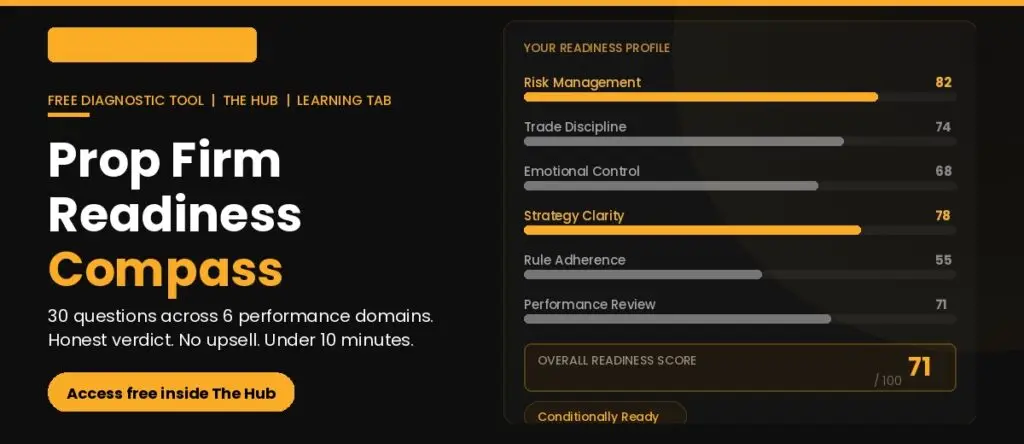
Before you pay a single challenge fee, find out whether your trading system, risk discipline, and psychological framework are actually ready for a structured evaluation environment. The SOT Prop Firm Readiness Compass is a free diagnostic tool built specifically for this purpose – available to all members inside the Smart Online Trader Client Portal and Hub under the Learning tab. Hub access is complimentary. It takes less than ten minutes and gives you a clear, honest verdict across six performance domains – no hype, no upsell, just the data you need to make an informed decision.
Smart Online Trader – Performance Academy
Build the System Before You Take the Evaluation
The SOT pathway gives you the structured development environment, daily pre-market sessions, and performance framework the 7% who succeed build their trading on. Your $5,000 simulated prop firm evaluation is already included at Month 7 – no separate challenge fee required.
Frequently Asked Questions
How many prop firms actually closed in 2024?
Between 80 and 100 proprietary trading firms ceased operations globally between February 2024 and late 2025, representing approximately 13-14% of all global operators, according to Finance Magnates Intelligence and Brokeree Solutions research. The figure of 90% sometimes cited on social media is not accurate.
What caused the prop firm collapse in 2024?
The primary trigger was MetaQuotes revoking platform licences from prop firms serving US clients or operating without proper broker relationships from 2 February 2024. This exposed a deeper structural problem: most affected firms depended almost entirely on challenge fee revenue from traders who failed evaluations, with no genuine broker infrastructure or capital reserves underneath.
Is prop trading legal in South Africa in 2026?
Yes. South African residents are legally permitted to contract with international prop trading firms. The FSCA regulates licensed brokers and FSPs, but prop firms generally fall outside this regulatory scope as they do not manage client funds in the conventional sense. All trading income from international prop firms must be declared to SARS under the progressive income tax system of 18% to 45%.
What percentage of prop firm traders actually get paid?
According to FPFX Technology data analysed across more than 300,000 prop trading accounts, only 7% of traders who purchase a prop firm challenge ever receive a payout. Only 14% pass their initial challenge evaluation. The majority of failures are caused by behavioural issues – revenge trading, oversizing positions, and drawdown violations – rather than a lack of strategic edge.
Did established prop firms survive the 2024 collapse?
Yes – firms with proper broker infrastructure, regulated corporate structures, and genuine capital reserves not only survived but grew significantly through 2024. Industry data shows leading operators posted revenue growth of over 50% year-on-year and expanded their account bases by more than a third. The collapse eliminated the weakest operators while accelerating consolidation among those built on sustainable foundations.
What should South African traders look for in a legitimate prop firm in 2026?
Four criteria are now non-negotiable: a verified regulated broker relationship, platform independence from any single provider, a revenue model that does not depend primarily on trader failure, and a genuine trader development pathway rather than a standalone challenge product. Traders should also verify payout history through independent reviews and check that the firm or its underlying broker carries recognised regulatory licences.
How is Smart Online Trader’s Performance Lab different from a standalone prop firm challenge?
The SOT Performance Lab is not a standalone challenge product. It is a milestone inside a structured 12-month trader development pathway. Members develop their system through the Performance Academy before arriving at a $5,000 simulated prop firm evaluation at Month 7. SOT’s primary revenue is generated through live trading volume via its ATFX SA broker relationship – meaning the business model is aligned with trader success, not trader failure.
Disclaimer: Smart Online Trader and its employees are not licensed Financial Services Providers (FSPs). This content is for educational purposes only and does not constitute financial or investment advice. Always consult an authorised FSP before making any trading or investment decisions.
