
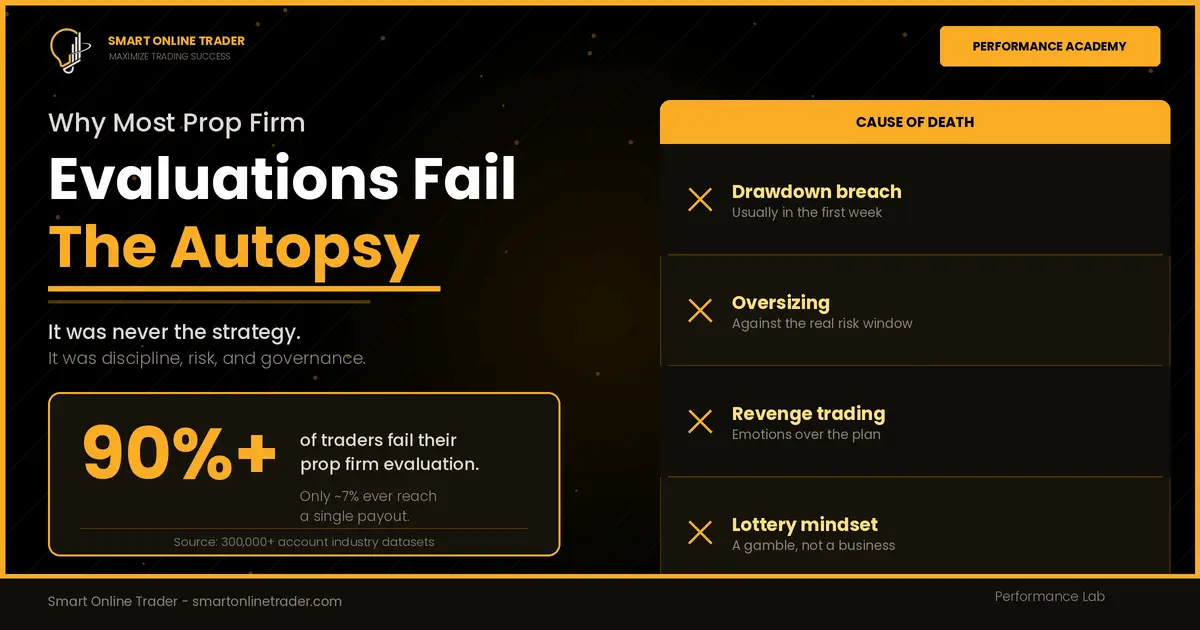
Somewhere between 90 and 95 percent of traders who attempt a prop firm evaluation fail it. That is not a marketing exaggeration designed to scare you into buying something. It is the consistent finding across multiple independent datasets, including one study of more than 300,000 trading accounts. Only about 5 to 10 percent of traders pass, and just 7 percent ever receive a payout. Those numbers are brutal. But here is what almost nobody in this industry will tell you honestly: the traders who fail do not fail because their strategy was wrong. They fail for reasons that are entirely diagnosable, entirely predictable, and entirely preventable. This article is the autopsy. We are going to open up the failed evaluation, examine exactly what killed it, and show you how to make sure yours survives.
The Numbers Nobody Wants to Frame Honestly
The prop firm industry has a marketing problem, and it works against you. Every firm sells the dream of getting funded, the screenshots of five-figure payouts, the promise that capital is one evaluation away. What they do not put on the landing page is the failure rate. So let us put it here, plainly.
Across independent datasets, the picture is remarkably consistent. Roughly 5 to 10 percent of traders pass their evaluation. Only about 7 percent of everyone who buys a challenge ever reaches a single payout. The average trader needs 2 to 4 attempts before a first funded account, and for most participants the cumulative cost of failed attempts outweighs anything they eventually earn. In plain terms, the expected value of walking into an evaluation unprepared is negative.
This is not because the system is rigged. Well-run firms make money when their traders succeed, not just when they fail. The evaluation is hard for a specific reason, and understanding that reason is the difference between joining the 7 percent and funding the industry with your failed retries.
Cause of Death: It Was Never the Strategy
Here is the single most important finding from the data, and it is the one that changes everything about how you should prepare. The most common failure mode is not a strategy that lacks edge. It is behavioural. Oversizing, revenge trading, and drawdown violations account for the overwhelming majority of failed evaluations.
Read that again, because it inverts the entire way most traders prepare. Traders who fail spend their preparation time hunting for a better strategy, a new indicator, a sharper entry signal. But the strategy was almost never the cause of death. The autopsy reveals something else entirely on the table: a breakdown in discipline, risk control, and psychological governance under the specific pressure of trading to someone else’s rules.
As one industry analysis put it, the evaluation is genuinely hard, but it is hard for psychological reasons, not strategic ones. That is the whole game. And it is precisely why a trader who is profitable in their own relaxed personal account can walk into an evaluation and fail within days.
The Four Things That Actually Kill Evaluations
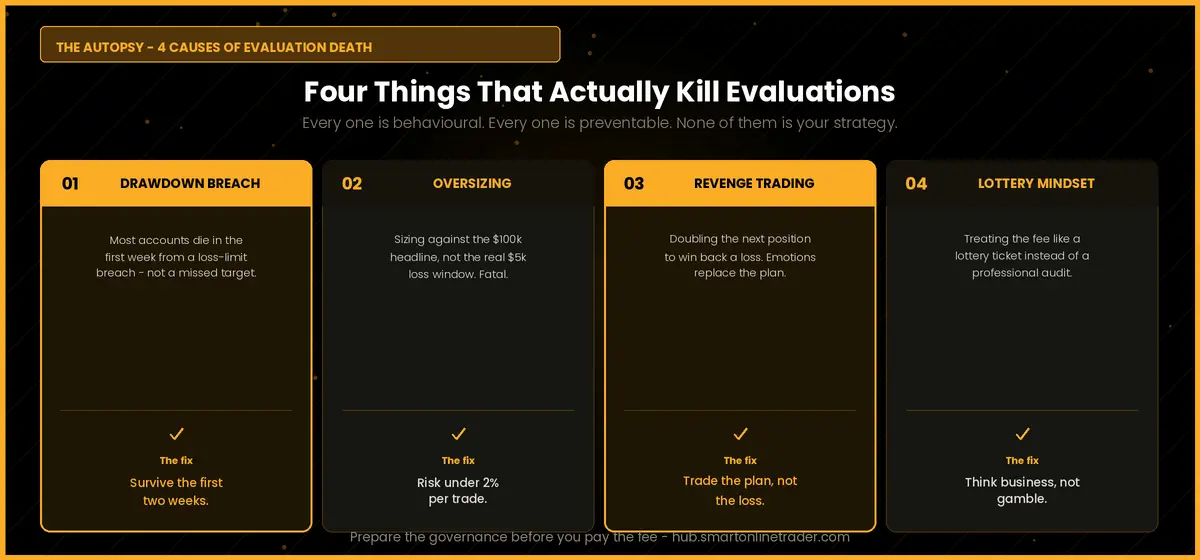
When you examine enough failed evaluations, the causes of death cluster into four repeating patterns. Every one of them is behavioural. Every one of them is preventable.
1. The Drawdown Breach, Usually in the First Week
This is the number one killer, and its timing is the detail almost nobody talks about. The majority of evaluation failures happen in the first week, from a daily loss limit or maximum drawdown breach, not from a trader who reaches day 25 and narrowly misses the profit target. Most accounts die early and die from a loss limit, not late from a missed goal.
The mechanism is simple and cruel. A trader has a $100,000 account but only a $5,000 loss window before breaching. They size their positions against the $100,000 headline number rather than the $5,000 reality, take a couple of normal losing trades, and the account is gone before the strategy ever had a chance to work. The implication is powerful: a trader who simply survives the first two weeks without a drawdown breach has dramatically better odds than the headline 5 percent suggests.
2. Oversizing Against the Real Risk Window
The data here is unambiguous. Traders who risk less than 2 percent of their account per trade pass at significantly higher rates, roughly 40 percent more likely to succeed than those who risk more. Yet the pressure of a profit target and a ticking clock pushes most traders to size up, chasing the target quickly instead of surviving toward it. Oversizing is not a strategy decision. It is a governance failure, and it is fatal inside a narrow drawdown window.
3. Revenge Trading After a Loss
A losing trade is a normal event. What kills the evaluation is what happens next. The trader who takes a loss and immediately doubles the next position to win it back has stopped trading their plan and started trading their emotions. Prop firm rules are specifically designed to expose exactly this behaviour, because it is the clearest signal of a trader who cannot yet govern themselves under pressure.
4. Treating the Evaluation Like a Lottery Ticket
This is the root cause beneath the other three. Many traders approach a challenge with a gambling habit rather than a business plan. They treat the evaluation fee as the price of a lottery ticket rather than the entry cost of a professional audit. The trader who thinks in lottery terms over-leverages to win big quickly. The trader who thinks in business terms takes small, disciplined, repeatable positions and lets probability do the work within the risk window. Passing a challenge is proof you can operate like a professional within structure, not emotion.
Why Good Traders Fail Anyway
Here is the part that catches skilled traders off guard. You can be genuinely profitable in your own account and still fail an evaluation, because the evaluation introduces a variable your personal trading never had: someone else’s rules, and the pressure that comes with them.
In your own account, a drawdown is uncomfortable but not fatal. In an evaluation, a drawdown breach is instant death. In your own account, there is no clock. In an evaluation, the profit target and time window create urgency that distorts decision-making. In your own account, the money is yours and the psychology is familiar. In an evaluation, you are trading toward a rule set your governance framework was never built to handle. The skill did not disappear. It was overwhelmed by a pressure environment the trader never trained for.
This is why the honest answer to “how do I pass” is almost never “find a better strategy.” It is “build the governance to survive the rules.”
The Autopsy’s Conclusion: How to Actually Survive
Every cause of death on the table points to the same prescription. Survival is not about a sharper edge. It is about structure, discipline, and preparation. Here is what the data says actually works.
Risk small. Keeping risk under 2 percent per trade, and often closer to 0.5 to 1 percent, is the single biggest measurable differentiator between those who pass and those who do not. Protect the first two weeks. Since most accounts die early from drawdown breaches, simply surviving the opening period without a breach dramatically improves your odds. Know the rules cold. Accidental disqualification from a misunderstood trailing drawdown or consistency clause is entirely avoidable. Treat it as a business audit, not a lottery. The mindset shift from gambling to process is the foundation everything else rests on. And prepare the governance before you pay the fee, not after you have failed.
Where Smart Online Trader Fits This Exactly
This is the entire reason the Smart Online Trader approach exists, and why it is built the way it is. The autopsy proves that evaluations are failed on discipline and governance, not strategy. So the Smart Online Trader ecosystem is built to develop precisely those things, in the right order, before you risk an evaluation fee.
It starts with honest diagnosis. The Prop Firm Trade Readiness Compass, free inside the SOT Community Hub, is purpose-built to assess the exact competencies this autopsy identified as causes of death: drawdown discipline, daily loss limit adherence, consistency across a multi-day window, and the psychological governance of trading to strict rules. It tells you, before you pay a fee, whether you are ready, and precisely which gaps to close if you are not.
From there, the Performance Lab lets you develop and prove that governance in a fully simulated environment, where the lessons cost nothing but effort. You build the discipline, the risk control, and the rule-adherence that the evaluation demands, in a setting designed to develop them rather than simply take a fee when they are absent. The goal is simple and honest: to make sure that when you do attempt an evaluation, you are walking in as one of the prepared few, not funding the statistics as one of the unprepared many.
The Bottom Line
The 90 percent do not fail because trading is impossible or because the system is rigged against them. They fail because they walk into a professional audit with a lottery ticket mindset, size positions against a headline number instead of a real risk window, and have never built the governance to survive someone else’s rules under pressure. Every one of those is fixable. The autopsy is not a death sentence for your funded-trading ambition. It is the diagnosis that, taken seriously, moves you from the 90 percent to the 7 percent. Prepare the discipline before you pay the fee. That is the whole difference.
Frequently Asked Questions
What percentage of traders actually pass prop firm evaluations?
Across multiple independent datasets, including a study of over 300,000 accounts, roughly 5 to 10 percent of traders pass their evaluation, and only about 7 percent of everyone who buys a challenge ever receives a payout. The average trader takes 2 to 4 attempts before a first funded account. These figures are self-reported by firms and not independently audited, so treat them as directional, but they are strikingly consistent across sources.
Why do most traders fail prop firm evaluations?
Not because of poor strategy. The most common failure modes are behavioural: breaching drawdown or daily loss limits, oversizing positions, and revenge trading after a loss. Industry data is clear that the evaluation is hard for psychological and discipline reasons, not strategic ones. Most failures also happen early, often in the first week, from a loss-limit breach rather than from missing the profit target at the end.
Can a profitable trader still fail an evaluation?
Yes, and it happens often. A trader who is profitable in their own relaxed account can fail because the evaluation introduces variables their personal trading never had: a hard drawdown limit where a breach means instant disqualification, a profit target, and a time window that creates pressure. The skill does not disappear. It gets overwhelmed by a rule environment the trader never trained for.
How much should I risk per trade during an evaluation?
The data strongly favours conservative risk. Traders who risk under 2 percent of their account per trade pass at significantly higher rates, around 40 percent more likely to succeed, and many disciplined traders keep risk closer to 0.5 to 1 percent. The reason is the narrow drawdown window: on a $100,000 account you may only have a $5,000 loss buffer, so sizing against the headline number rather than the real risk window is a common and fatal mistake.
Why is surviving the first two weeks so important?
Because most evaluation accounts die early. The majority of failures come from drawdown or daily loss limit breaches in the first week, not from traders who reach the final day and narrowly miss the target. A trader who survives the opening two weeks without a breach has dramatically better odds than the headline pass rate suggests. Early survival is a governance outcome, not a strategy outcome.
How can I prepare properly before paying for an evaluation?
Prepare the governance before the fee, not after a failure. Start by honestly assessing your readiness across the exact competencies evaluations test: drawdown discipline, loss-limit adherence, multi-day consistency, and psychological control under rules. The free Prop Firm Trade Readiness Compass inside the SOT Community Hub is built for exactly this, and the Performance Lab lets you develop and prove that governance in a fully simulated environment first.
Are prop firm evaluations a scam because so many people fail?
A high failure rate does not by itself mean a scam. Well-run firms earn from profit splits when traders succeed, not only from evaluation fees, so their sustainable interest is in funding traders who can follow rules and produce profits. That said, the industry has seen many firms restructure or close, so verifying a firm’s rules, transparency, and payout history matters. The low pass rate is primarily a reflection of how few traders arrive with the discipline and governance the evaluation demands.
Find out if you are ready, before you pay an evaluation fee.
Take the Prop Firm Readiness Compass Free
Develop and prove your governance in a fully simulated environment.
IMPORTANT DISCLAIMER
Smart Online Trader and its employees are not licensed Financial Services Providers (FSPs) and do not provide financial, investment, or retirement planning advice. This content is for educational and informational purposes only and does not constitute financial advice, investment recommendations, or a solicitation to buy or sell any financial instrument. Online trading and prop firm trading involves substantial risk of loss and is not suitable for all individuals. Never trade with money you cannot afford to lose. Prop firm evaluations referenced in this article operate in a simulated environment. Always consult a licensed Financial Services Provider, a qualified financial advisor, or your registered broker before making any trading or investment decision.
Francois du Plessis operates as an Authorised Representative under supervision of AT Global Markets SA (Pty) Ltd, an Authorised Financial Services Provider, FSP No. 44816, Registration No. 2013/129459/07.
