
Geopolitical events and commodity prices are connected far more tightly than most people realise. When a conflict flares thousands of kilometres away, the effect rarely stays there. It shows up close to home, at the fuel pump, in the grocery aisle, and in the monthly petrol price adjustment that every South African household feels. Understanding why that happens is one of the most practical forms of financial literacy available today, and it is the foundation of trading commodities with skill rather than emotion.
This article breaks down how geopolitical events and commodity prices are linked, and what that means for the raw materials our daily lives depend on. It also shows how to build the ability to read these markets responsibly, in a structured, simulated environment, without gambling on headlines.
Why Geopolitical Events and Commodity Prices Move Together
Commodities are physical goods. Crude oil, natural gas, gold, wheat, and copper all have to be produced somewhere, shipped through real routes, and delivered to real buyers. That physical nature is exactly why they are so sensitive to world events. A pipeline, a port, or a single narrow shipping lane can become the difference between plentiful supply and sudden scarcity.
There is a second layer that catches new traders off guard. Markets do not simply price what is happening right now. They price what participants expect to happen next. A commodity can rise on the mere threat of disruption, long before a single barrel actually goes missing. In other words, expectation moves price as powerfully as reality does. This is the single most important idea behind every commodity move, and it is where disciplined analysis begins.
The 2026 Iran War: A Live Case Study in Geopolitical Events and Commodity Prices
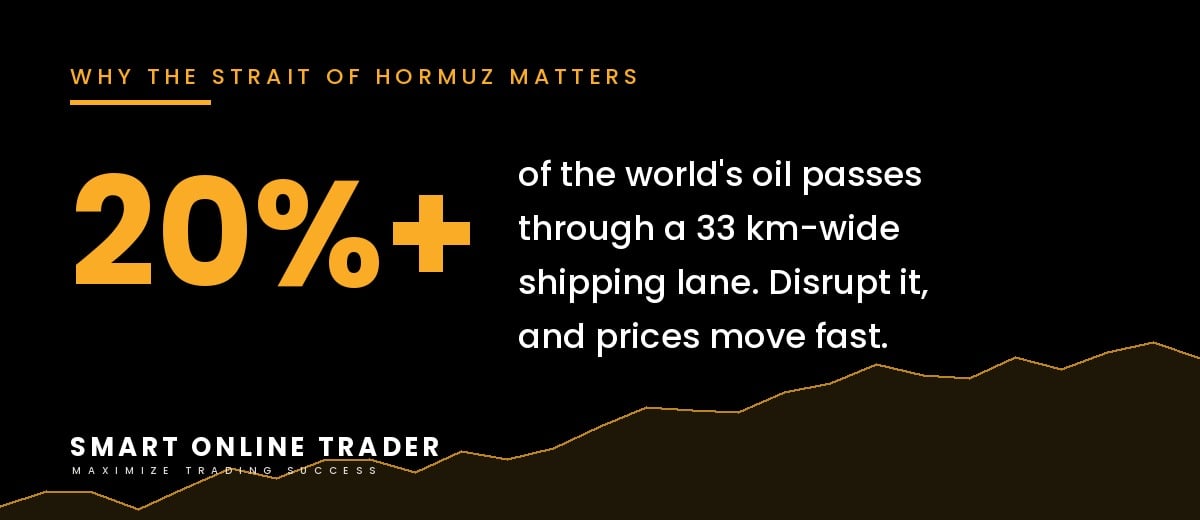
The current conflict centred on Iran offers a textbook illustration. Much of the world’s seaborne oil travels through the Strait of Hormuz, a waterway only around 33 km wide at its tightest point. More than 20 percent of global oil flows through it. When that chokepoint comes under threat, energy markets react immediately.
Through 2026, as tensions escalated and eased, the price of Brent crude swung dramatically. It climbed above 110 US dollars a barrel during the sharpest phases of the crisis, then fell back toward 70 dollars when a ceasefire briefly held, then rose again as hostilities resumed and tankers avoided the strait. Gold, meanwhile, held above 5,000 dollars an ounce as investors moved toward assets they view as safe during instability. None of this is a forecast. It is simply a clear example of how quickly geopolitical events and commodity prices feed into one another.
The Commodities That React First to Geopolitical Events
Not every commodity responds to the same events in the same way. Knowing which market reacts to which trigger is a core skill, and it is exactly what a structured education teaches. Here are the four groups that tend to move first.
- Energy. Oil and natural gas are the most obvious. Supply routes, production decisions, and conflict near major producers all move energy prices, which then feed straight into transport and manufacturing costs.
- Gold and precious metals. Gold behaves like a hybrid between a commodity and a currency. In times of fear, demand for it often rises, which is why it is called a safe-haven asset.
- Agricultural (soft) commodities. Wheat, maize, and other soft commodities depend on growing seasons, shipping, and fertiliser supply. Conflict and trade disruption can lift food prices worldwide.
- Industrial metals. Copper is nicknamed Dr Copper because its price gives a real-time read on the health of the global economy. When growth expectations shift, industrial metals move.
These are not abstract categories. They are the exact modules covered inside our comprehensive Commodities course in The Hub, from the world of commodities and what makes prices move, right through to execution and professional-grade strategy.
How Commodity Prices Reach Your Household in South Africa
For South Africans, the link is especially direct. Higher crude prices lift the landed cost of fuel, which flows into the monthly petrol and diesel price. Because almost everything we buy is transported by road, a fuel increase quietly raises the cost of food, deliveries, and daily commuting. A weaker rand can amplify the effect further, since oil is priced in US dollars.
So a conflict on the other side of the world genuinely reaches your household budget. Recognising that chain of cause and effect is empowering. It turns confusing news headlines into something you can actually understand, and in time, something you can learn to analyse as a trader.
The Long-Term Picture: Commodity Prices, Inflation, and R10,000
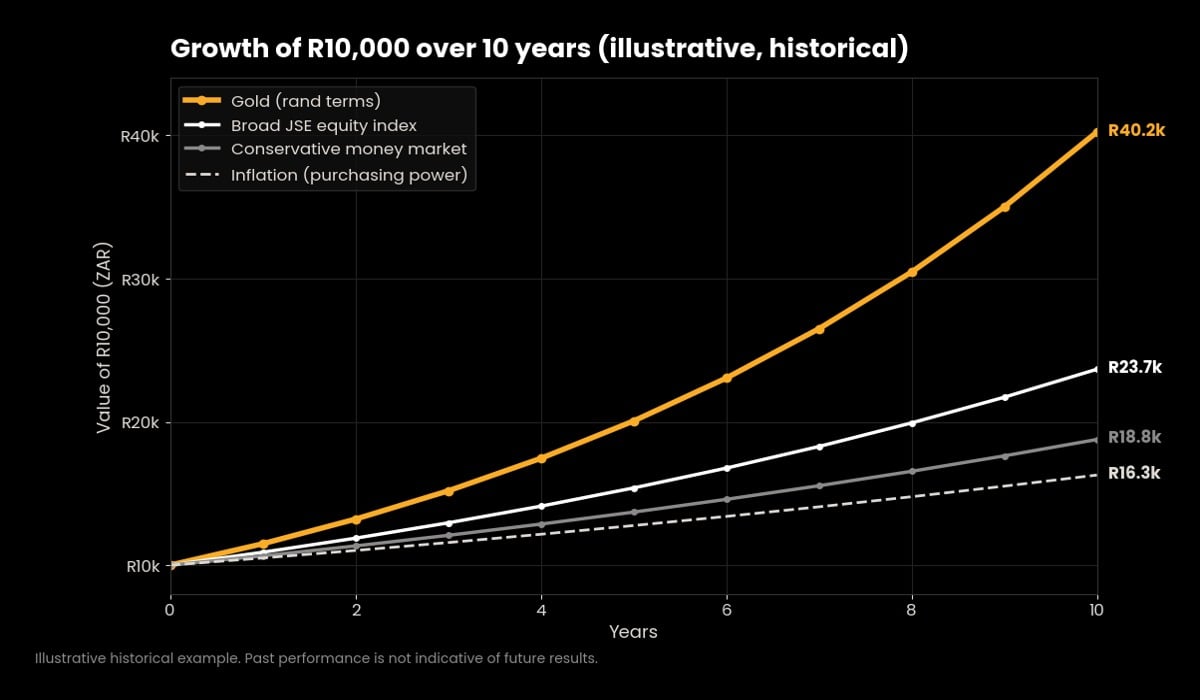
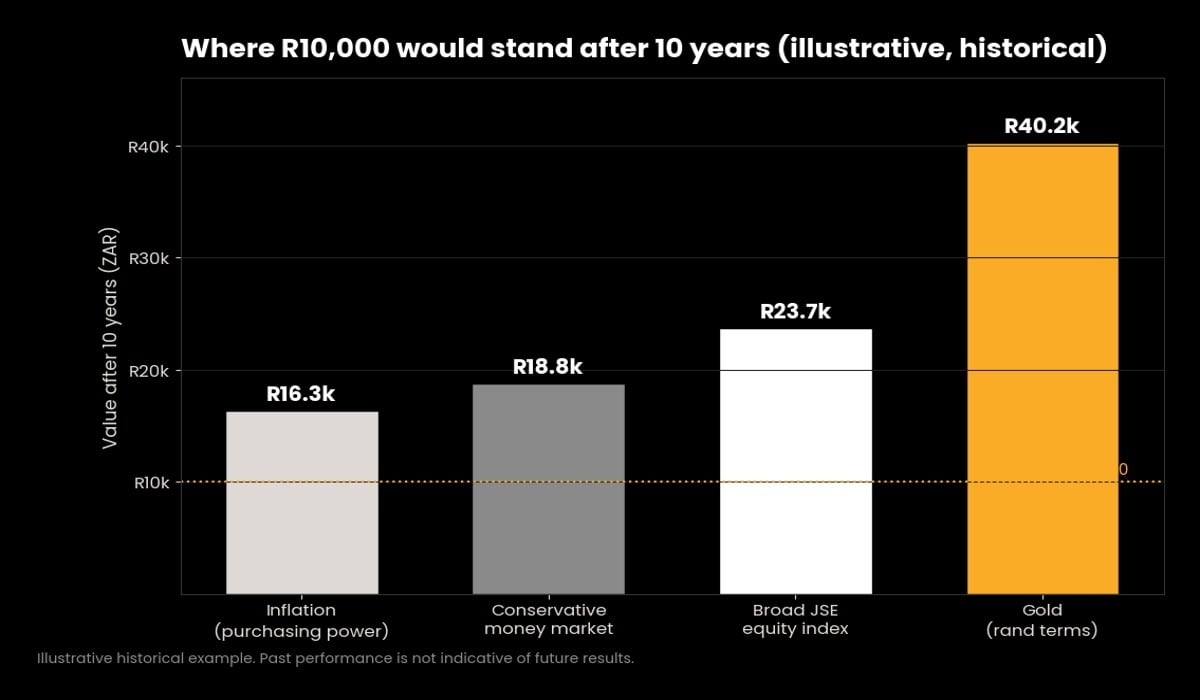
Daily headlines are one side of the story. The long-term side is quieter, but arguably more important. To see why understanding geopolitical events and commodity prices matters over time, consider a simple historical illustration. Where would R10,000 stand today if it had been placed in different homes about ten years ago? The table below is a purely historical, illustrative comparison, not a projection.
| Where the R10,000 went | Roughly per year | Value after about 10 years | Versus inflation |
|---|---|---|---|
| Left as cash, uninvested | 0 percent | R10,000 | Lost around 40 percent of its buying power |
| Kept pace with inflation | about 5 percent | about R16,300 | Breakeven in real terms |
| Conservative money market | about 6.5 percent | about R18,800 | Slightly ahead |
| Broad JSE equity index | about 9 percent | about R23,700 | Comfortably ahead |
| Gold, in rand terms | about 15 percent | about R40,200 | Far ahead |
Over this specific window, South African inflation averaged roughly 5 percent a year, so R10,000 needed to grow to about R16,000 just to stand still. Conservative instruments edged slightly ahead of that line. Gold, measured in rand, rose about 302 percent over the decade, driven in large part by the very link between geopolitical events and commodity prices described above.
Two Honest Cautions About Commodity Prices
Two honest cautions belong right next to those numbers. First, gold was the standout. A broad basket of commodities is far more volatile and has endured long flat or losing stretches, so “commodities” and “gold” are not the same story. Second, buying and holding an asset is not the same as actively trading it. Trading commodities through instruments like contracts for difference is high-risk, and the majority of retail traders lose money. Figures like these show opportunity, not a promise.
Past performance is not indicative of future results. The figures above are historical illustrations for education only. They are not projections, not advice, and not a guarantee of any return. All investing and trading carries the risk of loss.
Why Knowledge and Mentoring Beat Luck in Commodity Markets
Here is the uncomfortable truth inside that table. The people who left money in cash lost ground to inflation. Many who chased growth without training lost far more. The gap between those two outcomes is rarely luck. It is knowledge.
Understanding how geopolitical events and commodity prices interact, how to size risk, when to stay out of the market, and how to follow a plan, is a learnable skill. That is the entire purpose of structured education and expert mentoring. It is the difference between reacting to a headline and reading a market.
At Smart Online Trader, that is exactly what we build. Our comprehensive Commodities course and expert-led mentoring give you the framework to read these markets with discipline, all practised in a simulated environment first. We cannot promise returns, and we never will. What we can do is help you replace guesswork with structure.
Trading Commodities: Understanding Beats Reacting
Here is where discipline matters most, and where many beginners go wrong. Seeing that geopolitical events and commodity prices are linked can tempt people to treat every breaking headline as a signal to place a trade. That is not trading. That is gambling on the news, and the market has usually moved before you even finish reading.
Professional traders focus on process over prediction. They do not try to guess the outcome of a war. They build a repeatable framework: they know what data is scheduled, they understand how a given commodity tends to behave, they size their risk carefully, and they follow a plan. The goal is not to be right about the news. The goal is to manage uncertainty with structure. That mindset sits at the heart of trading psychology, and it is learnable. It is the whole point of a proper education.
How to Trade Commodities Responsibly
Learning to read geopolitical events and commodity prices well is a skill, not a gamble, and you do not need to risk real money to build it. At Smart Online Trader, skill is developed inside a simulated environment first, where you can practise reading commodity markets, testing ideas, and building discipline with no real capital on the line. You can then take that same discipline into a structured prop firm evaluation, still in a fully simulated setting. Education comes before execution, always.
Our comprehensive Commodities course in The Hub takes you from the fundamentals of supply and demand, through weather, geopolitics, and inventory reports, the dollar correlation, and technical analysis, all the way to professional strategies like spreads and systematic models. It is available exclusively to our Trader Essentials and Premium Performance Tracker membership tiers, and it is designed to turn world events from a source of anxiety into a subject you can read with confidence.
Turn world events into an edge you understand
Join the Smart Online Trader Client Portal and Community Hub at no cost. Explore the full Commodities course, meet the community, then choose the membership tier that fits your goals and enrol online.
Frequently Asked Questions
How do geopolitical events affect commodity prices?
Commodities are physical goods that depend on real supply routes and production. Geopolitical events can disrupt that supply or change what traders expect will happen next. Because markets price expectations, a commodity can move on the threat of disruption alone, well before any actual shortage occurs.
Why does the Strait of Hormuz matter so much for oil?
The Strait of Hormuz is one of the world’s narrowest and most important shipping chokepoints, and more than 20 percent of global oil passes through it. Any threat to safe passage there raises fears of supply shortages, which tends to push oil prices up quickly.
Does conflict always push commodity prices up?
No. Prices depend on the specific commodity and the nature of the event. Conflict near a major oil producer can lift energy prices, while the same event might barely affect an unrelated market. Prices can also fall again quickly once tensions ease, as happened repeatedly during 2026.
How do higher oil prices affect South Africans specifically?
Higher crude prices feed into the monthly fuel price. Since most goods are transported by road, that increase raises the cost of food, deliveries, and commuting. A weaker rand can make the effect stronger, because oil is priced in US dollars.
Can I learn to trade commodities without risking real money?
Yes. At Smart Online Trader, you develop skill inside a simulated environment first. You can practise reading markets, testing ideas, and building discipline with no real capital at risk while you learn.
Which commodities are most sensitive to geopolitical events?
Energy commodities like oil and natural gas usually react first, followed by gold as a safe-haven asset. Agricultural commodities can move on trade and shipping disruption, and industrial metals like copper respond to shifts in global growth expectations.
Where can I learn commodities trading with Smart Online Trader?
Our comprehensive Commodities course lives inside The Hub and is available to Trader Essentials and Premium Performance Tracker members. You can join The Hub at no cost, explore the course, and then select the tier that suits you.
Do commodities always beat inflation and other investments?
No. Over the last decade, gold in rand terms strongly outpaced inflation, but commodities as a whole are volatile and can underperform for years at a time. Past performance is not indicative of future results, and every asset carries the risk of loss.
Will trading commodities make me the returns shown in the chart?
No. Those figures are historical illustrations of buy-and-hold asset classes, not trading results or projections. Trading is high-risk and most retail traders lose money. Education and risk management improve your understanding, but no outcome is guaranteed.
Smart Online Trader and its employees are not licensed Financial Services Providers (FSPs). This content is for educational purposes only and does not constitute financial or investment advice. Past performance is not indicative of future results, and all trading and investing carries the risk of loss. Always consult an authorised FSP before making any trading or investment decisions.
