
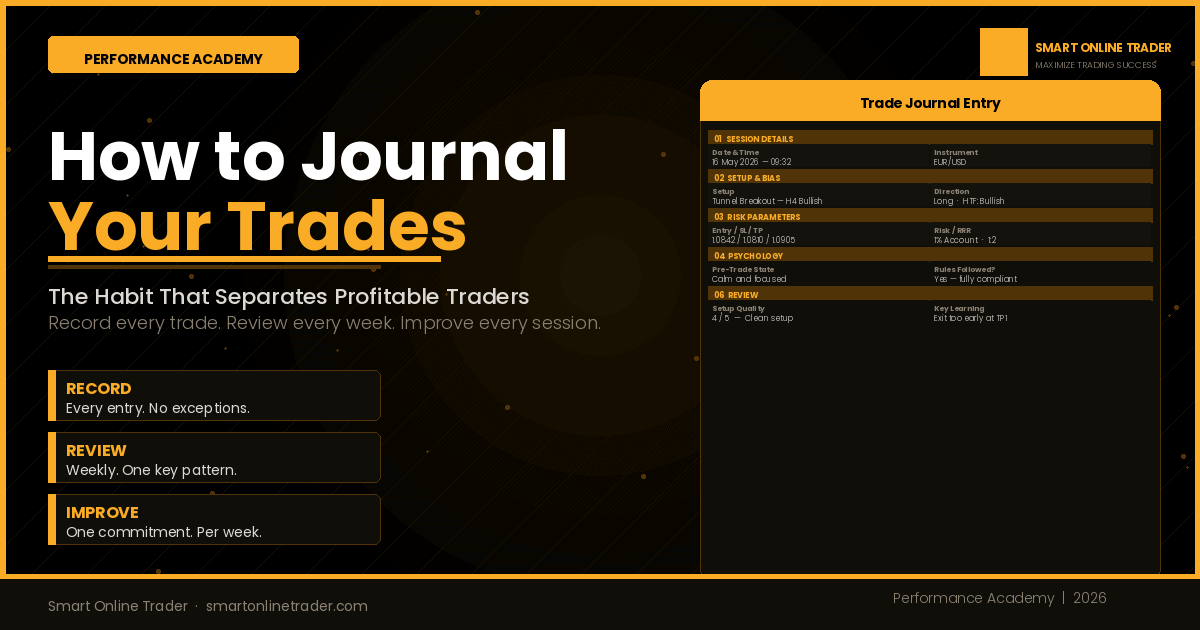
How to Journal Trades: The Habit Of Successful Traders: Most traders spend hours studying charts, refining entries, and chasing better strategies. But the traders who compound their skills fastest – and most reliably – are usually doing something far less glamorous. They know how to journal their trades, and they do it every single session, without exception.
This is not about writing a diary. A trade journal is a structured performance system. It captures not just what you traded, but why, how, and – critically – what your decision-making looked like in real time. Done properly, it becomes the clearest feedback loop in trading. Done carelessly, or not at all, you are simply repeating the same week over and over without knowing it.
This guide shows you exactly how to journal your trades, what to record, how to review it, and how to turn that data into a genuine edge.
What Is a Trade Journal?
A trade journal is a structured record of every trade you take – capturing the setup conditions, your reasoning, your emotional state, the execution, and the outcome. Think of it as combining a performance log, a psychological audit, and a strategy database into one living document.
It is distinct from a trade log, which is simply an account statement showing entries, exits, and profit and loss. A trade log tells you what happened. A trade journal tells you why it happened and what it means going forward.
Professional traders across prop firms, hedge funds, and independent setups treat the journal as a mandatory part of their workflow – not a bonus activity for motivated beginners. It is the tool that converts experience into improvement.
Why Journaling Your Trades Is Non-Negotiable
The reason most retail traders plateau – staying at roughly the same skill level for months or years – is not lack of information. Most have access to strategies, courses, and market data. The gap is in structured self-awareness: the ability to spot patterns in their own behaviour and correct them systematically.
Without a journal, you rely on memory, and memory is selective. You will naturally recall your best trades more vividly than your worst. Wins get attributed to skill, losses to bad luck – which is exactly the opposite of what learning requires. The same emotional decisions keep repeating because they never get named and examined.
With a consistent trade journal, patterns become visible within weeks. You will see which session times produce your cleanest decisions. Patterns emerge – like consistently cutting winners too early on Mondays. The exact emotional state that precedes your worst trades becomes identifiable: usually overconfidence after a win, or desperation after a losing streak.
This is directly connected to what we covered in How to Avoid Emotional Trading: structure is what prevents feelings from overriding your rules. A journal makes that structure measurable.
The bottom line: you cannot manage what you cannot measure, and you cannot improve what you cannot see.
What to Record in Every Journal Entry
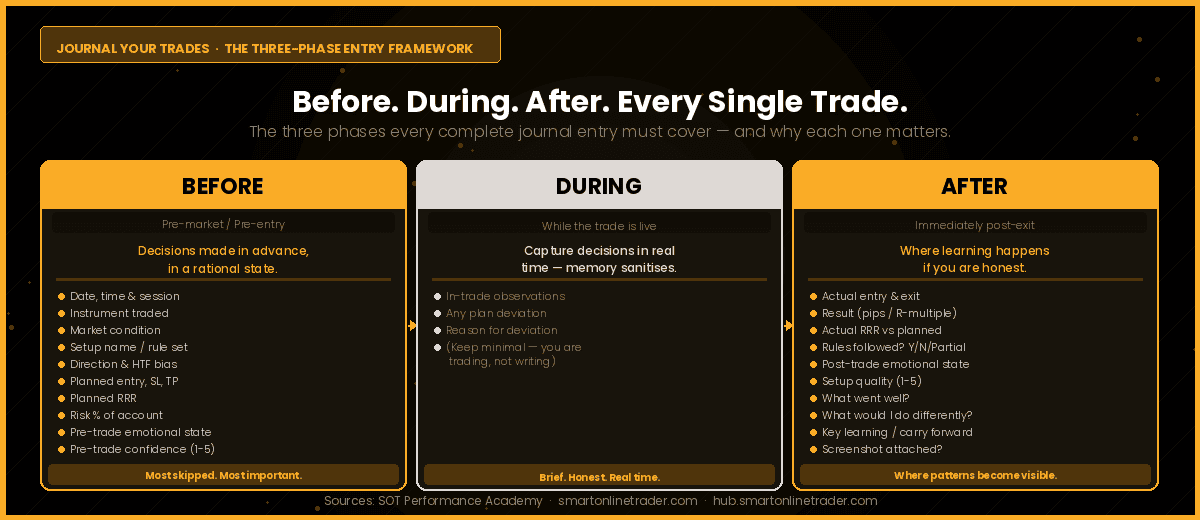
Knowing how to journal your trades means knowing when to write, not just what to write. A complete journal entry has three phases.
Before the Trade
This is the most commonly skipped phase – and the most important.
Before placing any trade, record the following:
- Date, time, and session (London open, New York overlap, Asian, etc.)
- Instrument being traded (e.g. EUR/USD, Gold, US30)
- Setup name or rule set triggered (e.g. Tunnel breakout with HTF confluence, Fibonacci retracement to 61.8%)
- Directional bias and reason: What is the higher-timeframe context? Is price trending or ranging?
- Planned entry, stop loss, and take profit levels: These must be decided before entry, not adjusted during the trade
- Risk percentage of account on this trade
- Current emotional state: One sentence. Are you calm and focused, frustrated from a previous loss, distracted, overconfident?
Journaling your emotional state before entry is the single most revealing column in a trade journal. Over weeks of data, you will see exactly how your mindset correlates with your outcomes.
During the Trade
Keep notes minimal here – you are trading, not writing. But record:
- Any significant deviations from your plan: Did you move your stop? Widen your target? Exit early?
- Why you deviated, in one sentence, written in real time
This captures the decision-making that memory will sanitise later.
After the Trade
This is where the full entry is completed:
- Actual entry, exit, and result (in pips/points and risk-to-reward ratio (RRR))
- Screenshot of the trade – chart at entry and at exit, marked up with your levels
- Did you follow your rules? (Yes / No / Partially)
- What went well?
- What would you do differently?
- Quality rating of the setup (1to 5 scale, separate from the result)
That last point is critical. Separate setup quality from outcome quality. A perfectly executed trade that loses due to news is a quality trade. A sloppy, impulsive trade that wins by luck is a poor-quality trade. Conflating the two is how traders develop bad habits that look like edges.
How to Review Your Trade Journal Effectively
Recording is only half the work. The other half is the weekly review – and this is where the compounding actually happens.
Set aside 30 to 45 minutes at the end of each trading week to do the following:
Step 1: Calculate Your Key Metrics
From the week’s entries, pull out:
- Win rate (percentage of winning trades)
- Average RRR on winners vs losers: Are you cutting winners before target, or holding losers past your stop?
- Setup-by-setup performance: Which setups are profitable? Which are breaking even or worse?
- Session performance: Do you trade better in a specific session?
- Rule compliance rate: Out of all trades taken, what percentage followed your rules completely?
Rule compliance rate is the most important metric for a developing trader. A 70% win rate with poor rule compliance is a liability. A 48% win rate with 95% rule compliance is a foundation. The second trader knows their system. The first does not know what they are actually doing.
Step 2: Identify the Week’s One Key Pattern
Do not try to fix everything at once. Look at the data and find one recurring issue: early exits, entering without HTF confirmation, trading during news windows, taking setups outside your defined pairs. Write it down, and make it the specific focus for next week.
This connects directly to the 5 Daily Habits for Routine Discipline we outlined previously – the journal is the feedback mechanism that makes those habits self-correcting.
Step 3: Re-read Your Emotional State Entries
Look at every pre-trade emotional note alongside the outcome. After four weeks of data, patterns will emerge. This is not abstract psychology – it will be specific and actionable. “When I note frustration pre-trade, I exit 40% early on winners.” That is something you can act on.
Step 4: Set One Commitment for Next Week
End the review with a single, written commitment. Not five goals. One. “Next week, I will not move my stop loss after entry.” Write it at the top of the next week’s journal page.
Common Trade Journaling Mistakes to Avoid
Even traders who journal often make the same errors that quietly reduce its value.
Recording only winning trades. This is selection bias in action. Losses – especially losses where you broke your rules – are your most important entries. If you took the trade, you record the trade.
Journaling only the numbers, not the reasoning. A spreadsheet of entry and exit prices is a trade log, not a journal. Without the reasoning behind the entry and the emotional state, you lose the most valuable data.
Reviewing inconsistently. A journal reviewed sporadically reveals almost nothing. The patterns that matter – emotional cycles, session performance, setup decay – only become visible over 30 to 50+ consistent entries. Schedule the weekly review like a paid appointment.
Using the journal to judge yourself. The journal is a diagnostic tool, not a report card. Approach it with curiosity, not self-criticism. As we covered in How To Trade Without Confidence, structure and process trump confidence – and the journal is where that process becomes visible data.
Separating the journal from the trading plan. Your trading plan defines the rules. Your journal tracks compliance with those rules. They are the same system. One without the other is incomplete.
Digital vs Physical Trade Journal: Which Is Better?
Both formats work. The best one is the one you will actually use consistently. That said, each has specific strengths.
Digital (Spreadsheet or App): Ideal for tracking metrics over time. You can sort by setup type, filter by session, calculate averages automatically, and attach chart screenshots directly. Tools like Notion, Google Sheets, Edgewonk, or TradesViz all work well. The data becomes searchable and computable. For a closer look at how to set up a spreadsheet-based journal from scratch, Forex.com’s trading journal guide covers the core columns and structure in practical detail.
Physical (Notebook): Has a cognitive advantage for the emotional and reasoning sections. The act of handwriting slows your thinking and tends to produce more honest, detailed self-assessment. Many experienced traders use a hybrid approach – a notebook for pre-trade and in-trade notes, and a spreadsheet for the numerical data and weekly review.
Choose based on your workflow. What matters is completeness and consistency, not the medium.
Frequently Asked Questions
How long should a trade journal entry take to complete?
A complete entry – including the pre-trade, in-trade, and post-trade sections – should take between 5 and 15 minutes in total. The pre-trade section takes the longest initially but becomes quick once the habit is established.
Can I journal my trades if I use an automated or algorithmic system?
Yes. Even with an automated system, your journal shifts to capturing why you deployed it, what market conditions you expected, and how the system’s output compared with your predictions. Systematic traders benefit enormously from journaling their model assumptions and reviewing deviations.
How many trades do I need before the journal data becomes useful?
You can draw preliminary observations from as few as 20 to 30 trades. Statistically meaningful patterns – the kind worth changing your behaviour around – typically emerge after 50 to 100 entries in similar market conditions.
Should I journal demo trades and live trades separately?
Yes. Keep them in clearly labelled separate sections or files. Demo trades are valuable for testing setups, but the psychological data will differ significantly from live trading where real capital is at risk. Both are worth tracking, but not mixed together.
What is an RRR and why does it matter in a trade journal?
An RRR, or risk-to-reward ratio, expresses your trade result relative to the amount you risked. If you risk 1% of your account and make 2%, that is a 2R trade. Expressing all trades in RRR’s makes your journal data comparable across different account sizes, instruments, and position sizes – and immediately reveals whether your reward-to-risk ratio is sustainable. As covered in our Trade Readiness Checklist, knowing your average RRR is a core readiness requirement before going live.
Is there a free trade journal template I can use?
A well-structured Google Sheets template is one of the most accessible options available. Basic spreadsheet software with the columns outlined in this article will serve you well from day one. What the template looks like matters far less than whether you complete it after every trade.
The Bottom Line
Learning how to journal your trades is one of the highest-return habits you can build as a trader – and one of the most consistently ignored. It requires no new strategy, no new indicator, and no new capital. It requires discipline, honesty, and fifteen minutes of structured attention after each session.
The compounding effect is real. Traders who review their journal data honestly, identify patterns systematically, and make one targeted adjustment per week improve at a rate that chart-studying alone will never match. They are not guessing at what is holding them back. They have the data in front of them.
The Trading vs Gambling Distinction comes down to process. Gamblers do not review. Traders do.
Start your first entry today, even if your template is imperfect, even if you only have a notebook. The habit matters more than the format. Let the data guide you.
